

U.K.-based Nomad Foods, the largest frozen food company in Europe, has set new financial targets as it saw a worse-than-expected start to 2025.
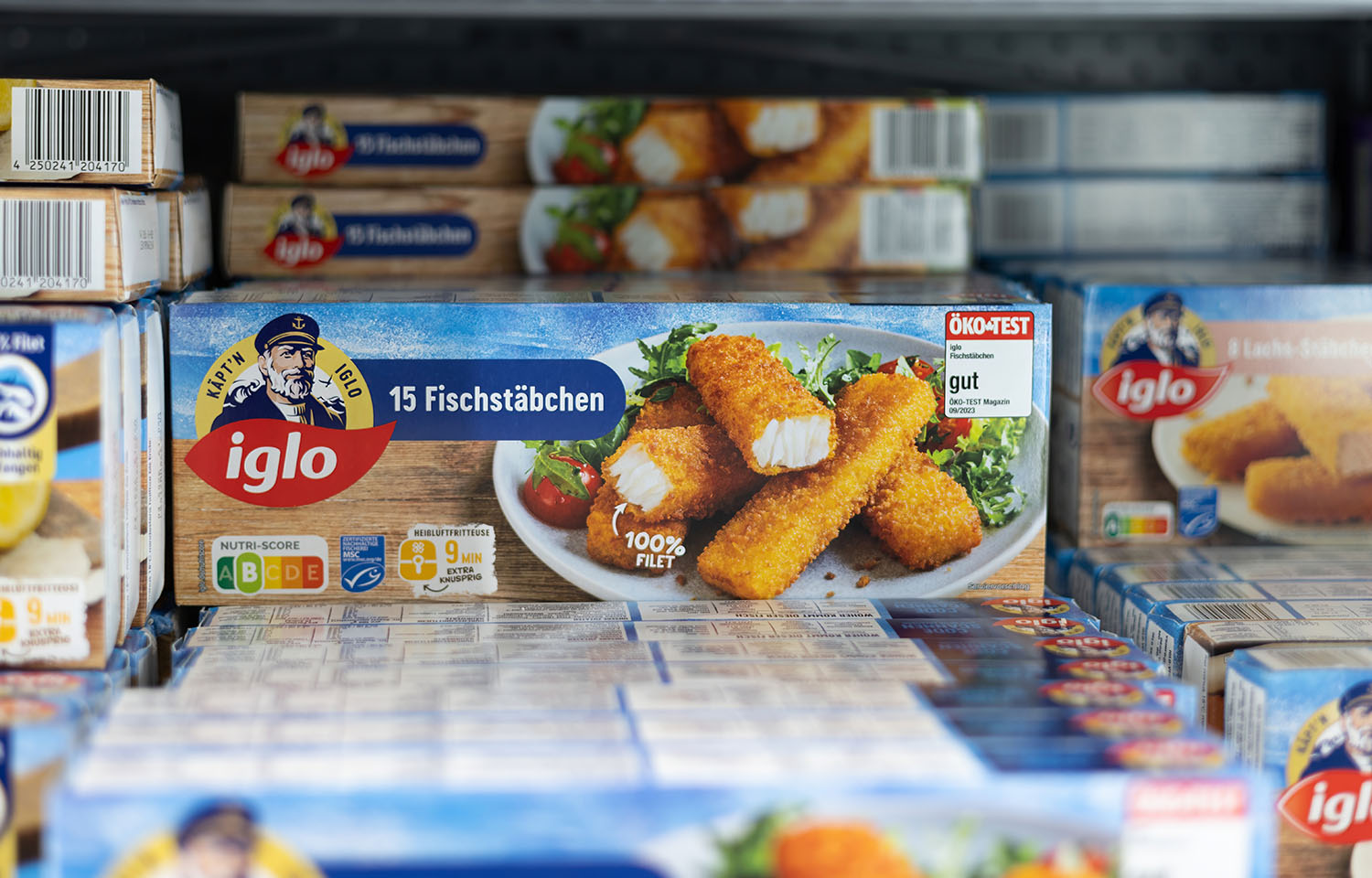
Nomad Foods – the operator of major frozen brands that sell seafood like Birds Eye, Findus, iglo, Ledo, and more – posted decreased revenue and decreased adjusted EBITDA that led it to lower its full-year guidance. The company also recently debuted an “increased efficiency program,” looking to create operational savings as it works to bolster its finances.
“This year is proving to be more challenging than expected,” Nomad Foods CEO Stéfan Descheemaeker said.
In H1 2025, Nomad’s revenue decreased by 1.9 percent to EUR 1.5 billion (USD 1.77 billion), down from EUR 1.53 billion (USD 1.79 billion), and its organic revenue decreased by 2.4 percent due to a volume decline of 2.3 percent.
“Record-setting warm weather across many Western European markets has disrupted consumer behavior, leading to changes in retailer merchandising strategies and contributing to volume declines, particularly within our savory frozen categories,” Descheemaeker said. “While this is unfortunate, we also recognize that it is transitory, and our focus remains on what we can control.”
Gross profit decreased to EUR 417 million (USD 489 million) in H1 2025, down from EUR 443 million (USD 520 million) in the same period last year, and operating profit also decreased to EUR 161.3 million (USD 189.5 million), down from EUR 173.1 million (USD 203.3 million).
Adjusted EBITDA for H1 2025 was EUR 129 million (USD 151 million), marking a decrease of 7.2 percent compared to the same period of 2024. Adjusted profit for the period decreased 16 percent to EUR 61 million (USD 71 million).
Nomad Foods Co-Chair and Founder Noam Gottesman said the company has faced external headwinds in 2025 but its in-market performance has been promising.
“The company’s ability to stabilize market share in the quarter demonstrates that its commercial plans are working,” Gottesman said. “Furthermore, Nomad’s growth initiatives for the remainder of this year and next year are impressive, and I believe that category growth will recover, which will translate into strong financial results going forward. The underlying health of the business is strong."
In the same period of 2024, Gottesman said the business was shifting from protecting its profitability amid inflation. Inflation in the U.K. hit record-high levels in 2023, causing repercussions like the collapse of retailer Wilko. Those pressures began to ease but remained problematic in 2024 as shipping constraints caused by Houthi militia attacks in the Red Sea added another complication to recovery.
Nomad Foods continued to gain market share in Q4 2024, and in January, it predicted organic revenue growth of between 1 percent and 3 percent in 2025, with adjusted EBITDA growth of between 2 percent and 4 percent.
“I am pleased with the strong momentum we have built across our portfolio as we enter 2025, which will mark our 10th anniversary as a public company,” Descheemaeker said in January. “We enter 2025 with a portfolio that is well-positioned for evolving consumer trends with more than two-thirds of our revenue expected to be generated from great-tasting and nutritious seafood, poultry, and vegetable products.”
Those expectations have proven too optimistic, and now the company is predicting its organic revenue will be either flat or see a decrease of 2 percent compared to the prior period. Full-year adjusted EBITDA guidance has fallen to a decrease of between 3 percent and 7 percent.
To alleviate some of its issues, the company recently announced that it is establishing an increased efficiency program, which it said will generate EUR 200 million (USD 234 million) in operational savings between FY 2026 and FY 2028. As part of the program, Nomad Foods said it is planning to “improve its manufacturing network utilization, reduce logistics costs, and unlock overhead efficiencies.”
"While we have faced challenges in 2025, we are proud to have successfully stabilized market share, demonstrating that our Commercial Flywheel is working,” Descheemaeker said. “We have numerous initiatives underway to drive profitable sales growth for the remainder of 2025 and into 2026.”
Descheemaeker said the company’s innovation and renovation initiatives are showing positive momentum and that the second half of the year will show more positive movement than the first.
“We are excited about our innovation and activation plans and, assuming normalized weather, expect our organic sales to return to growth in the second half of the year,” he said.
