






U.K. food prices rose 14.6 percent in June 2023, down from 15.4 percent in May and 15.7 percent in April, according to new data from the British Retail Consortium.
Average prices in U.K supermarkets and retail chains rose 8.4 percent in June, down from 9 percent in May, the highest-ever figure recorded by the BRC, which based its calculations on data collected 1 to 7 June.
"If the current situation continues, food inflation should drop to single digits later this year." BRC Chief Executive Helen Dickinson told Reuters on 27 June.
Mike Watkins, the head of retailer and business insight at NielsenIQ, which co-produces the data used in the BRC survey, noted U.K. retailers had dropped prices for staples such as milk, cheese, and eggs in June.
"If global supply chain costs continue to fall, we may now be past the peak of price increases," Watkins said. "However, with most households needing to save money, purchasing behavior for the rest of this year is still likely to shift towards essential needs with discretionary consumption being deprioritized or delayed."
Last week, Tesco CEO Ken Murphy said his company determined inflation in the U.K. had likely peaked, according to Reuters. Tesco, which launched a major range review in May, reported a 9 percent year-on-year increase in sales in Q1 2023 on 16 June.
British take-home grocery sales rose by 10.8 percent for the month ending 11 June in comparison with the same period last year, according to Kantar. Total grocery sales rose 12.4 percent over the four weeks, with sales in the week ending 17 June reaching GBP 2.9 billion (USD 3.7 billion, EUR 3.4 billion), making it the second-biggest sales week of 2023 behind Easter.
U.K. data firm Kantar also reported lowering grocery price inflation, at 16.5 percent in June, but said prices remain high enough to force U.K. consumers into tough shopping decisions.
“It’s still the sixth-highest monthly figure in the past 15 years,” Kantar Head of Retail and Consumer Insight Fraser McKevitt said. “The ongoing squeeze is clearly weighing on the nation’s mind. Of the top five financial worries that consumers have, rising grocery prices is the only one that they are more concerned about now than at the start of this year.”
Nearly 70 percent of households are either “extremely” or “very worried” about food inflation, ranking it the second most-significant concern behind rising energy bills, according to Kantar.
“Savvy shoppers have been continuing to swerve the full force of price increases, with many switching to the cheapest own label lines," McKevitt said. “Total spending on these value ranges has rocketed by 41 percent compared to last year and retailers have been quick to respond, expanding their offerings to meet demand. This has helped the value tier to become the fastest-growing part of the market every month since June 2022.”
U.K. consumers are changing their food shopping and eating habits as a result of the ongoing the cost-of-living crisis in the U.K., according to McKevitt.
“The most prominent change we’ve seen is that people are preparing simpler dishes with fewer ingredients,” he said. “Our data shows that the public are turning away from their oven and increasingly using microwaves, which reflects the shift to simpler cooking. There were 4 percent fewer meals made using an oven according to our most recent 12-week data compared to the same period last year, while microwaved meals rose by 8 percent.”
Online food sales sagged in June, dipping to 10.4 percent of all fast-moving consumer goods sales, down from 10.9 percent in May. Online grocery sales peaked at 15 percent of total sales during the Covid pandemic but now stand at 7 percent, according to market research firm NIQ. Still, more total commerce is happening online, up 4.1 percent year-on-year, versus a 13.4 percent increase in in-store sales.
McKevitt noted retailers are moving away from rounding prices to the nearest GBP 1.00 (USD 1.26, EUR 1.16), with more products being priced at GBP 1.25 (USD 1.58, EUR 1.45).
“Traditionally retailers have priced products at ‘round-pound’ points, but there is evidence that the cost of living crisis is changing that,” he said.
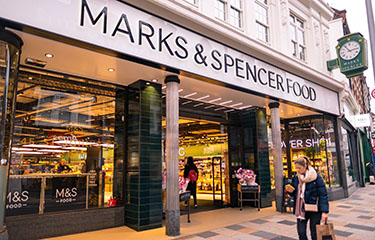
Aldi was the fastest-growing retailer for the 12 weeks to 11 June, 2023, with sales up 24.6 percent, giving it a 10.2 percent market share. Lidl’s sales were up 23.2 percent, pushing it to a 7.7 percent market share. Morrisons' sales rose by 0.8 percent, and its market share remained at 8.8 percent. Sainsbury’s and Asda’s sales both grew at 10 percent over the past 12 weeks and have 14.9 percent and 13.7 percent market shares respectively. Tesco, saw its sales increase by 8.9 percent and it captured a 27.1 percent market share. Marks & Spencer's sales rose 15.4 percent, making it the fastest-growing non-discount food retailer in the U.K.
Photo courtesy of William Barton/Shutterstock
