






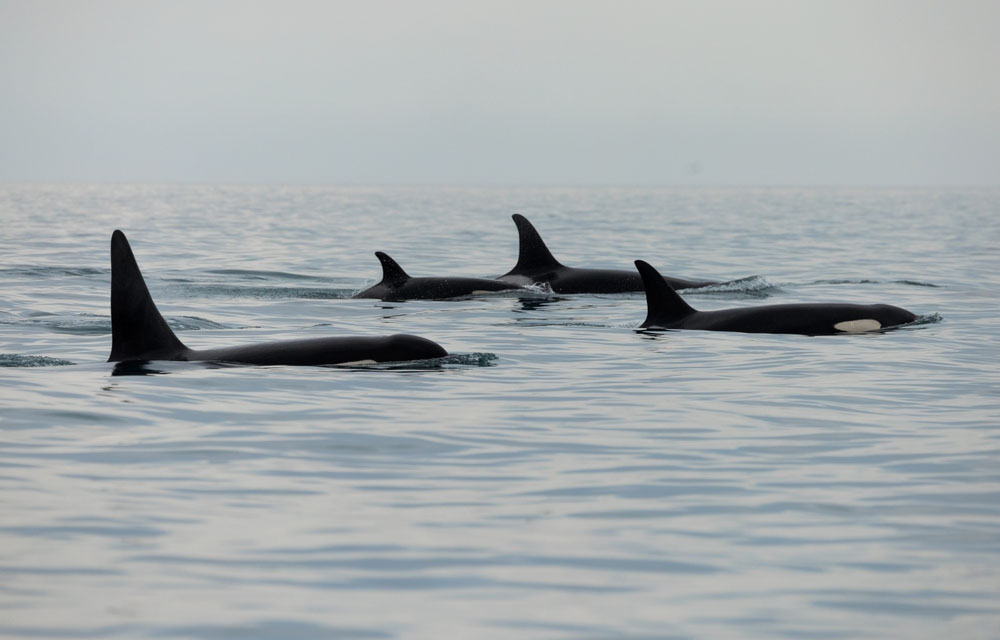
The California Department of Fish and Wildlife (CDFW) is accepting public comments on whether it should list southern resident killer whales under the California Endangered Species Act (CESA).
Southern resident killer whales were first listed as endangered under the U.S. federal Endangered Species Act (ESA) in 2005, and the population was estimated at just over 70 individuals in 2024. The whales depend primarily on salmon for prey, and declining salmon populations have led to malnutrition, according to CDFW, limiting the species’ recovery. Other key threats include vessel noise and disturbance and exposure to chemical contaminants.
The Orca Conservancy first petitioned the California Fish and Game Commission to list the whales under California’s conservation law in November 2025.
In an April report, CDFW recommended that the commission adopt the petition.
“Based upon the information contained in the petition and other relevant information, the department has determined that there is sufficient scientific information to indicate that the petitioned action to list southern resident killer whale as endangered under CESA satisfies the ‘may be warranted’ legal standard,” the department said in its recommendation.
However, CDFW also noted that the federal government has not transferred authority for conserving southern resident killer whales to the state, meaning state regulations could come into conflict with the Marine Mammal Protection Act.
Other Pacific coast states have already listed the whales as endangered under state law; in 2004, the state of Washington listed the whales as endangered, and in 2024, the state of Oregon listed the whales as endangered.
In 2023, a lawsuit nearly resulted in an end to commercial salmon fishing in Southeast Alaska after a federal judge ruled that NOAA Fisheries had not properly considered the impact fishing could have in reducing prey for southern resident killer whales. Another judge ultimately allowed commercial fishing to continue while NOAA Fisheries updated its paperwork, and in 2024, the agency released a new biological opinion enabling commercial fishing.
On 17 June, the commission granted candidacy status to the whale species.
“Although southern residents have been federally listed as endangered under the U.S. Endangered Species Act since 2005, California currently lacks state-level protections specifically recognizing the population's endangered status,” Orca Conservancy said in a blog post following the decision. “California plays an important role in the lives of southern residents. While they are most commonly associated with Washington State and British Columbia, southern residents regularly travel along the California coast, particularly during winter months following Chinook salmon runs.”
Now, CDFW has one year to complete a status review to inform the commission’s final decision. The department has requested for all data and public comments to be submitted for that review by 10 September.
