






COMEPESCA wants Mexican consumers to expand the variety of seafood species they’re eating, and it’s launched a new book to help people discover their new favorite.
This month, the Mexico-based seafood sustainability NGO launched “Conociendo México a través de sus pescados y mariscos,” a colorful 256-page book highlighting the bounty of fish, shellfish, and plants that can be harvested from Mexico’s waters and how they can be utilized.
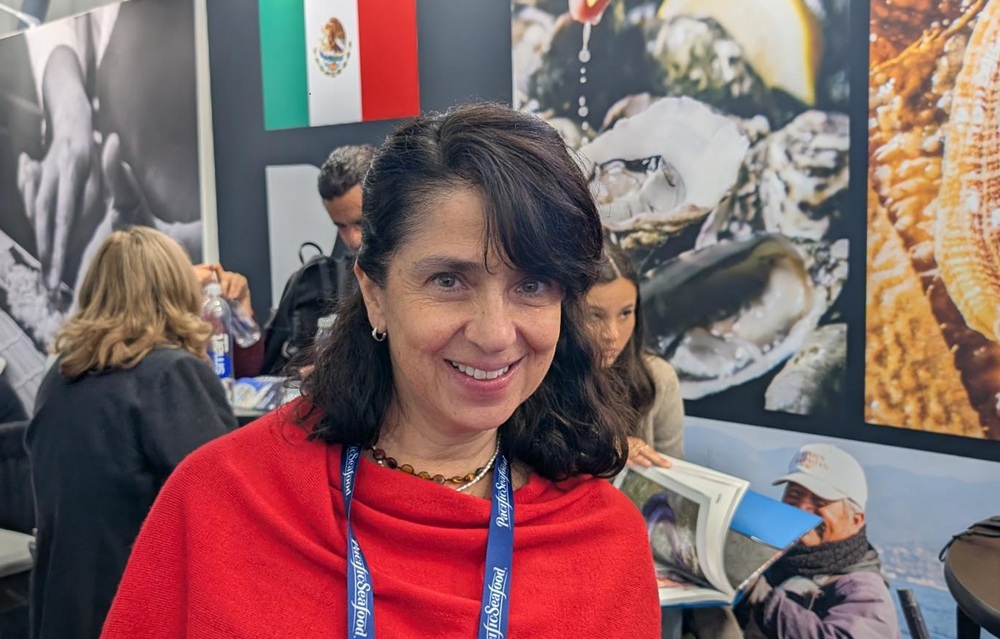
“One of the things that we’re trying to communicate is the great diversity of seafood that is in our country, from the Pacific, the Atlantic, and the Caribbean side – from peninsula to peninsula,” COMEPESCA CEO Citlali Gomez Lepe told SeafoodSource at the 2026 Seafood Expo North America, which took place 15 to 17 March in Boston, Massachusetts, U.S.A. “We are an industry-based NGO. The idea is to promote the responsible consumption of sustainable seafood.”
The book contains write-ups from 52 authors highlighting the various aquatic species of Mexico, illustrated with high-quality photos of the fish, fishers, and chefs of Mexico.
“One of the best photographers in Mexico – Ignacio Urquiza – he adopted us because he wanted to highlight the importance of all the social and environmental aspects of the seafood,” Gomez Lepe said. “We wanted to highlight all of the species but in a pretty way.”
The challenge is two-fold, she said.
First, Mexico’s most lucrative species are exported to other countries, where they fetch much higher prices than they can domestically.
“Asia pays more for our product, and Mexico doesn’t have the capacity of paying what they paid for the lobster, for example. All the Marine Stewardship Council-certified lobster that we have in the northwest of the country goes to Asia because [of] the prices,” Gomez Lepe said.
Mexican consumers also lack knowledge of the alternative species harvested along Mexico’s coast that they could be consuming. There is simply no market for many species, despite their availability. Without anyone willing to buy them, many edible fish are simply discarded.
“We have more than 300 edible species in Mexico, and nobody talks about that. What is happening is that sometimes the fishermen have to ... throw it away because it doesn’t have much market access,” Gomez Lepe said.
That has led to a situation where despite its sizable commercial fishing sector, Mexico imports the vast majority of the seafood people consume.
“We import more than 70 percent of what we eat, and it’s nonsense,” Gomez Lepe said. “It’s not fair. We have to change that.”
COMEPESCA is trying to change that by educating the population about the rich bounty of seafood options available along the nation’s coasts. One of the ways it is doing so is by directly connecting fishers and chefs, bringing unpopular fish to the people with the expertise to transform it into a high-quality and desirable dish.
“Chefs ... care about sustainability, and mostly they care about the ingredients," Gomez Lepe said. "So the movement we’re trying to lead in Mexico is not only the sustainable seafood movement; it’s the movement that engages the consumer with the origin [and] the ingredients.”
She highlighted that chef engagement with underused species is one of the prime goals of the new book.
“When the fishermen see their product [in the book], it’s like, ‘Wow! This is a top chef in Mexico!’” Gomez Lepe said. “Carp is not very popular, but when you see super chefs treating it like that, it’s like, ‘Wow, I’m producing this, and I feel proud.’ That proud feeling moves mountains.”
Gomez Lepe pointed to verdillo – also known as barred sand bass – as one such success story.
“The fishermen didn’t find market access, so what we did is put it in fashion with the chefs. We began taking the fishermen to the chefs to cook it. It’s so good; it’s a very white fillet, and the fish are really good. They’re small and tasty. And now, all the chefs want verdillo, and it’s great because they have market access because of that,” Gomez Lepe said.
COMEPESCA plans to continue its efforts to encourage chefs to use more sustainable local species and consumers to diversify their seafood intake.
“We’re going to work more with the fishery improvement projects that already exist and need market access and recognition from the market to elevate the price a little bit. People should not only be eating three or four species,” Gomez Lepe said.
Some of the proceeds from book sales will go toward purchasing solar-powered ice machines that can help remote fishers get their catch to market.
“One of the projects that we have, too, is Ice in a Box – solar-powered ice machines so that fishers can have access to the market with a very good quality. What happens is that suddenly, in some seasons, they capture a lot [of fish] but there is no price,” Gomez Lepe said. “Most communities don’t even have electricity. In La Baja, for example, it’s very remote. They have to drive five hours to get to an ice machine.”
Gomez Lepe said that there is one such solar-powered ice machine in the southeast of Mexico, which was funded by the German government in coordination with local organizations. By expanding access to ice, COMEPESCA hopes to expand the variety of seafood consumers can access.
“I am very proud of this book because it was a great effort that we did to promote consumption,” Gomez Lepe said. “This book not only reflects what we are, but we are learning from it. I think that is one of the highlights – the community that we’ve made among all of us in which we don’t see each other as competitors, but we see each other as a community. I think that is one of the best things that can happen to an industry, to our sector, and our country.”
