

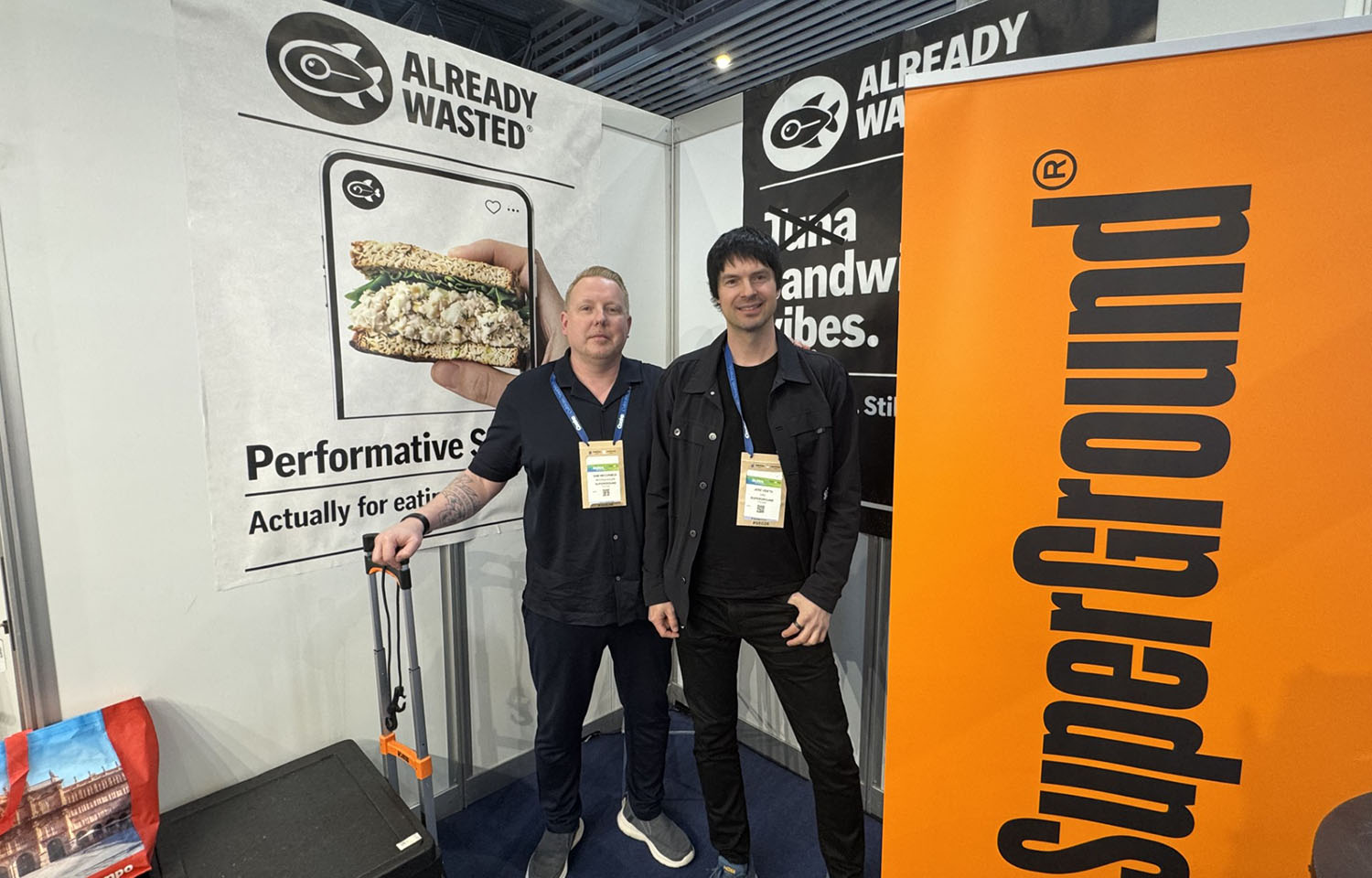
Helsinki, Finland-based industrial global food production company SuperGround touted its mission of reducing waste from fish processing at this year’s Seafood Expo Global.
SuperGround’s products, including fish balls, burgers, fish cakes, spreads, and fillers made with ingredients that typically go to waste, were on display at the show, where Chief Product Owner Jere Vento said he was pushing samples in hopes of scaling the product to new markets.
“We’re looking for people who can take it immediately, and we have sold about 10 containers during these three days,” Vento said. “We want to validate because this is the year we are really commercializing and really going big volume, so it’s important for us and important for our investors to see that, actually yes, people want to eat [our product] and want to come back.”
The firm specifically promoted its newest offering, sandwich filler, in hopes of garnering new attention from European countries looking for innovative food products. The filler can go on a sandwich, wrap, or even in pasta, and Vento said the company has found that sandwich fillers are the most beneficial end product to focus on selling to foodservice customers, particularly in the U.K., which has a strong sandwich culture.
“We take bones, we take skins, we take everything basically, and we turn that into a basic ingredient using only fish and water, nothing else added,” Vento said. “From that basic ingredient, we can make pretty much any kind of seafood product. That basic ingredient is very neutral; it doesn’t matter what kind of fish you use. We can turn this ingredient using natural flavorings and using different kinds of natural texturization like oat flakes so we can create a tuna experience, we can create a salmon experience, we can create a cod experience without having those specific fish.”
The most challenging part of expansion to new customers and markets, Vento said, is encouraging open-mindedness while remaining transparent. Products include fish bones, heads, and eyes, and Vento said many consumers are turned off from even trying the sample if they think or know about what they might be eating ahead of time.
“If you only tell the concept, it’s really hard to understand what kind of product it is, and [consumers] assume they won’t like it,” Vento said. “When you go to a new market or work with new partners, that’s probably the hardest part of getting them involved. If they haven’t seen the product, they haven’t tasted it, they don’t like it. But, when they actually taste it and see it, that’s when they have tons of ideas come up.”
There are several benefits, Vento said, to using the normally wasted parts of fish from processors.
First, it costs less – often 50 percent less – than traditional name-brand fish filler products. Second, the products have the same grams of protein per serving as traditional products, with SuperGround’s sandwich filler offering 18 grams of protein per serving. Due to the head and bone contents, SuperGround actually offers more fiber, 100 times more calcium, 20 times more collagen, and several omega, A, and E vitamins from fish heads and skins. Third, Vento described the sustainability aspect as the cherry on top of the product because consumers can enjoy a product for its taste and health benefits while also promoting waste reduction efforts.
“It’s not rocket science what we do,” Vento said. “We have really unique technology, but no one is eating technology. That’s why we have a product team, and that’s the main thing we do is we design these products for us and other companies.”
SuperGround utilizes both poultry and fish byproducts to create their products, with Vento explaining the company has tested 20 different species of fish and works with numerous processors around Europe to gather resources for production.
“When we started out, we were basically buying the byproducts from the fisheries, and now our main partner is in France,” Vento said. “We will go public soon, so I can’t say the name of the company, but I can say that they are the leading trout farmers in France, and we are doing it jointly, starting production this summer in France. They have the fish, they have the size streams, they have the labor, they have the ability to take this production to large volumes. We bring the technology, and then we bring the knowledge of end products, and that’s a really important part of this.”
Once product is collected, Vento said it takes six to eight different machines depending on the facility’s setup. Grinders, mills, and kettles are used to grind bones down, aiming to break up the collagen with large amounts of pressure. Once broken down, the “slurry” is cooked at 100 degrees Celsius for a few seconds before the fish product is frozen into blocks to be shipped.
“One of the things consumers don’t want is they don’t want to have a suspicious fish blend,” Vento said. “That’s why we’re very transparent about what we have, and in the end, the buyers basically decide that. If you want to continue selling salmon sandwiches, it makes sense to use salmon bones and salmon heads for that.”
SuperGround is able to work with interested customers to customize the end form, flavor, texture, and size. Once companies decide the format, samples are sent to the sales team for feedback so that it can be tested in the market with consumers. The only limitations for SuperGround’s fish collection is that it cannot use fish guts, and it cannot use large fish due to the unknown component of the fish’s diet, as well as allergy concerns with larger fish.
Currently, the company is approved to sell seafood products in Europe and is pending FDA approval in the U.S. Poultry products are approved for sale in Asia, and Vento said the company is mainly focused on foodservice but is looking to expand to retail products in early 2027 with partners across Europe and the U.S.
One of the best partnerships, Vento said, was working with Finnish schools to sell products for school lunches. The SuperGround team surveyed young consumers in schools with unlabeled “traditional” filler products and SuperGround products. The result was 97 percent of kids asking for SuperGround after trying it, Vento said.
Vento began his tenure with the company as an investor. After a year, he became a board member after he gained more insight and interest in the company. He said he has believed in the mission enough to now lead the product team as chief product owner and said he’s loved getting to challenge himself professionally.
“I really like to do new things. I’m the kind of person who is best when I start something new,” Vento said. “That’s pretty much my whole working career, and at SuperGround, I love the fact that we can offer something that is familiar to people. At the same time, it’s not like they [already] have it. I don’t end up constantly banging my head against the wall trying to tell you that you need to change.”
