





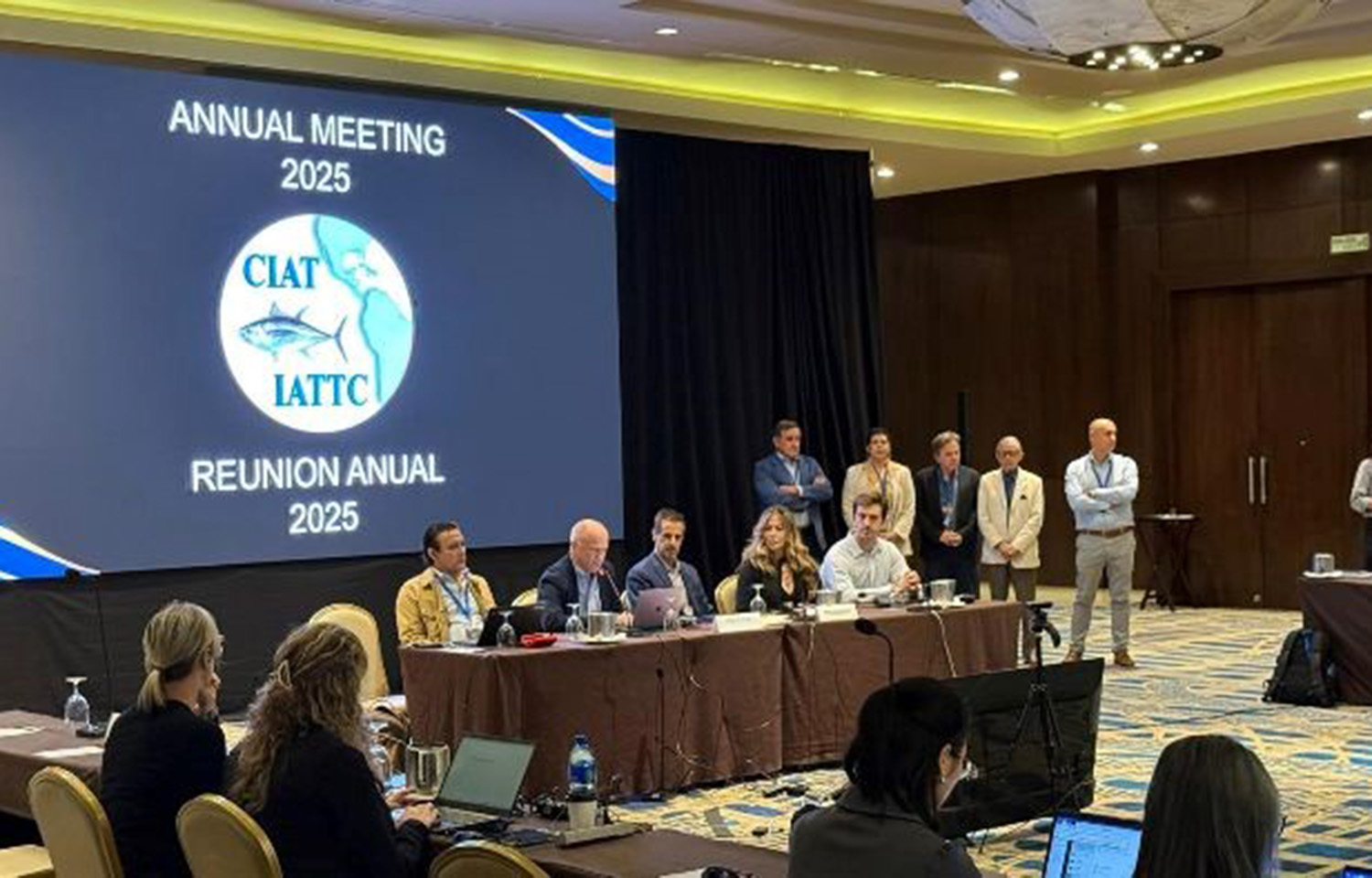
The most recent Inter-American Tropical Tuna Commission (IATTC) meeting – which ran from 1 to 5 September in Panama City, Panama – made progress on a range of different conservation measures but stalled on harvest strategies and other measures.
The 103rd meeting of the IATTC had several proposals on the table – from establishing boarding and inspection procedures for the prevention of illegal, unreported, and unregulated (IUU) fishing to new resolutions on fish aggregating devices (FADs). Prior to the meeting, NGOs pushed the commission to adopt harvest strategies for multiple tuna species and also to establish more progress on a management procedure for bluefin tuna.
The International Seafood Sustainability Foundation (ISSF), which advocated for progress on several priority areas prior to the meeting, said the commission “delivered more than many expected in some areas” but still has progress to make on others.
One area that yielded great results both for NGOs and for fishing organizations was the expansion of fishing for bigeye, yellowfin, and skipjack tuna in the regional fishery management organization’s (RFMO) Easter Pacific Ocean (EPO) area. All three stocks were found to be healthy, and as a result, the area's purse seine fleet fishing closure was scaled back.
Prior to the IATTC meeting, the bigeye, yellowfin, and skipjack purse seine fleet had a 72-day fishing closure, which was reduced by eight days during the meeting.
"This session reflects years of effort from our fishermen to maintain tuna populations in optimal conditions and being able to have a sustainable way of life over time," Julio Morón, the managing director of Organización de Productores Asociados de Grandes Atuneros Congeladores (OPAGAC) and a representative of European fishing trade body Europêche at the meeting, said.
The IATTC first extended the fishing closure to 72 days in 2017 – a move it made in line with scientific advice on the three tuna species. Since that time, the stocks have improved enough to reduce the length of the closure, which Europêche partially attributed to the purse seine fleet’s work on sustainability.
“The tuna fleet continues to contribute funding to various programs, including enhanced port sampling, a new tagging initiative in addition to the existing, and 100 percent observer coverage under the Agreement for the Protection and Conservation of Dolphins [AIDCP],” Europêche said. “These contributions, financed through a per-cubic-meter fee, demonstrate the fleet’s commitment to science-driven management.”
The improved management of the three species also comes five years after the IATTC briefly withdrew its management of tropical tunas after a failed vote on managing bigeye, skipjack, and yellowfin tunas. That withdrawal marked the first time in the RFMO’s 70-year history that it had failed to establish management of tunas.
The lack of management lasted just weeks after it agreed at a special session to roll over previous quotas, and since then, management has improved enough to establish the fishing ban reduction.
The IATTC also made progress in other areas at its recent meeting, including FAD management.
Member countries approved a proposal that expanded requirements for keeping FAD satellite tracking active, increasing the amount of time that an FAD needs to be trackable.
ISSF said the move will allow recovery programs to track and retrieve FADs before they cause issues in sensitive habitats.
“This decision supports the work of FAD recovery initiatives such as those in French Polynesia, the Palmyra Atoll, and Galápagos Islands, aligning with ISSF’s longstanding call for practical, science-based FAD improvements and reduction of impacts,” ISSF said.
While the IATTC made progress, it failed to make develop any harvest strategies.
Harvest strategies establish pre-determined scientific metrics for managing a fishery stock, which allow an RFMO to react quickly to any changes. Both the ISSF and The Pew Charitable Trusts were pushing for new harvest strategies, and The Pew Charitable Trusts Senior Officer Dave Gershman told SeafoodSource ahead of the meeting that IATTC should establish harvest strategies while the fisheries are still in good shape.
“The key thing here is that with that sort of pre-agreement, everyone has the same expectation and the same understanding, and you can take action before there’s a crisis.” Gershman said.
The IATTC also was not able to establish additional observer coverage of longline fleets.
ISSF and Europêche both have highlighted the importance of stronger observer coverage, with Europêche in particular saying it is needed on Asian longline fleets to “level the playing field” with the European fishing fleet.
