






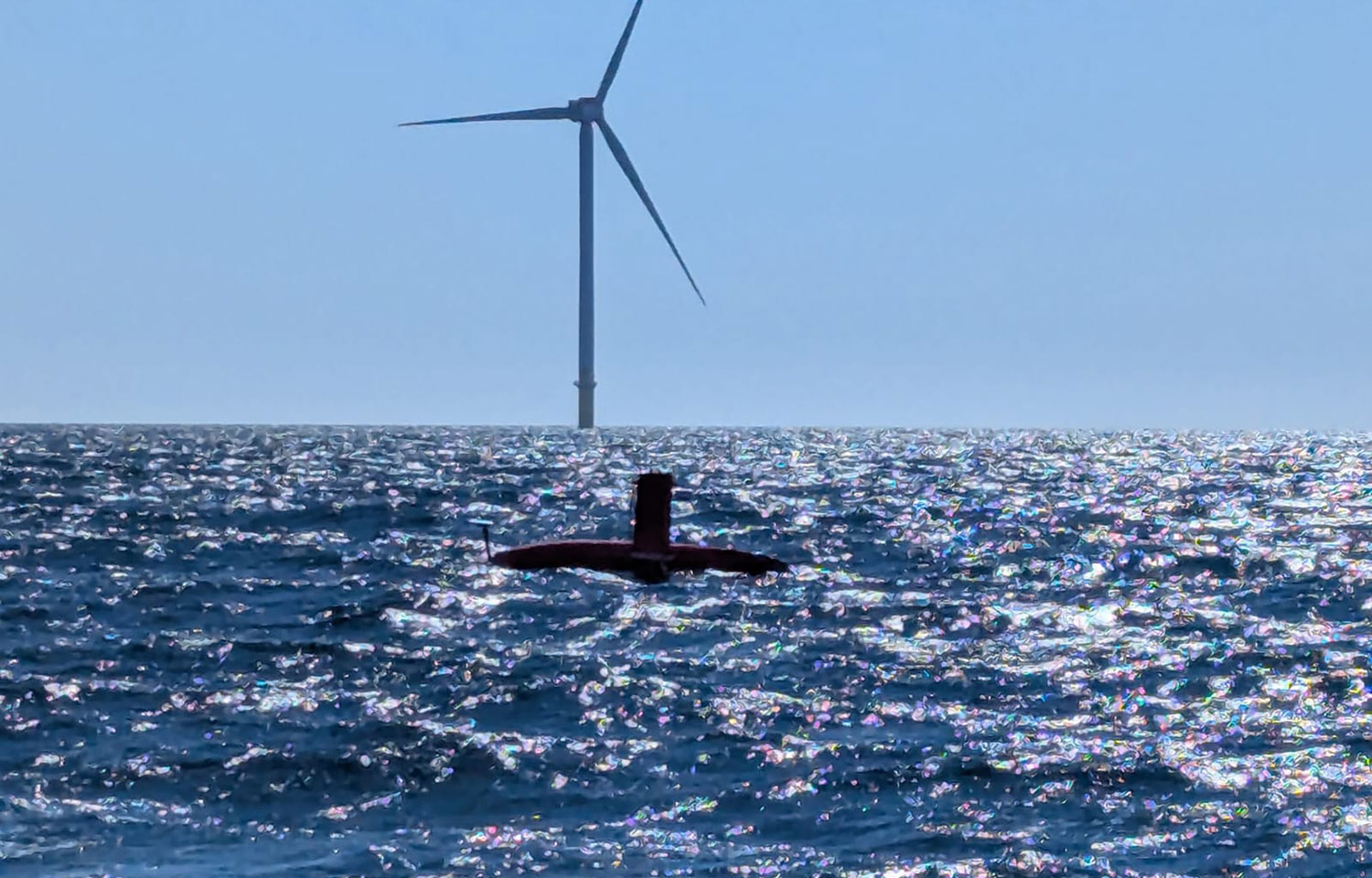
The Northeast Fisheries Science Center used a DriX uncrewed vessel to complement its survey of southern New England fisheries this spring, with the small drone collecting data that would be difficult for traditional research vessels to gather.
NOAA Fisheries has promoted the use of uncrewed systems as an emerging technology that can be used to overcome several challenges to federal government fisheries surveys. Advocates say the autonomous vessels can navigate in areas where larger vessels can’t operate, such as in and around the increasing number of offshore wind developments. While those installations have threatened to disrupt NOAA Fisheries long-term data collection efforts, researchers believe drones can help fill the gaps in data collection.
"Uncrewed systems have the ability to support various stock and ecosystem assessments through data acquisition, particularly in areas that have traditionally been or are increasingly becoming challenging to sample,” NFSC Advanced Technology Program Lead Conor McManus said in a release. “We are learning more about how marine ecosystems are changing while improving the technology and operations to be able to use it more expansively in the future."
NOAA Fisheries leadership has been supportive of adoption of the technology. U.S. President Donald Trump’s nominee to lead the agency, former NOAA Acting Administrator Neil Jacobs, testified earlier this year in favor of utilizing autonomous systems like DriX for fisheries surveys.
“If confirmed I will work with Congress to ensure NOAA has the needed resources to prioritize surveys, including by addressing professional mariner vacancies and retention, and expanding the use of uncrewed systems to augment NOAA's ability to conduct surveys,” Jacobs told lawmakers.
In 2022, the Bureau of Ocean Energy Management (BOEM) partnered with NOAA Fisheries on a strategy for mitigating the impact of right whales and offshore wind development on fisheries surveys, which emphasized the need for new technologies – including drones and autonomous vessels – that can collect supplemental survey data. NFSC’s recent use of DriX will help inform the federal government’s evaluation of what role uncrewed vessels can play in that mitigation strategy.
The main uncrewed vessel being used for fisheries survey work is the DriX, a 25-foot-long vessel that operates solely on the surface. Remote operators assign transect lines for the autonomous vessel to follow, and researchers can equip it with multiple sensors to collect key data on ocean conditions and the presence of fish.
NSFC first got to test out DriX in 2023, when the autonomous system was used to survey waters on a 3,000-mile path around and through offshore wind farms. DriX can operate as close as 65 feet from wind turbines – far closer than traditional research vessels.
NSFC conducted its second pilot survey with DriX from 16 April to 5 May, at the same time it was conducting the Northeast spring Bottom Trawl Survey. The vessel travelled 1,678 nautical miles collecting data around five offshore wind leases off the coasts of Massachusetts, Rhode Island, and New York.
“The DriX used acoustic transducers to collect data that will help compare fish and plankton aggregations around different levels of marine development. It will also allow scientists to map the distribution of fish and plankton in and around wind energy areas,” NOAA Fisheries said in a release.
The DriX was also used to sample whale forage areas for food sources, helping scientists better understand endangered North Atlantic right whale habitats.
"Uncrewed systems have the ability to survey important right whale foraging areas during times that are difficult to access with traditional vessels,” Chris Orphanides, NSFC’s protected species lead for marine development, said in a release. “These technologies could provide insights on habitat use and prey distribution that will be beneficial to management, and that otherwise would be difficult to achieve."
While scientists are still analyzing the data collected by the DriX this spring, they are actively planning its next use in a fisheries survey, which could take place as soon as this fall or in summer 2026.
