


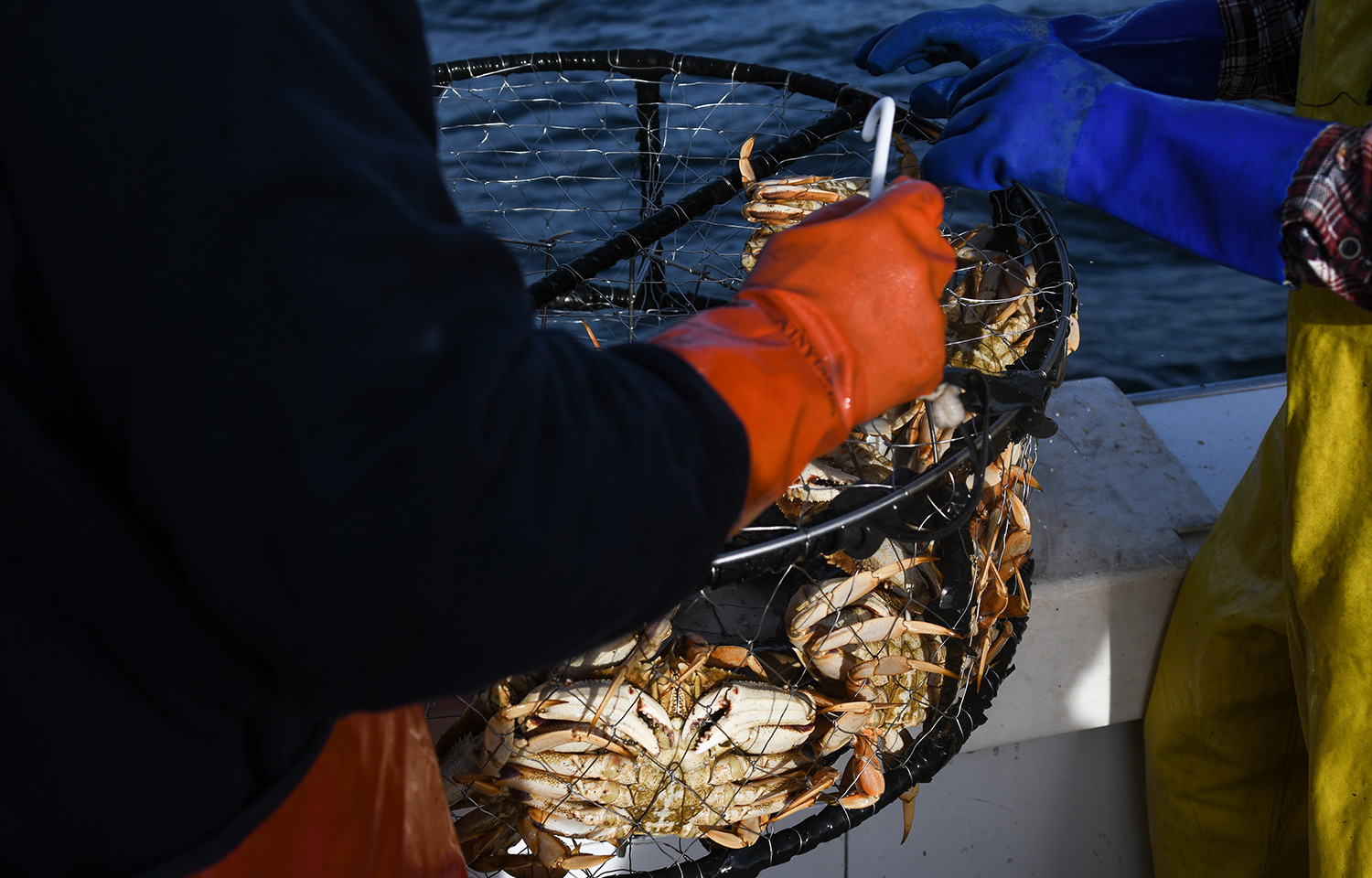
Fisheries regulators on the West Coast are further delaying the opening of their states’ respective commercial Dungeness crab seasons due to the presence of humpback whales and low meat quality, with all but a small portion of Oregon's coast unlikely to open before the end of the year.
On 6 December, the state of California announced it was delaying the start of the commercial crab season for a third time this year, citing the continued presence of blue and humpback whales in the area. The season was initially slated to open on 15 November.
California law requires state regulators to take protective action when there is a high risk of whale entanglement. In a 4 December assessment, the California Department of Fish and Wildlife (CDWF) reported that humpback and blue whale sightings remain high throughout most of the state’s fishing zones: a NOAA aerial survey counted 28 humpback whales in Fishing Zone 5 on 1 December.
The continued whale presence led the department to recommend further delaying the season start in all six of the state’s fishing zones.
“The recommendation is also supported by the high number of entanglements that occurred during the current 2024 calendar year and 3-year average Impact Score for the commercial fishery,” CDFW noted in its assessment.
California plans to conduct its next assessment around 20 December. If conditions have sufficiently improved by that point, the state could open the commercial season on 1 January.
Ocean conservation NGO Oceana welcomed the continued delay, highlighting the high number of reported entanglements this year. CDFW has confirmed four entanglements in 2024 caused by commercial Dungeness crab gear, while another nine humpback whales have been entangled in unidentified fishing gear.
“We support the Department’s decision to further delay opening the crab season, especially with whales still feeding off our shores and the alarming number of whale entanglements this year,” Oceana California Campaign Director Geoff Shester said in a statement.
The state of Washington has also opted to further delay its commercial Dungeness crab season through at least 30 December, after testing revealed low meat yields that do not meet the state’s minimum meat recovery criteria. The Washington Department of Fish and Wildlife will reevaluate after further testing is completed by 22 December.
The state of Oregon will partially open its commercial Dungeness crab season on 16 December after the Oregon Department of Fish and Wildlife (ODFW) pushed back the scheduled 1 December season start due to low meat yields and high levels of domoic acid. In a 6 December announcement, ODFW said conditions had improved enough to open the area south of Cape Falcon to the California border for commercial Dungeness crab harvesting.
“Pre-season testing in this area shows crab meat fill meets criteria and domoic acid is below the safety threshold,” the department said.
Oregon commercial fishers may begin putting traps in the water beginning 13 December and begin harvesting 16 December.
However, waters north of Cape Falcon to the Washington border will remain closed for the time being.
“Oregon will open the north coast in coordination with southern Washington to ensure consumers get a quality product and crab is not wasted. Dec. 31 is the earliest this area could open,” ODFW stated.
The three states also reminded fishers that due to fair start provisions, fishers that begin harvesting in an area that is opened earlier than others are banned from harvesting in delayed areas until at least 30 days after the delayed area is finally opened.
The Dungeness crab fishery has suffered from regular delays and early closures as regulators work to balance the needs of commercial fishers with the entanglement risks crabbing gear poses to migratory humpback whales. Last season, California regulators pushed back the season start from November 2023 to January 2024. The season was then closed early as humpback whales returned to the region in the spring.
Oceana has pushed California to adopt alternative crab fishing gear that reduces entanglement risk, along with other actions.
“Stronger measures are needed to bring entanglement numbers down and prevent this ongoing and unacceptable wildlife tragedy along the West Coast,” Shester said. “Whale entanglements off the West Coast this year are at a six-year high and it’s time to acknowledge that the current management system isn’t working. Stronger pre-emptive actions along with gear marking, electronic vessel tracking, and authorization of innovative pop-up fishing gear for large scale springtime use across California’s commercial Dungeness crab fleet is the ‘win-win’ for the future of the fishery and whales.”
California worked with 19 fishers in 2024 to test pop-up and ropeless gear in the Dungeness crab fishery, which Oceana hailed as an “overwhelmingly successful trial.”
“The pop-ups worked, and we brought home every trap that we set,” Crab fisherman Steve Melz of Half Moon Bay, California, said in a statement. “The whole test is a complete success: crabbing in the spring again in front of home, no dirty buoys to clean, you never go to the wrong end of the string and not to mention the better price that is paid for the crabs.”
