






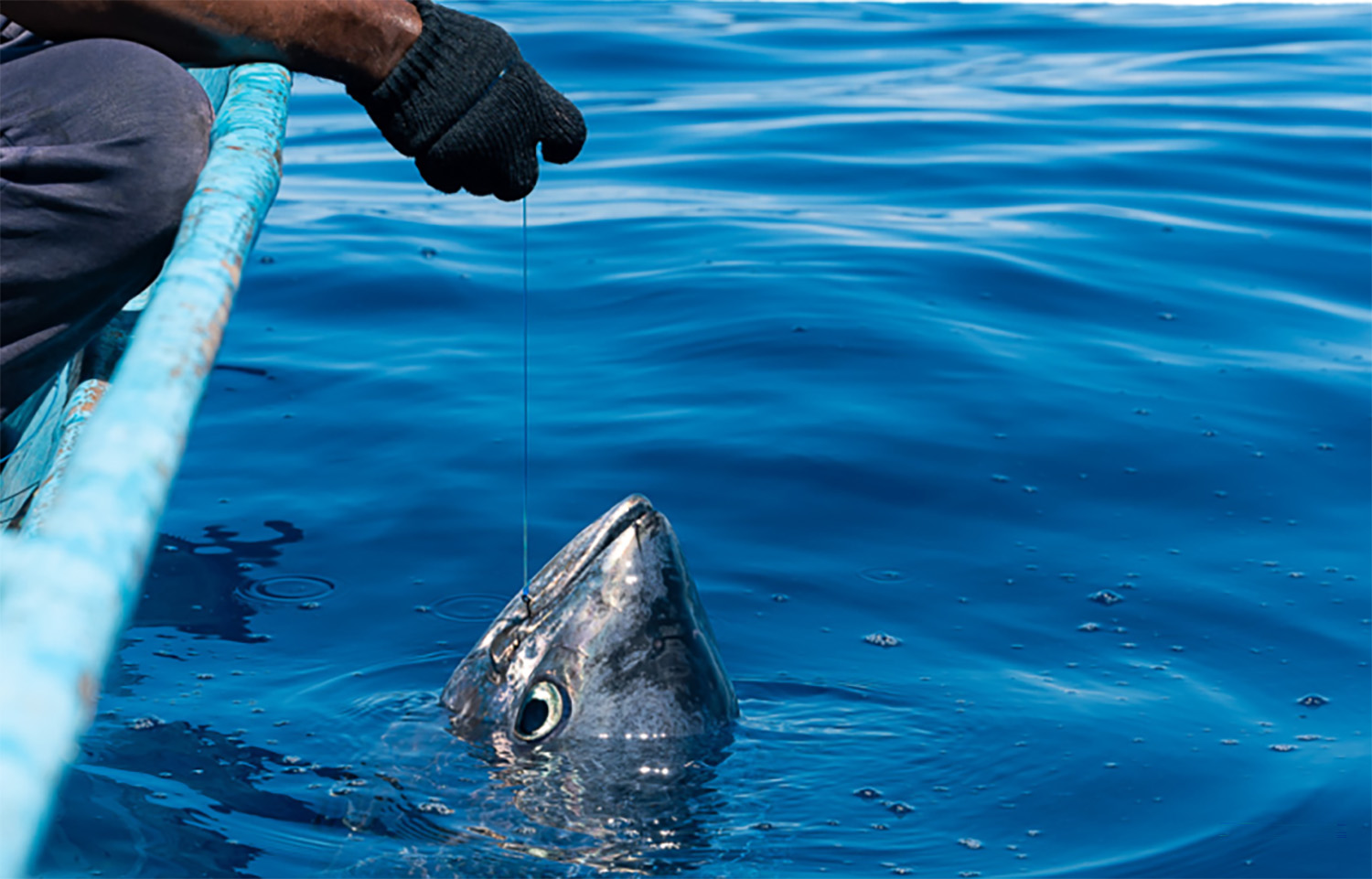
Despite its reputation as one of the most sustainable sources of tuna globally, pole-and-line fisheries are falling short when it comes to animal welfare, according to Carefish/catch, a research initiative backed by an international consortium of fishery stakeholders and research groups that focuses on studying animal welfare issues in fisheries around the world.
A new Carefish/catch report titled “Welfare assessment in pole and line fisheries” found that many of the fish caught in these types of fisheries suffer from myriad welfare issues.
For example, if pole-and-line fishers do not immediately stun tuna, the fish are often exposed to air for hours and crushed under other fish, the study alleges, and if fishers do attempt to stun the fish they catch, they often employ insufficient stunning methods and do not conduct a follow-up step like bleeding the fish.
Carefish/catch Spokesperson and Fair Fish Executive Director Fausta Borsani said the study highlighted that even low-impact fisheries need to make improvements and insisted that education on how to properly slaughter fish would make a huge difference for both animal welfare and product quality.
“Simple measures can make a big difference such as using a soft ramp for landing fish after they are pulled onboard, stunning them immediately, and then transferring them to ice, as is already done in Japan,” she said. “One important point to consider is the low market price for these fish in most regions in the world. This means realistic improvements may need to focus on low-cost modifications or finding ways to increase the product’s price or value.”
Borsani further explained that those low-cost methods could include percussive stunning, preferably using a captive bolt pistol, followed by either placing the fish in ice slurry, refrigerated seawater, or dry blast freezers. Fishers could also sever the aorta of the fish.
The Carefish/catch project is working closely with fisheries certification body Friend of the Sea (FOS), which is part of the international consortium that backs the initiative, to bring welfare improvements into practice, with Borsani confirming that FOS is launching a certification campaign specifically for fisheries using pole-and-line methods.
She said because this is a new standard, it will need to first be field-tested with fishermen to assess how efficient and feasible the sustainability requirements are in practice.
“During this process, data will be collected to refine and improve the certification standards,” she explained, adding that over the past few months, FOS has carried out several trials in different fisheries. “Overall, there appear to be no significant additional costs, and FOS certification requirements align well with maintaining product quality.”
Responding to Carefish/catch’s report, International Pole & Line Foundation (IPNLF) Fisheries Director Craig Turley told SeafoodSource he was surprised at the criticism and insisted the analysis is both inaccurate and misleading.
“It’s false to claim that when compared to other commercial gears, pole-and-line fishing causes prolonged suffering in tuna,” he said.
He explained that IPNLF has participated in the risk assessment process of the Catch Welfare Platform (CWP), which seeks to inform catch welfare in wild capture fisheries from an objective and scientific perspective, and that CWP has conducted risk assessments on pole-and-line and purse seine tuna fisheries, as well as other gears and species.
“During the risk assessment for pole-and-line, these fisheries were ranked among the lowest risk for the length of suffering among any gear type with the length of contact with fish gear being assessed as low double-digit seconds compared to minutes or even hours for other gears,” Turley said.
Turley said the claims of prolonged air exposure and insufficient stunning methods in particular are not credible.
“While it is true that most pole-and-line vessels do not use individual stunning methods because of the high throughput, it is not true that tuna die slowly on deck for hours. Tuna are obligate ram ventilators, meaning that they need to constantly swim in order to maintain respiration and oxygen flow or they will lose consciousness and perish within minutes. Therefore, it’s impossible that they would suffer for hours,” he said. “I have personally fished on pole-and-line vessels in South Africa, the Maldives, and Indonesia – actively witnessing many hours of fishing activity – and I do not recognize their account from any of my experiences. In addition, Carefish’s study reviewed 205 videos with an average view time of approximately four minutes and no videos that lasted close to an hour, further discrediting their claim. When compared to any other commercial fishing gear, pole-and-line gear contact time is magnitudes shorter, meaning less stress and suffering for the fish.”
The report’s other claim that fish are crushed under others does not seem applicable to pole-and-line fisheries, Turley said, adding that it’s “far more pertinent” to purse seine or trawl fisheries.
He also pointed out that IPNLF has animal welfare guidelines, co-authored with the International Seafood Sustainability Foundation (ISSF), already set out for pole-and-line fisheries, which makes the following practical suggestions:
- The area where fish will be landed should be as free of angles, ledges, and obstructions as possible to reduce tuna bruising and damage during capture;
- A smooth vinyl tarpaulin or sheet can be spread across the landing area to reduce scratching, skin abrasions, and bruising;
- The landing area for poled tuna should be as smooth as possible and ideally should be kept wet and cool with a saltwater deck hose; and
- When fish are landed on the boats, it is highly desirable that they can be placed on a cool, wetted deck and then dispatched, rinsed, and chilled as quickly as possible.
Turley said with the diverse geographies and socioeconomic conditions under which pole-and-line fishers work, a one-size-fits-all approach is not practical.
“For this reason, we would urge caution in applying a blanket approach to fish welfare standards that do not account for the vastly different circumstances, vessel designs or financial capacities of vessels and their owners to implement the solutions,” he said. “IPNLF is already cooperating with pragmatic science-based research groups such as the Catch Welfare Platform and the Aquatic Life Institute, to help provide accurate information and propose solutions. IPNLF’s absolute priority when it comes to fish welfare is to seek pragmatic solutions without compromising equity, safety, or placing undue burden on small-scale fisheries.”
