


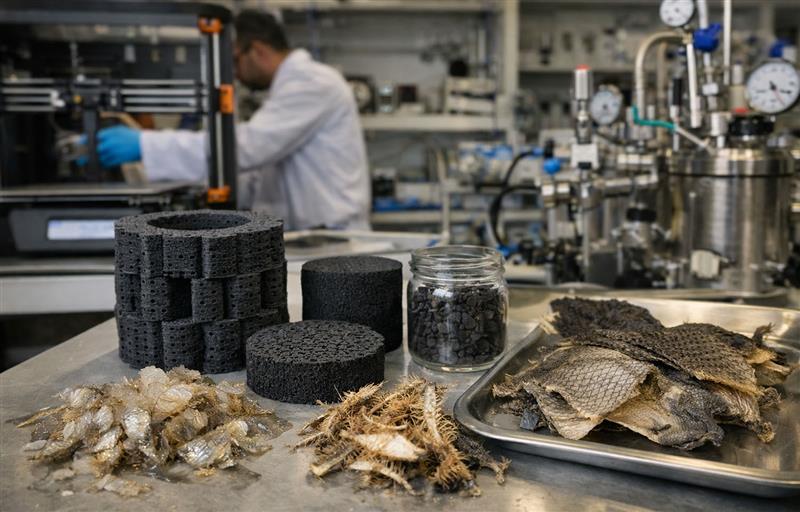
The NOVA School of Science and Technology's Association for Innovation and Development (NOVA.ID.FCT) announced a new Portuguese-led international consortium called AERO2cycle that will use industrial fish waste as the raw material for carbon capture.
In a release by NOVA.ID.FCT, the Caparica, Portugal-based private nonprofit said it will use fishery byproducts such as scales, skin, and bones as the feedstock for biochar, a carbon-rich material it plans to incorporate into functional aerogels that will in turn capture and convert carbon dioxide. The group said the processes will be developed by 2028.
The project is funded by the Portuguese Foundation for Science and Technology (FCT), led by NOVA.ID.FCT, and includes local universities Évora, Santiago de Compostela, and Jaume I as collaborators. Private nonprofit association B2E – Blue Bioeconomy CoLAB is also involved on the project.
NOVA.ID.FCT added that this project will help contribute to Europe’s carbon neutrality targets for 2050 as countries continue to increase carbon regulatory requirements on industrial emissions.
“The technology under development can be integrated into industrial gas treatment systems, enabling the direct capture of carbon dioxide from emission streams generated by production processes,” the release said. “Potential applications include sectors such as energy production, cement, chemical industry, or waste-to-energy plants, where emissions are inherent to operations.”
NOVA.ID.FCT said that by transferring the gaseous waste into a resource with economic value, the project will help create a new value chain based on captured carbon. Along with capturing carbon, the project will explore the conversion of retained CO2 into industrially useful chemical compounds instead of environmental pollutants. Examples could include specialty chemicals, cosmetic formulations, sustainable polymeric materials, or energy storage technologies.
The next stage of the project is to move from scientific research to technical application, combining marine waste valorisation, advanced materials innovation, and contribution to decarbonization targets, NOVA.ID.FCT said.
