




Fishers and aquaculturists in Thailand are urging the nation’s government and relevant stakeholders to take action to address the spread of invasive blackchin tilapia, which have been devouring fry and roe at alarming rates on affected farms.
Blackchin tilapia are aggressive predatory fish that hunt and feed on other fish species. Their average reproductive cycle is around 22 days, with a single female capable of producing between 200 and 900 eggs, allowing their population to grow rapidly if no mitigating measures are in effect.
In Thailand, this invasive species has posed a significant threat to local wildlife and has negatively affected fish and shrimp farms in the country, Thai Public Broadcasting Service (Thai PBS) reported in July last year.
The problem’s roots allegedly stem back to 2010, when Thailand-based food conglomerate CP Foods imported around 2,000 blackchin tilapia from Ghana for research at its facilities in the central province of Samut Songkhram.
The company stated that it properly disposed of the fish after the studies, but Thailand’s Fisheries Department said DNA tests have revealed the blackchin tilapia in the country originates from the same parent stock CP studied, Thai PBS reported.
Regardless of the fish’s origins in the country, in 2012, farmers in Samut Songkhram began to report issues with the invasive fish.
By 2016, the invasive fish had spread to many provinces in Thailand, disrupting native species and ecosystems as a whole.
A survey conducted in 2017 found that around 30 million invasive blackchin tilapia were present in shrimp-farming areas of Samut Songkhram, causing economic damages ranging from THB 150 million to THB 350 million (USD 4.4 million to USD 10.3 million, EUR 4.2 million to EUR 9.9 million), Thai PBS reported.
In July 2024, the Thai government launched a comprehensive strategy to fight back against the invasive fish, approving funds of THB 500 million (USD 14.7 million, EUR 14.1 million) in total to eliminate it from the nation’s waters, the Bangkok Post reported 17 January.
Similarly, CP Foods said it has supported initiatives such as the Thai Department of Fisheries introducing a genetically modified variant of blackchin tilapia to curb its reproduction.
Starting in February, the Thai government also began to allocate a budget of THB 12 million (USD 351,650, EUR 338,180) for purchasing the invasive fish caught by local fishermen at the price of THB 20 (USD 0.59, EUR 0.56) per kilogram. Under the program, the purchased fish would be converted for use in rubber plantations as part of an initiative run by the Rubber Authority of Thailand.
As a result of the measures, CP Foods said that the population of the invasive fish in Thailand has dropped, with the number of affected provinces decreasing from 19 to 17.
“This demonstrates that the continuous implementation of these measures is yielding concrete results in reducing the spread of this invasive species,” CP Foods said.
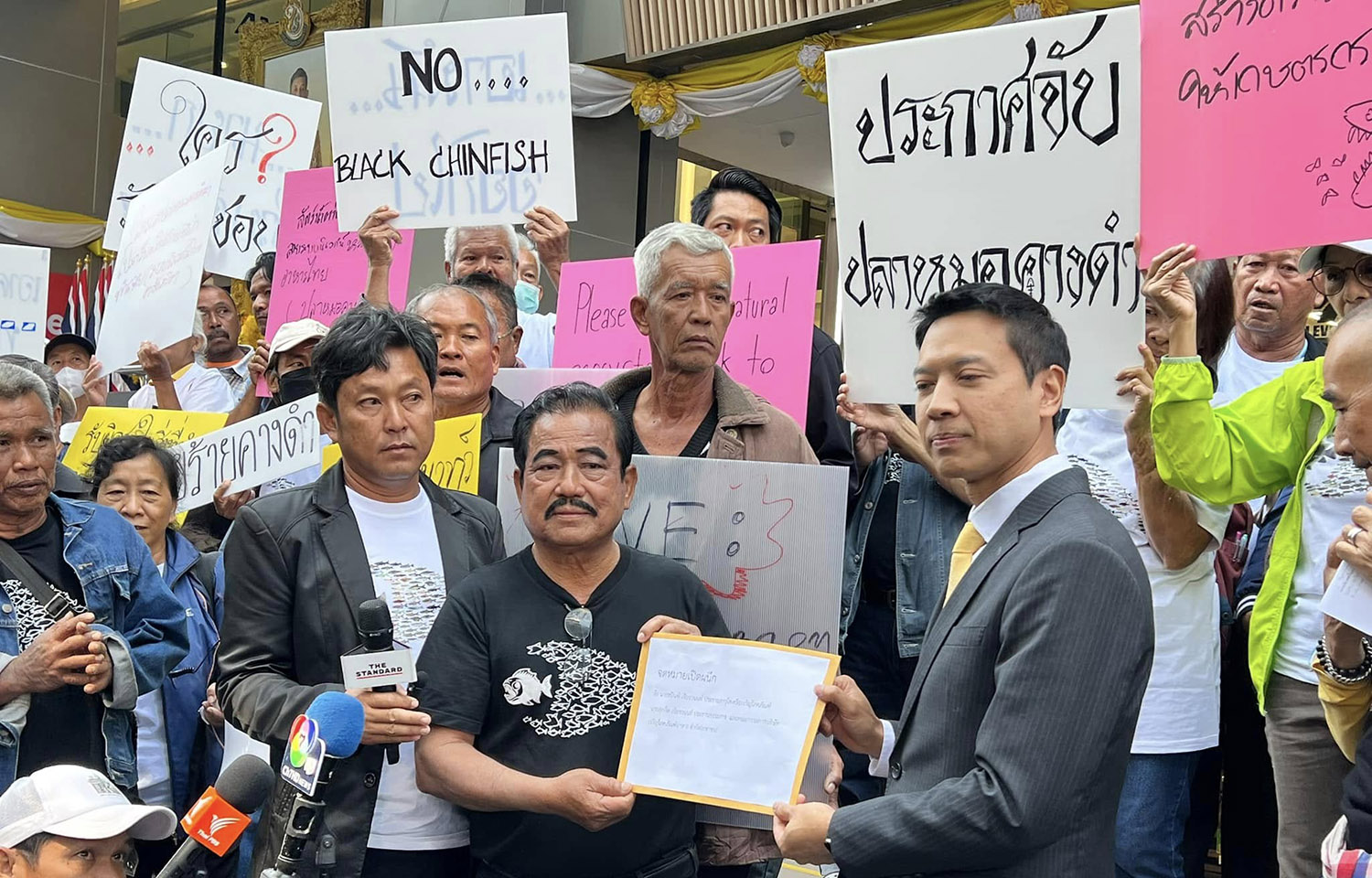
Many Thai farmers, however, refute the reported progress and have expressed disappointment with the government’s handling of the crisis.
Farmers in the Amphawa District of Samut Songkhram claimed they have incurred losses and also said the government’s measures to control the situation are insufficient, poorly targeted, and that the surveys announced by the government are not accurate, The Nation newspaper reported 18 January.
"The government's efforts have been more about show than substance," a farmer was quoted by The Nation as saying. "They haven't targeted the areas that are most severely affected, and their programs haven't been effective."
Withoon Lienchamroon, the director of sustainable food growth organization BioThai, blamed the government and CP Foods for their failure to control the spread of the blackchin tilapia and warned that the invasive fish could affect neighboring countries if no proper action is taken.
“At present, this problem still has not been conscientiously addressed, and these problems may multiply and become even more drastic in the future,” BioThai said in an open letter to CP Foods. “This problem may lead to severe environmental harms and food security challenges at the regional level.”
Elsewhere, a group of fish farmers and fishermen in the province of Samut Sakhon filed a class action lawsuit against CP Foods in September 2024, demanding compensation worth THB 2.5 billion (USD 73.3 million, EUR 70.4 million).
A Thai court accepted the case as a class-action suit on 4 March, paving the way for the case to move forward.
Separately, representatives of the Law Council of Thailand, on behalf of 54 fishermen and fish farmers in the same province, filed another lawsuit against 18 state agencies and officials, including the Thai Department of Fisheries and its director general, for negligence of duties.
