



A U.S. Senate committee has approved legislation that would increase restrictions on vessels engaged in harmful fishing practices, recommending that the full Senate pass the bill.
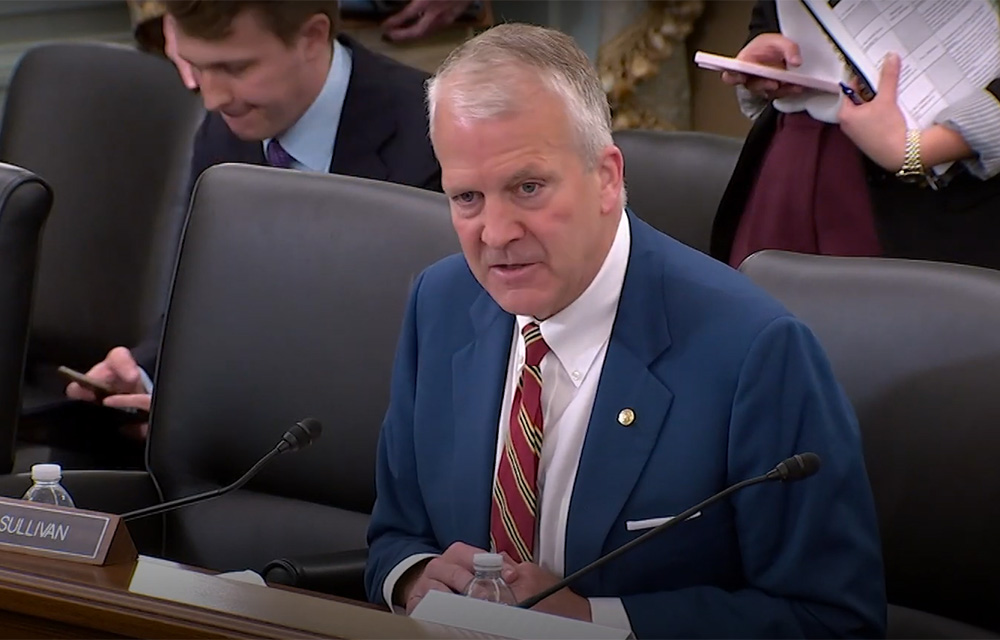
“This is another measure in a long line of bipartisan comprehensive bills that [U.S. Senator Sheldon Whitehouse (D-Rhode Island)] and I have been introducing and passing over the last several years,” U.S. Senator Dan Sullivan (R-Alaska) said after the committee voted in favor of his bill, pointing to the 2020 Save Our Seas Act. “President Trump has been a big supporter of these clean ocean legislation initiatives, and now we have the FISH Act, which is focused on illegal, unreported, and unregulated [IUU] fishing, which is both a challenge globally, it’s a challenge for our country, and it’s certainly a challenge in Alaska.”
If passed into law, the Fighting Foreign Illegal Seafood Harvest (FISH) Act would establish a blacklist of vessels with a history of engaging in illegal, unreported, or unregulated fishing. Those vessels would be banned from the United States’ exclusive economic zone (EEZ). The bill also orders the U.S. Coast Guard to conduct more inspections of suspicious fishing vessels.
“Globally, IUU fishing makes up approximately 20 percent of global seafood harvested. Catches result in economic losses estimated between [USD] 10-23 billion [EUR 9-20 billion] to fisheries that fish legally each year,” Sullivan said. “For Alaska, IUU fishing is a growing threat. It certainly is a major factor on our very low commercial salmon harvests that we’ve had in the last few years. There are many reasons for a smaller salmon catch in Alaska, but one of them, clearly, Mr. Chairman, is IUU fishing in the North Pacific and parts outside of Alaska’s waters.”
Sullivan also pointed to Russia’s and China’s increased military presence in the North Pacific and the Arctic as worrying signs for sustainable fisheries.
“Both have expansive Arctic and North Pacific ambitions and presence, and they’re some of the worst violators of IUU fishing,” Sullivan said. “The Chinese in particular have their grey fleets that travel all over the world off the coast of Africa, off the coast of Latin America, ravaging the high seas fishing stocks. They are literally a cancer on global fishing, and this bill goes after Russian and, in particular, Chinese fishing fleets, which oh by the way, use slave labor.”
Sullivan and Whitehouse first introduced the FISH Act in 2022, reintroducing it in the following Congress as well. Last year, Sullivan tried to get the text of the bill passed as part of the annual funding bill for the U.S. Department of Defense.
The U.S. Senate Committee on Commerce, Science, and Transportation passed the bill on a voice vote 30 April, amending it slightly to provide USD 105,700,000 (EUR 93,687,788) in funding to implement the legislation from fiscal year 2026 through 2031.
Sullivan said he looks forward to bringing the FISH Act up for consideration by the full Senate soon. A companion bill was introduced in the House by U.S. Representative Ken Calvert (R-California), but the legislation has not yet been considered by the House Committee on Natural Resources.
In a statement, the National Fisheries Institute praised the Senate committee’s passage of the FISH Act.
“We strongly support the FISH Act legislation that works to actively address IUU concerns unlike the current Seafood Import Monitoring Program (SIMP) that NOAA itself has concluded, “does not prevent or stop IUU fish and fish products from entering U.S. commerce,’” NFI President and CEO Lisa Wallenda Picard said.
