




U.S. senators voted to attach legislation designed to combat illegal, unreported, and unregulated (IUU) fishing to the Senate’s annual military spending legislation just before it passed.
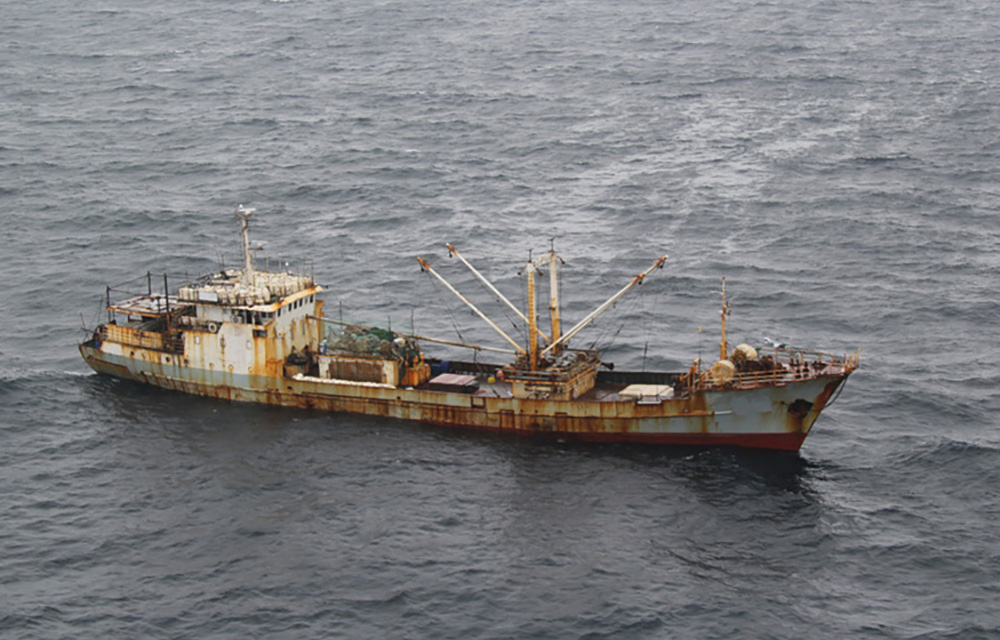
If passed, the Fighting Foreign Illegal Seafood Harvest (FISH) Act would require the U.S. government to establish a blacklist of vessels involved in IUU activities. Vessels on the list would be banned from U.S. waters. The legislation would also require the U.S. Coast Guard to increase at-sea inspections to combat IUU fishing. The bill also requires reports to be submitted on how new technologies can help combat IUU fishing and on how Russian and Chinese fishing affects the U.S. market.
U.S. Senator Dan Sullivan (R-Alaska) and U.S. Senator Sheldon Whitehouse (D-Rhode Island) first introduced a version of the legislation in 2022, and it was reintroduced in 2023. Progress on the legislation has been slow, leading Sullivan to attempt to attach the FISH Act to the 2025 funding bill for the U.S. Department of Defense. Though that effort was not successful, Sullivan and Whitehouse reintroduced their bill earlier this year, and it was approved by a Senate committee in April.
“Globally, IUU fishing makes up approximately 20 percent of global seafood harvested. Catches result in economic losses estimated between [USD] 10 billion to USD 23 billion [EUR 9 billion to EUR 20 billion] to fisheries that fish legally each year,” Sullivan told the committee at the time. “For Alaska, IUU fishing is a growing threat. It certainly is a major factor on our very low commercial salmon harvests that we’ve had in the last few years. There are many reasons for a smaller salmon catch in Alaska, but one of them, clearly ... is IUU fishing in the North Pacific and parts outside of Alaska’s waters.”
Still, the lawmakers again worked to attach it to military spending legislation to ensure its passage. Sullivan first proposed adding the FISH Act to the 2026 National Defense Authorization Act (NDAA) in September, submitting an amendment in September to do so. On 9 October, U.S. Senator Roger Wicker (R-Mississippi) officially proposed the amendment, and it was adopted by voice vote. The NDAA was passed by the full Senate later that day.
Still, the FISH Act will still need to clear multiple hurdles in order to become law. The House passed its version of the NDAA last month, which has multiple differences from the Senate version, including substantially lower spending. The House version also includes an amendment eliminating any exceptions for seafood from the government’s “Buy American” provisions, but it’s not clear how big of a change that would be from current restrictions on the government purchasing foreign seafood.
The two legislative bodies are likely to set up a conference to align the two bills, and it’s not uncommon for lawmakers to make significant changes to the final bill during the process. The FISH Act amendment will need to survive the conference negotiations in order to be included in the final version delivered to the president for his signature.
The Senate NDAA also includes a ban on the military buying seafood originating from or processed in China and selling it in commissaries and dining halls.
While the Senate vote will move the military budget process forward, the federal government remained partially shut down after Congress failed to pass the appropriations bills funding the government for fiscal year 2026, which began 1 October.
