






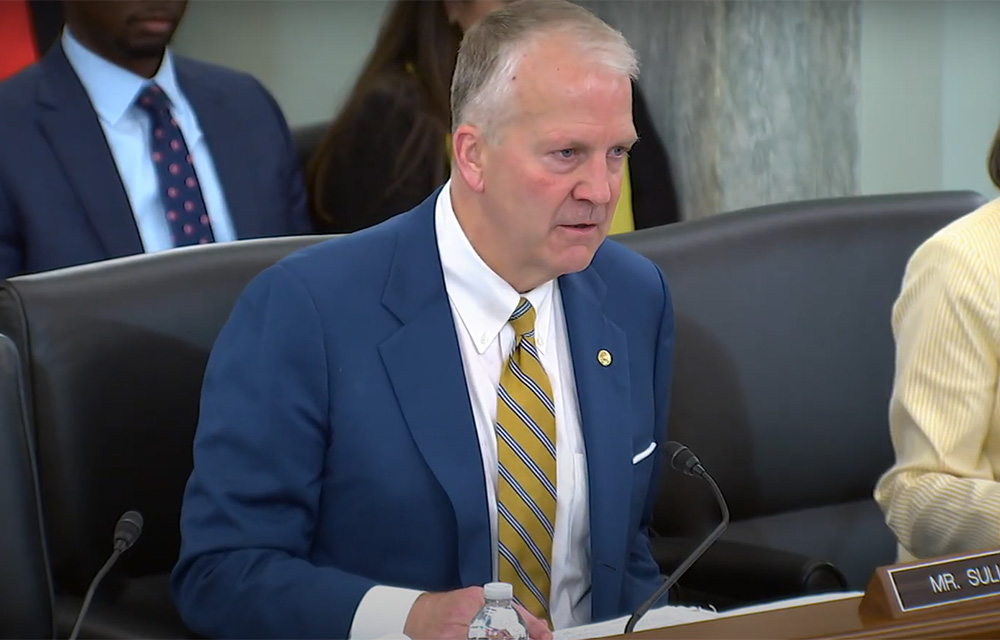
U.S. senators used a subcommittee hearing to heavily criticize illegal, unregulated, and unreported (IUU) fishing practices – an activity they claimed reduces revenue for America’s seafood sector and poses a direct national security threat to the country.
“It is estimated that IUU fishing accounts for up to 20 percent of the global catch, which translates to global losses between USD 10 billion and USD 50 billion [EUR 8.7 billion to EUR 43.4 billion] annually for fishing fleets that actually fish legally like ours in America,” U.S. Senator Dan Sullivan (R-Alaska) said in the recent Senate Subcommittee on Coast Guard, Maritime, and Fisheries hearing.
Sullivan has been a frequent critic of Russia's and China’s distant-water fishing fleets, pushing hard for the U.S. to ban or severely limit seafood imports from either country. Sullivan collaborated with former U.S. President Joe Biden to close a loophole that allowed Russian seafood processed in China to be imported to the U.S. and, earlier this year, pressured Trump nominee Howard Lutnick, who now leads the U.S. Department of Commerce, to “promote American ‘freedom fish,’ Alaska ‘freedom fish,’ and [not] allow communist fish from Russia and China coming into our markets.”
During the 12 June hearing, Sullivan again lambasted China’s distant-water fishing fleet.
“Of course, the Chinese Communist Party in China plays a significant role in this problem in the global fishing industry and is the worst offender of IUU fishing by far, no surprise. The Chinese government has provided billions of dollars in subsidies to its distant-water fishing fleets, gray fleets as we sometimes call them, enabling their fishing sector to grow exponentially,” Sullivan said. “According to Global Fishing Watch, China operates approximately 57,000 fishing vessels, which accounts for 44 percent of the world's total fishing activity, operating in tandem with the Chinese military to protect its fishing fleet.”
U.S. Senator Ted Cruz (R-Texas) highlighted reporting released by the Outlaw Ocean Project, which unveiled evidence of labor abuse, unsafe conditions, and other violations in China’s distant-water fleet.
“Many of these Chinese vessels exploit crews through forced labor, unsafe conditions, and wage theft,” Cruz said. “Crew members are held against their will, denied basic human rights, and even subjected to physical violence. This is not competition. It is barbaric economic warfare. Let me be clear: Our waters are not open to poachers.”
China recently ratified the Port State Measures Agreement (PSMA), an international agreement to tackle IUU fishing, hasn’t seemed to dampen any concerns.
“I don't think anybody actually believes that China is going to enforce the rules of the PSMA, particularly for Chinese-flagged vessels that are bringing illegal catch back to China, but it gives the U.S. a great tool to name and shame Beijing and try to hold its feet to the fire internationally,” said Gregory Poling, who is the director and senior fellow of the Southeast Asia Program and Asia Maritime Transparency Initiative at the Center for Strategic & International Studies (CSIS) as well as a witness at the hearing.
While China’s fleet received the brunt of the hearing’s criticism, Russia’s IUU fishing was also highlighted. One of the witnesses before the subcommittee, Alaska Bering Sea Crabbers President Gabriel Prout, told lawmakers that Russian IUU crab continues to harm American crabbers in spite of a ban on Russian seafood imports.
“For over 20 years, Russian IUU crab has undercut the economic foundation of our industry,” Prout testified. “In 2021, a U.S. International Trade Commission [ITC] report found that in 2019, over 20 percent of U.S. imports of snow and king crab from the Russian Far East came from IUU sources. Fortunately, U.S. imports of Russian crab have largely ceased thanks to the embargo that began under President Biden, continued under President Trump, and was strengthened by Senator Sullivan's work to close the China transshipment loophole. Still, Russia's IUU crab continues entering global markets through other channels, suppressing prices and creating unfair competition for us harvesters who follow the law.”
That situation isn’t unique to Alaskan crabbers. The ITC claims that IUU imports reduce revenue in commercial fisheries across the country.
“The ITC estimated that prohibiting IUU imports would increase the fishing industry's operating income by nearly USD 61 million [EUR 52.9 million] annually, benefiting a broad range of segments,” Nathan Rickard, a trade expert and partner with legal firm Picard Kentz & Rowe, told senators. “The shrimp industry, largely operating in the Gulf and South Atlantic, would see a USD 13 million [EUR 11.3 million] annual boost. The salmon industry on the west coast and in Alaska would see income grow by USD 12 million [EUR 10.4 million] a year. Blue Crab watermen in the Mid-Atlantic and Gulf would receive another USD 6 million [EUR 5.2 million] a year, while lobstermen in the Northeast would see a USD 4 million [EUR 3.5 million] annual increase. Our commercial fishermen need all the help they can get.”
One of the recurring themes of the hearing was the national security concerns raised by IUU fishing.
In his opening remarks, U.S. Senator Sheldon Whitehouse (D-Rhode Island) alleged that Chinese fishing vessels are being used by the Chinese government for intelligence operations. Sullivan added that China uses its military and Coast Guard vessels to enable IUU fishing, protecting its fishers from local interference.
“The Chinese fishing boats benefit from the protection of the Chinese Coast Guard and Navy, ensuring their ability to pilfer resources around the globe,” Sullivan said.
Poling added that IUU fishing also poses direct security issues.
"IUU fishing is not just an economic, food security, or environmental issue, as we've already heard; this is a national security threat, one that over the last decade, the U.S. and partners and allies have woken up to,” Poling said, claiming that IUU fishing vessels often simultaneously engage in trafficking of drugs, weapons, and people, money laundering, and tax evasion.
“They also indirectly contribute to piracy, as we've seen in the Gulf of Guinea or Somalia over the last two decades and, in some cases, even to insurgency and terrorism, as was the case in the Sri Lankan Civil War in the 1990s and 2000s,” Poling added. “So, vessels that engage in one type of illegal activity do not generally only engage in that one type of illegal activity.”
From a U.S. government perspective, the Pacific Islands is one of the greatest areas of concern.
“Other than Western Africa, the Pacific Islands probably suffer from the second-largest amount of IUU fishing in the world as a percentage of their total catch. They are also reliant on the revenues from fishing both their own and the sale of fishing rights to other states, like the U.S., who do follow the rules through things like the South Pacific Tuna Treaty,” Poling said, adding that China’s IUU fishing practice “denies these states the revenues they need."
"It undermines their governance. It takes away livelihoods and fish protein from their communities," he said. "It opens them up to all kinds of illegality. It also opens them up to potential elite capture and influence operations, as China engages in checkbook diplomacy across the region.”
While acknowledging that Coast Guard patrols around the Pacific Islands are important to deterring IUU activity, Poling said the area is simply too large to adequately police with vessels. Instead, Poling said the U.S. needed more drones and satellite imagery to generate maritime domain awareness of the region.
Senators also used the subcommittee hearing to highlight the Fighting Foreign Illegal Seafood Harvest (FISH) Act – legislation introduced by Sullivan and Whitehouse to crack down on IUU fishing.
“It puts IUU fishing vessels on a blacklist, raises costs for IUU vessel owners and importers, and supports increased Coast Guard enforcement and work with our partners,” Sullivan said.
“The FISH Act of 2025 would meaningfully improve the market position of our domestic seafood producers. It would effectively counter abhorrent practices in foreign fisheries, and it would restore American consumer confidence in the seafood sold in our market,” Rickard said. “The FISH Act appropriately recognizes the central importance of data collection, data sharing, and data analysis to ensure that IUU seafood is kept out of the U.S. market.”
The U.S. Senate Committee on Commerce, Science, and Transportation approved the bill in a 30 April voice vote.
Despite lawmakers’ concerns, it’s not clear that the U.S. government currently has the resources to increase IUU enforcement and stop imports. In her opening comments, U.S. Senator Lisa Blunt Rochester (D-Delaware) pointed out that the Trump administration’s massive cuts to NOAA staff and proposed cuts to the agency’s budget will make it harder for the agency to tackle IUU fishing.
“Unfortunately, the administration has fired about 18 percent of NOAA Fisheries staff and is looking to cut the budget by 30 percent to make matters worse. Cuts to the rest of the agency are undermining this work even further,” Rochester said. “Due to the ongoing hiring freeze, 30 percent of NOAA’s research ships will not leave the dock this summer. Fewer research ships in the water will result in fewer assessments and surveys opening the door for illegally caught and fraudulently labeled products to flood the market, which would undercut our own domestic seafood industry and threaten consumer safety.”
Whitley Saumweber, director of the Stephenson Ocean Security Project at CSIS and the hearing’s final witness, affirmed that the Trump administration’s cuts would undermine efforts to tackle IUU fishing.
“The dismantling of USAID has already caused widespread harm to ongoing efforts, and the threats to NOAA are deeply concerning, just as the U.S. government needs a positive presence with partners abroad,” Saumweber said. “A 30 percent cut in NOAA’s budget would be devastating to these efforts on a number of fronts."
