



The Aquaculture Stewardship Council (ASC) entered 2026 with its new feed standard, its new ASC Farm Standard, and, in March, debuted a brand-new logo as it continues to push for greater aquaculture sustainability.
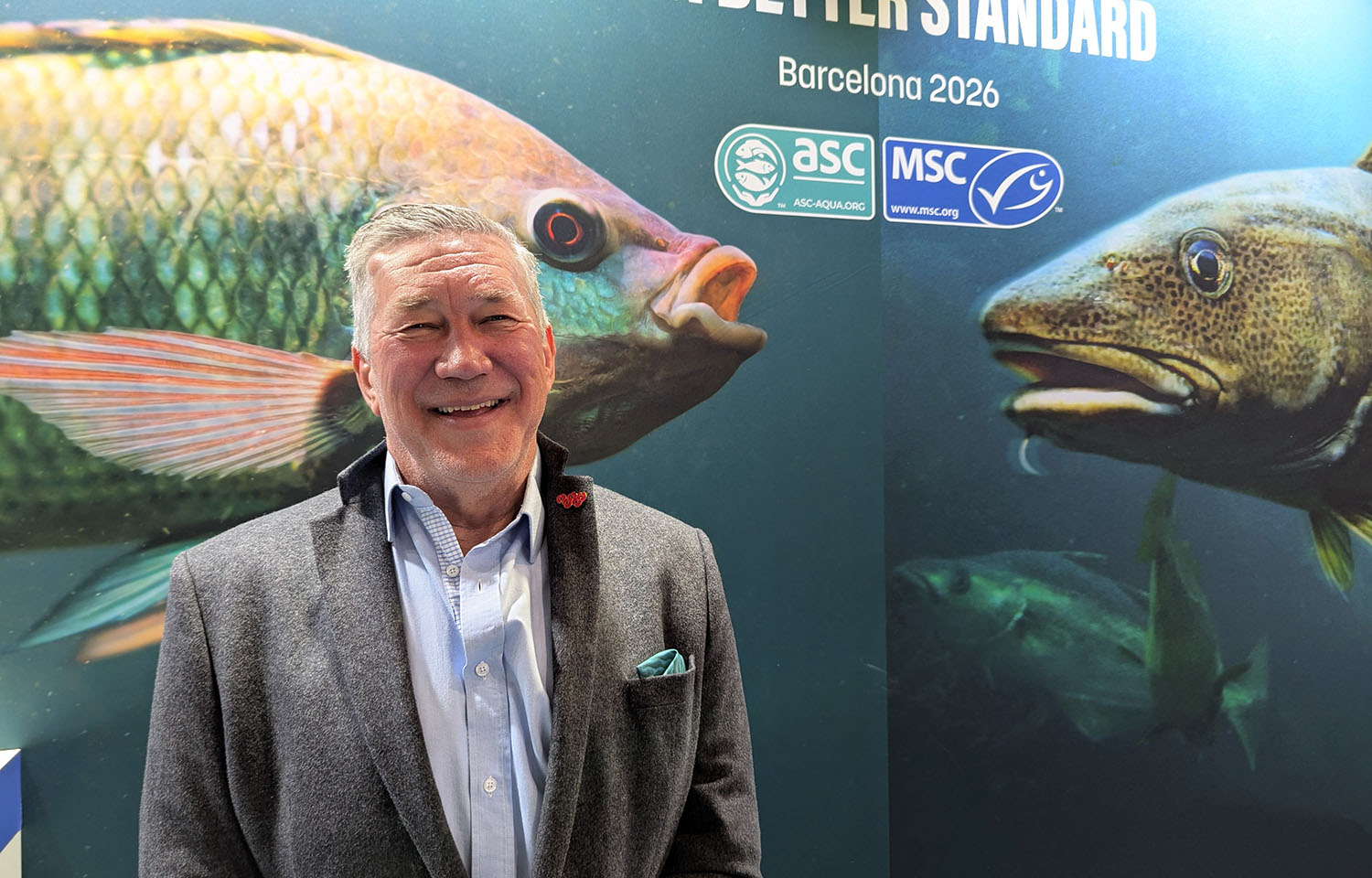
ASC CEO Chris Ninnes told SeafoodSource during the 2026 Seafood Expo Global (SEG) – which ran from 21 to 23 April in Barcelona, Spain – that the implementation of both the farm and feed standards is still underway.
“Those are two big pieces of work where the implementation is still underway,” Ninnes said. “We’ll certainly be thinking about Version 1.1 for feed and highly likely Version 1.1 for the farm standard before that goes live, mainly because we’ve invested so much time and resource within the organization to try and make this implementation as smooth as possible.”
ASC launched the farm standard at SEG in 2025 and has designed it to be a more consistent metric for aquaculture operations across all species standards that the ASC covers.
“What we’re trying to drive with this new farm standard is consistency,” Ninnes said. “We brought all of these species standards together when they were developed 15 to 20 years ago in isolation. Even though it was all coordinated, the species standards grew on their own in their own way, so they tackle issues in different ways.”
As a global standard, those differences between different species were making things complicated as the question of what an ASC fish is could differ from one species to the next, diluting its impact, he explained.
A side effect of bringing those different standards together is increased efficiencies that Ninnes said should hopefully make things easier for farms seeking to reach the ASC Farm Standard.
“Because we’re bringing 11 or 12 standards into one, there are efficiencies there that should feed down through into audit costs because the whole accreditation process, the whole training process, is much simpler,” he said.
The new standard is also highlighting concerns around animal welfare and making the approach to human rights issues more consistent, which Ninnes said is partially in response to market demand.
Ninnes acknowledged that the certification has faced criticism from NGOs and environmental groups, some of which have claimed the ASC is doing more to serve industry interests than the environment. He argued much of that criticism is related to ASC’s broad mission of improving aquaculture across all species and in multiple parts of the supply chain.
“For some groups that have got a very single-issue focus, that’s all they think about. But, we can’t do that,” he said. “We have to take into consideration that overall framework that farming has to operate within. So, we can’t be specific to any one issue.”
Ninnes said the new ASC Farm Standard has been criticized in both directions, with some groups claiming the new standard is too lax on aquaculture operations while others claim it is too stringent to be achievable and, thus, isn’t helping due to companies deciding to abandon any hope of achieving sustainability standards.
He said the goal of the review processes it undergoes when creating and updating standards is designed to ensure that both perspectives are taken into account – to thread the needle between stringent enough to drive change but not so complicated and onerous that it no longer gets industry uptake.
“That’s the dilemma for a global standard because you want to have a set of rules that define what responsible seafood farming is about, but at the same time – just to use salmon as an example – farming salmon in Chile is very different from farming salmon in Norway or Scotland,” Ninnes said. “It’s the same, too, for all of the other species and commodities we’re involved with.”
The new Farm Standard has already received some uptake in the industry.
In April, Lubimar, a Spain-based sea bass and sea bream estuary farm, became the first farm in the world to achieve certification to the ASC Farm Standard, and Ninnes said the farm is an example of what the ASC is hoping its standard will drive toward.
“It’s just a fantastic operation, I was lucky to get out there and see it. It’s an incredible production system,” Ninnes said. “It’s so integrated into the local natural wetland habitat, and it’s quite unique. What they do in terms of forging that approach in alignment with nature is just perfect, and it’s something we want to drive with the standards.”
Ninnes said at a basic level, all aquaculture operations have one main goal: Look after the fish they are caring for because that’s the basis of how the business makes money. That core goal is in many ways aligned with ASC’s mission of improving sustainability and reducing environmental impact because those goals also serve to improve fish welfare.
ASC is also working to build its improver program, which helps aquaculture operations that can’t achieve the certification standard on their own. Ninnes said that program has been running for a few years with two main pathways.
One of those pathways is toward achieving ASC certification, while the other – which is still in the process of being rolled out – is a pathway to better management practice.
That second pathway has required a different approach as there’s no market-based incentive like there is with ASC certification. For those farms, engaging with the ASC has become a means of accessing financial markets that were otherwise unavailable.
“If you have better access to finance, better access to insurance products, you have the ability to drive efficiency within that sector and also bring about change,” Ninnes said. “In the coming years, that will be a significant part of what we also do.”
Ninnes said ASC recognizes capital markets are essential to financing in the seafood sector, and the organization wants to be part of the leading edge of the “blue financing” movement. ASC certification, or membership in the improver program, could be a key performance indicator (KPI).
Some of that effort has already paid off, with the ASC and Marine Stewardship Council (MSC) being mentioned in the KPIs for blue finance by the World Bank’s Blue Finance Guidelines.
Outside of the standards themselves, ASC is also continuing to work on promoting itself so that more consumers know what the council is and recognize what its label means. The organization launched its first public marketing campaign in 2022, and Ninnes said that process taught the organization a lot.
“The U.S. market now is our fastest growing market globally,” Ninnes said.
The ASC has started dedicated marketing campaigns in key markets of Europe, which were aided by the efforts of the MSC which has also spent years establishing its brand in the region.
Along with those campaigns comes a new consumer label, which it launched in March. That label is partially in response to E.U. rules over packaging and environmental claims, mainly the Empowering Consumers for the Green Transition Directive, which comes into force in September. That rule tightens what claims are allowed to be made by labels and also forbids any “unreliable voluntary sustainability logos.”
Across all of those efforts, the underlying motivation for ASC is driving improvements in aquaculture, Ninnes said.
“We’re here to serve the seafood sector, the farmers, and all of those concerned people in between,” Ninnes said.
