






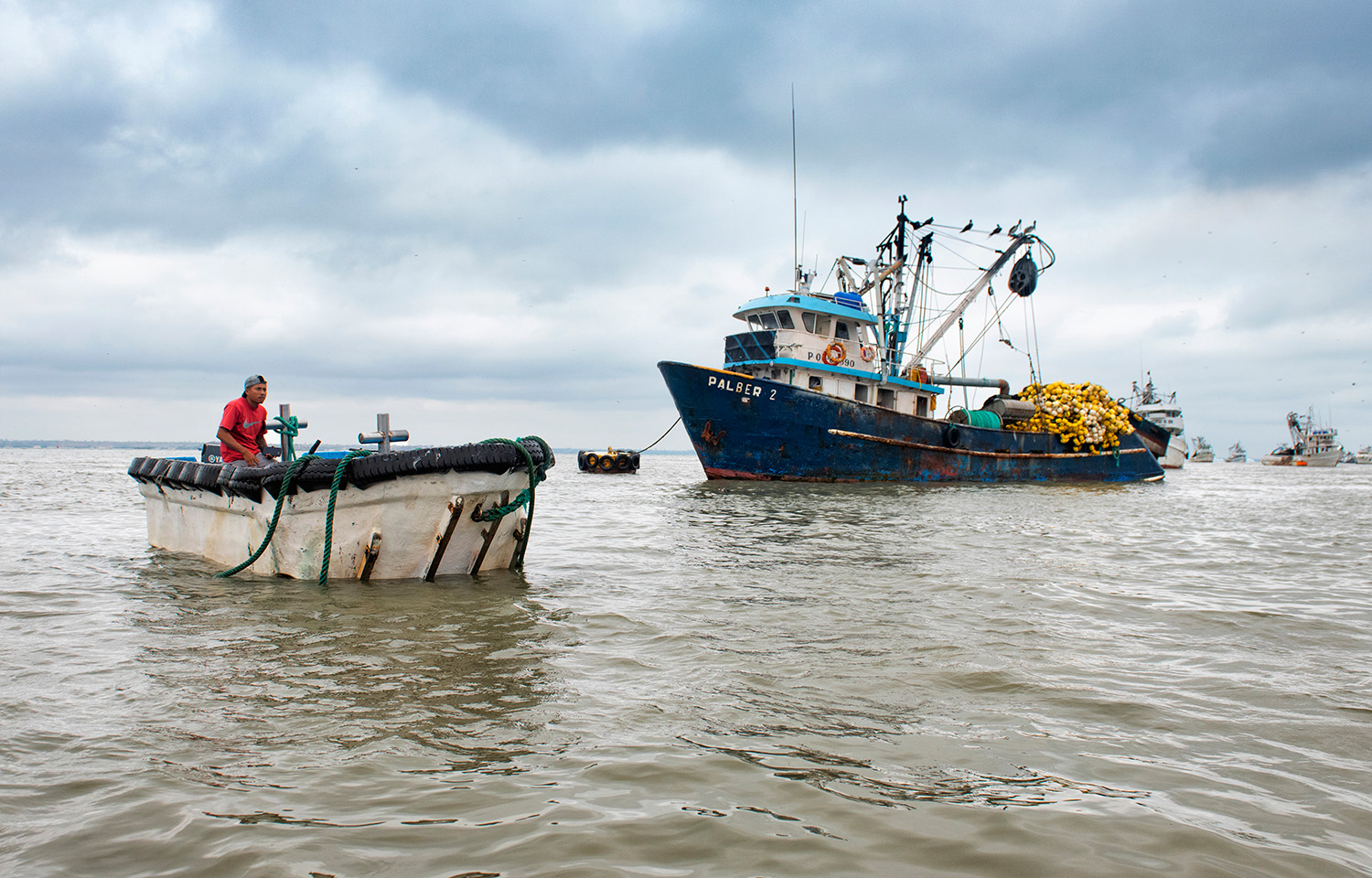
In Ecuador, volatile prices and dwindling supply threaten the backbone of the country’s USD 1.3 billion (EUR 1.1 billion) tuna sector, according to the World Wildlife Fund (WWF).
However, the WWF is working hard to mitigate overfishing and stabilize supply by working alongside local sustainability organizations like the Foundation for Tuna Conservation and Responsible Fishing (TUNACONS).
In 2016, three tuna companies came together in Ecuador to assess the challenges and needs of the nation's tuna industry. In 2017, two more companies joined them to form a fishery improvement project (FIP). With a formal namesake, TUNACONS was able to earn Marine Stewardship Council (MSC) certification for its sustainability practices, and in 2018, WWF signed a memorandum of understanding with TUNACONS, highlighting the project as a case study for righting a fishery on the brink of collapse, according to Pablo Guerrero, who leads WWF’s fisheries efforts in Ecuador.
“[TUNACONS] is organized. They have a different vision about the business. They understand that sustainability is the future; it’s what will keep markets open in the future because markets are demanding,” Guerrero said. “Of course, working in the international arena is not easy because we are talking about international officials. Tuna is a highly migratory species, but TUNACONS have done their part.”
TUNACONS’ website lists four missions for its work as an organization. The first is to promote actions for the sustainability of the tuna purse-seine fishery in the Eastern Pacific Ocean and to promote maximum implementation of sustainable yield of tropical tuna stocks based on scientific and technical studies. The organization also wants to encourage and carry out technical training programs for the tuna fishing industry’s benefit and support the reduction of environmental impacts on marine ecosystems by strengthening public and private management on the national and international scale.
Guerrero said the organization has particularly excelled at diminishing the impact of marine pollution and other ecosystem disruptions by adopting a code of conduct for best practices, especially when it comes to bycatch of sea turtles, sharks, and manta rays. The organization has accomplished this via the implementation of eco-fish aggregating devices (eco-FADs).
TUNACONS has developed prototypes and run testing sequences on these devices, which aim to minimize bycatch and reduce oceanic pollution through minimizing the presence of “ghost gear,” or traditional plastic nets that other species can get caught in. TUNACONS has also worked on designing eco-FADs that do not fall off and get lost on the ocean floor.
On the policy side, the organization has focused on governance measures with the Inter-American Tropical Tuna Commission by participating in the regional fishery management organization's (RFMO) meetings at the technical, scientific, and political levels.
“By influencing on a positive manner to fishing authorities, they are able to negotiate management and conservation manners at the RFMO,” Guerrero said. “At the local level, they have guided through the design and implementation of national plan manufacturing of the conservation of tropical tunas in Ecuador and a national plan of action for management of FADs. Those are management tools that have been adopted as national policies.”
Guerrero added that while FADs were introduced to the Eastern Pacific Ocean in the 1990s, the prototype research and development TUNACONS has taken on with this technology has been vital to conservation, and while the organization did not invent FADs, it’s workshopping better ways to use similar technology with different tangible products.
As a small country with huge economic sway, the Ecuadorian tuna fishing sector has the capital and power to influence international policy in a sustainable, future-focused manner, Guerrero said. Before TUNACONS, however, Ecuador was unwilling to use that influence.
“It was amazing to see the before and after, [at first] having an Ecuadorian delegation with no voice at the tuna commission [and] more or less inactive in terms of [...] supporting or presenting conservation proposals in the tuna commission; nowadays, it’s completely different,” Guerrero said. “They didn’t have the sense of urgency of doing things or making decisions or taking a position in the RFMO.”
For instance, prior to TUNACONS, the IATTC only focused regulations on Class C boats, which are over 363 cubic meters, Guerrero said. Smaller boats were not allowed to carry observers on board until TUNACONS pushed for regulations that allowed them onto smaller boats.
“All that data collected from the smaller fleet of TUNACONS is delivered to the IATTC, and that strengthened the stock assessments that are done by the scientific tuna commission,” Guerrero said. “That information was a big gap in the past [but now] gives scientists the opportunity to do better science and, therefore, [give] better scientific and technical advice to the commission.”
Guerrero said it’s important to spread case study success stories like that of TUNACONS, particularly as the industry evolves and adapts.
“It's not the same industry of 30, 40 years ago; we are talking about new people with different visions and additional sustainability, which is good for everyone, good for the environment, and good for business,” he said.
