






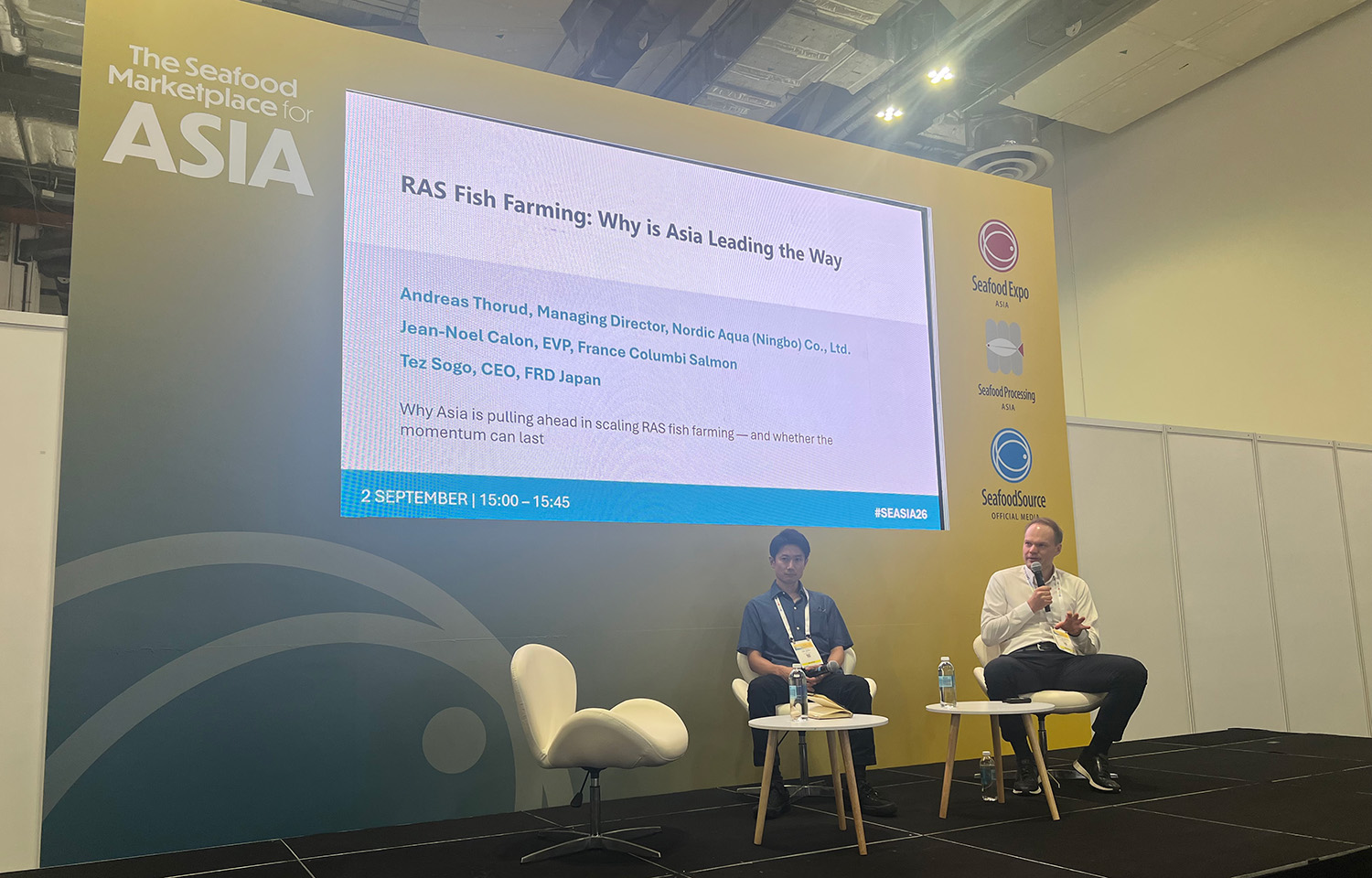
Across the world, land-based fish farms that employ recirculating aquaculture system (RAS) technology have struggled to consistently turn a profit, but according to panelists at the 2026 Seafood Expo Asia (SEA), taking place 2 to 4 September in Singapore, several components of operating a land-based RAS facility in Asia are helping place the continent at the forefront of the sector’s global push for scale.
Over the past few years, RAS farms in Asia have experienced operational success, with such firms as FRD Japan and Nordic Aqua recording strong biological results across several reporting periods at their facilities outside of Tokyo, Japan, and in Ningbo, China, respectively.
“We operated R&D test farming for years to ensure our system could farm fish without a problem, the fish is tasty, and we can get good prices for it,” FRD Japan CEO Tez Sogo said during the SEA panel “RAS Fish Farming: Why is Asia Leading the Way.”
Sogo explained that once FRD secured operational proof of concept over more than 20 generations of fish, it felt comfortable to begin commercially scaling and now sits at 3,500 tons of annual capacity. The firm has plans to scale again to 10,000 tons at its facility around 2028.
Following a similar trajectory, Nordic Aqua recently achieved capacity of 8,000 tons at its Ningbo farm, with its next phase of expansion set to widen capacity to 20,000 tons.
“What has been very encouraging for us is we have hit production targets through Phase 1 and Phase 2 [of expansion], and we know we can get good biological performance from the system,” Nordic Aqua Managing Director Andreas Thorud said.
With both firms poised to scale operationally, Sogo and Thorud emphasized that external factors like investors, governments, and consumers now need to align in order for either company to realize financial success.
In China, Thorud said government priorities align with the continued growth of land-based aquaculture.
“There is a push in China for modernization of aquaculture, self-sufficiency, and food security, and we are part of that broader picture, so we get a little bit of a tailwind there,” he said, adding that government priorities around sustainable energy also give RAS operations a preferential boost. “There has not been any governmental bottlenecks for us."
Jean-Noel Calon, the executive vice president for France at Columbi Salmon, contrasted that government support with the landscape in other markets like Europe and North America, where permitting processes can be arduous and combative. Columbi has plans to develop a RAS farm in Galicia, Spain, which represented a pivot for the firm after its planned Belgian RAS project had its building and environmental permits annulled by the nation’s government earlier this year.
“It can take a lot of time, a lot of effort, and a lot of money. Sometimes you have [a permit] after 18 months or two years, and then you don’t have it,” he said.
Sogo said the process is typically much simpler in Japan.
“In Japan, it’s relatively easy to get permission. One of the most difficult parts is wastewater regulations, but that’s just numbers. If you have a system in place, there’s no reason for the government to stop you. Usually it takes three to six months to get permission, which I believe is one reason there are a few large RAS operators in Japan,” he said.
Besides a lack of government support in such markets as Europe, Calon said projects in the U.S. and the E.U. also often face NGO pushback that can sway public opinion and delay or fully stop projects in their tracks, while Asian projects have not faced nearly as much public criticism.
With many external factors in their favor, as well as a solid operational foundation, Thorud said firms such as Nordic Aqua are ready to take advantage and hopefully begin turning a consistent profit.
“You need to have the market, the technology, the policy, and then your business case. You have to create stability in the market. You have to build those customer relationships, and then [customers] will start to like you and then buy. It’s a step-by-step process,” he said.
