

FRD Japan – one of four companies in the country working on large-scale, land-based recirculating aquaculture system (RAS) salmonid-farming projects in the country – is touting its energy-efficient system as it continues construction of its commercial-scale facility.
FRD, which focuses on rainbow trout production, said its land-based system avoids introducing wasted feed or fish feces into the ocean and does not create a concentration of sea lice or disease that can unintentionally transfer to wild fish in the same area. Additionally,
Additionally, by producing trout in a market in which it is legal to label trout as salmon, the company reduces the salmon industry’s carbon footprint by lowering the amount of Atlantic salmon being flown in from faraway markets – mainly Norway.
These types of sustainable measures have allowed the company to attain Aquaculture Stewardship Council (ASC) certification, despite the ASC issuing an update standard with more stringent feed traceability requirements. All but one Japan Fish Feed Association member have said they cannot meet the new standard, throwing into doubt the certification’s future prevalence in Japan.
Nevertheless, the company continues to prioritize sustainability in its output, which has a current production capacity of 30 metric tons (MT). Its first harvest and retail sales occurred in the summer of 2019, but the commercial-scale plant that is currently under construction will boost this total by another 3,500 MT annually starting in 2027.
Capital for the construction came from sales of new shares and loan agreements with several financial institutions generated through Japan’s Sustainable Blue Finance Framework, which promotes the financing of businesses that contribute to marine conservation and sustainable fisheries.
Even as its facility remains under construction, the company has been promoting its “Okasodachi Salmon” brand trout through several campaigns.
Taking advantage of the company’s location near Tokyo, sales so far have been mainly to the city's Coop supermarkets, with a heavy marketing focus on the products’ sustainability.
In August, certain 7-Eleven stores promoted a product made with Okasodachi Salmon as part of the convenience store chain’s Mirai Deli product series, which features food items such as tank-farmed fish that it promotes as “sustainable.” A month later, the company announced that the Kurkku Fields farm and park – a 74-acre sustainable farm and outdoor art museum in Chiba – would offer several salmon dishes featuring Okasodachi Salmon.
The company expects more partnerships like these to crop up as production continues to grow.
“There will be big additional sales campaigns when the harvesting of the commercial plant starts,” FRD Japan Head of Business Development and Marketing Chihiro Miyagawa said.
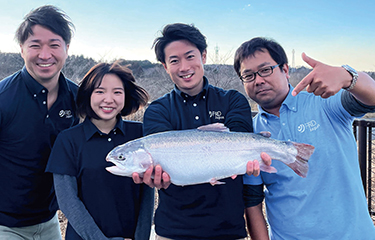
Photo courtesy of FRD Japan
