


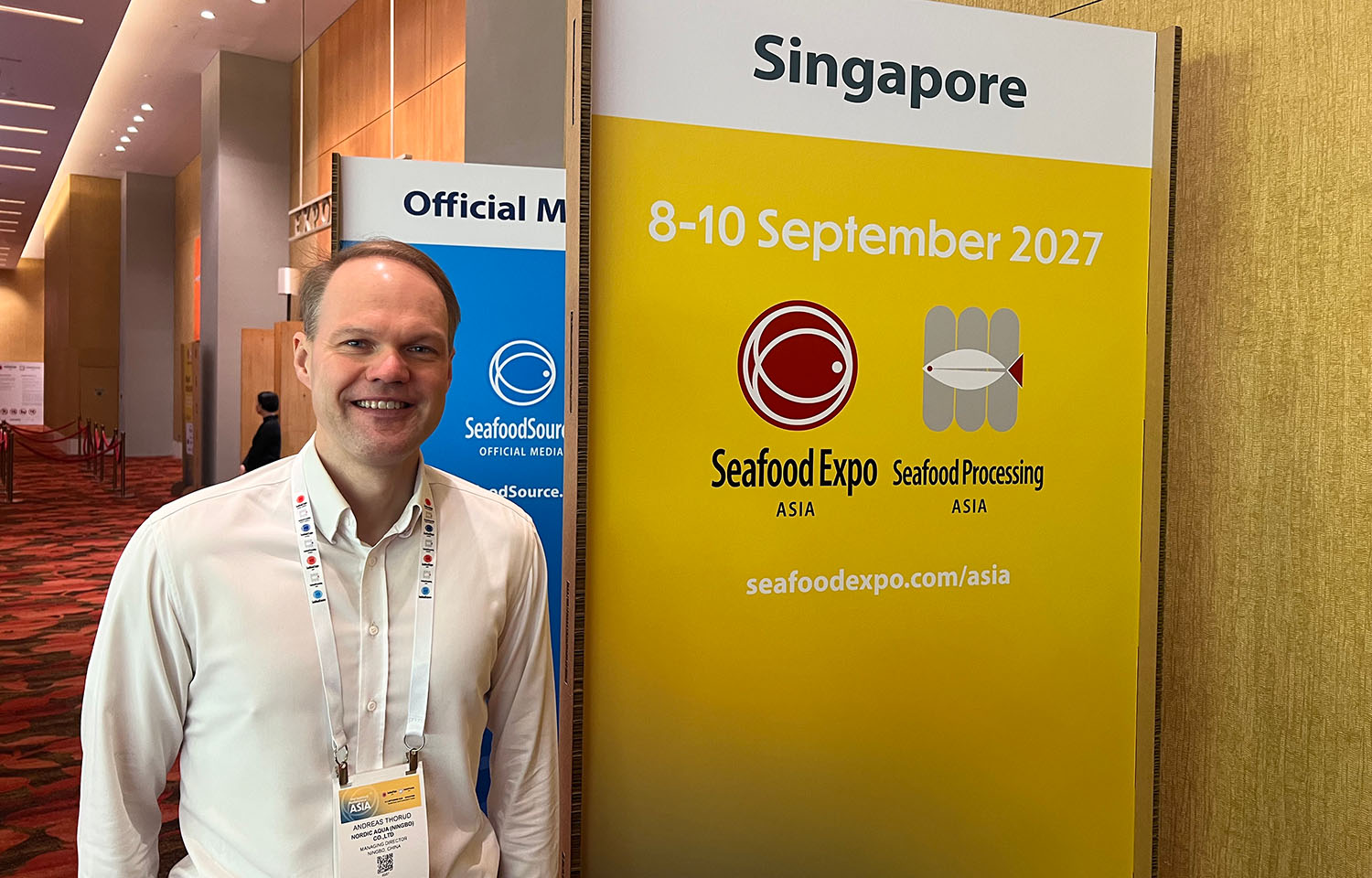
Oslo, Norway-based fish-farming firm Nordic Aqua recently reached full production capacity on Phase 2 of its land-based salmon facility in Ningbo, China.
According to Nordic Aqua Managing Director Andreas Thorud, the achievement now places the recirculating aquaculture system (RAS) project at an inflection point.
Phase 3 of the project envisions raising production capacity to 20,000 metric tons (MT), which would more than double Phase 2’s full run-rate of 8,000 MT.
Operationally, Thorud said the project has proven it can produce steady results, with the firm having now achieved satisfactory harvest volumes, mortality rates, and superior share over multiple reporting periods.
“We have shown that from Phase 1 to Phase 2, we have a proven facility in terms of production volume,” he told SeafoodSource at the 2026 Seafood Expo Asia (SEA), which took place 2 to 4 September at the Sands Expo and Convention Center in Singapore.
As a result, Thorud said the Ningbo facility has built a strong operational business case but cautioned that core farming operations comprise just one component of an overall investment decision on the project’s next phase, which he said would likely come by the end of 2026.
Another component is consumer acceptance.
While China has become a top export destination for salmon and consumers are increasingly recognizing and buying the species, Thorud said these trends don’t automatically result in a boon for Nordic Aqua.
“People think of it like, ‘China is huge, so the market has to be huge,’ but attitudes toward domestically produced products have shifted a lot over the past few years. At the end of the day, a Chinese consumer is concerned about the quality of a product and how it fits their needs,” he said, explaining that with salmon, these perceptions might result in preference for Norwegian imports over locally produced fish. “We hope that being a localized producer with Norwegian heritage and technology [might sway consumers]. You have Disneyland in Shanghai. It’s still authentic Disney.”
Thorud said Nordic Aqua may also be able to sway consumers by communicating the food safety of its products in marketing efforts, as Chinese shoppers can have a tendency to question the safety of local products.
“We don’t use any antibiotics. We are not plagued with common diseases that can be found in farmed salmon. We want to be more downstream, and that resonates with the local buyer. So far, the feedback we have heard is very encouraging, and we are just going to continue focusing on being a reliable supplier,” he said.
At this year’s SEA, Thorud said Nordic Aqua was exploring possible business opportunities outside of China, and he said the firm has drawn some interest from neighboring nations. But, the bulk of supply, even with a significant ramp-up, would likely continue to be absorbed by the Chinese market.
Another component that factors into a Phase 3 investment decision is costs.
Land-based aquaculture operations around the globe have struggled to turn a profit, and runaway costs have been a primary reason.
“RAS is not a net-pen with a roof; it is a profoundly different production system,” aquaculture consultant Alan Cook, who previously worked as a managing director at Mowi and executive at New Zealand King Salmon, said in a LinkedIn blog post late last year, pointing out that equipment can depreciate in value much quicker than traditional farming methods. “Civil works (concrete tanks, foundations) may last decades, but the heart of a RAS facility – the machinery that keeps the fish alive – does not.”
Thorud said Nordic Aqua has been able to keep costs relatively lower than other land-based operations, especially recently.
“There are two sides of it: operational and capex. On the capex side, we delivered Phase 2 under the original forecast of EUR 77 million [USD 89.3 million] at EUR 65 million [USD 75.4 million]. It took good project management, and that demonstrated we could deliver something under budget,” Thorud said. “Our recent Q2 results saw our farming costs also come down. That was due to good production and [showed] we could spread fixed costs over a bigger volume.”
Nordic Aqua, like all other salmon firms, is also at the mercy of global prices.
“We were somewhat surprised that prices of salmon in the first half of [2026] were somewhat depressed compared to the outlook, which was reflected in our financial achievements,” Thorud said. “Two years back, this would have been a different story.”
Thorud said that while awaiting an investment decision, Nordic employees in Ningbo will continue to control what they can, and he expressed optimism that Phase 3 will receive a vote of confidence.
“We’re at the right time, in the right market, with the right product to some extent. We feel comfortable with that,” he said. “It’s very exciting.”
