



Companies across the global aquaculture industry are adapting to changes in fishmeal and fish oil supply and adjusting their feed mixes accordingly.
At the same time companies are making these changes, the sector does not have the comprehensive environmental data it needs to accurately measure sustainability and avoid any unintended consequences associated with making ingredient substitutions, according to Cargill Animal Nutrition and Health Director of Sustainability for Aqua Nutrition Dave Robb and IFFO Technical Director Brett Glencross.
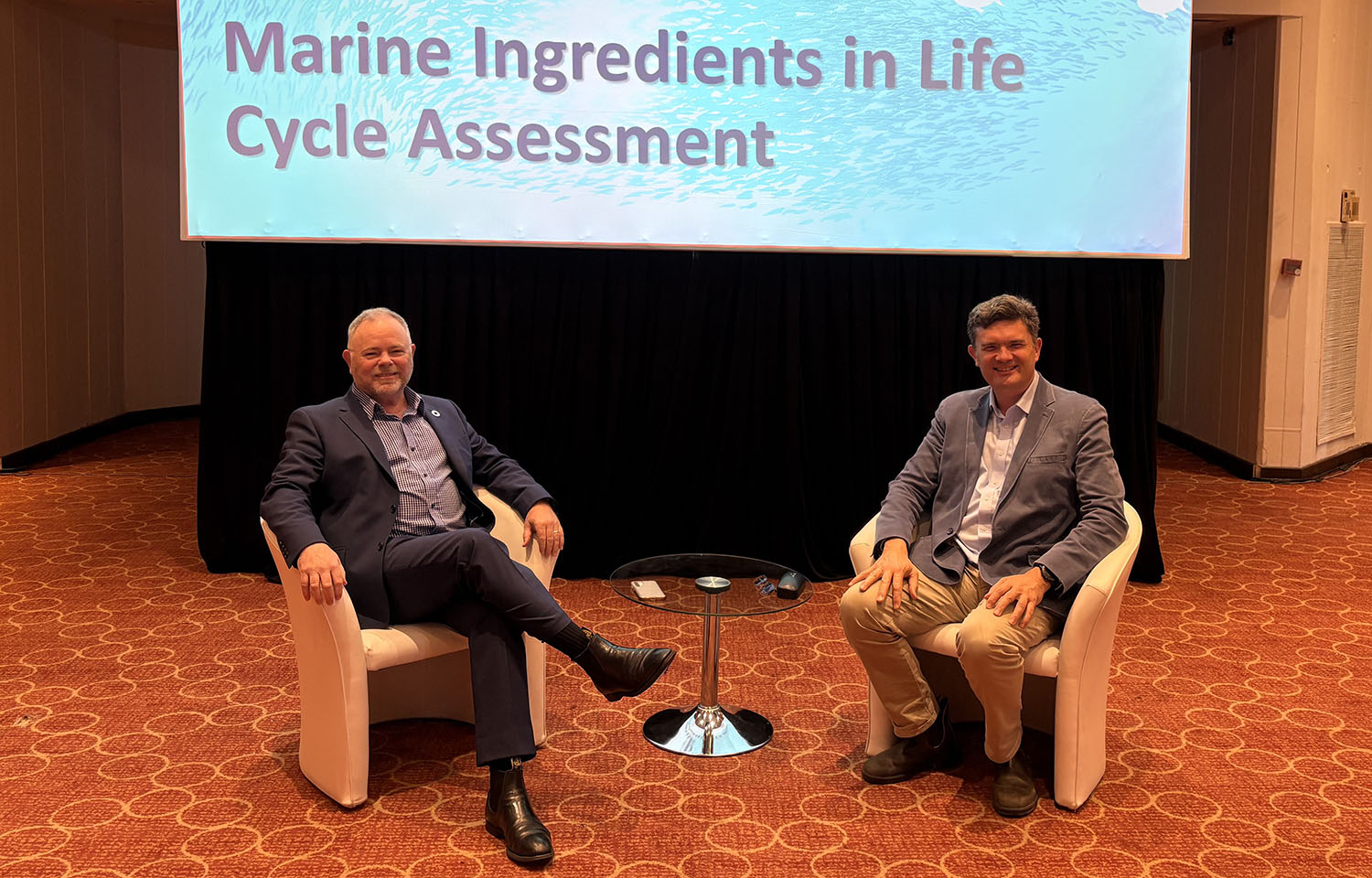
Speaking at the IFFO’s Annual Conference, held this year in Buenos Aires, Argentina, from 19 to 21 October, the two experts led an event entitled “IFFO Showcase: Marine Ingredients footprint in GFLI’s Life Cycle Assessment (LCA) database.”
The event covered the aquaculture industry's work in improving LCA methodologies and data for feed ingredients, with Robb and Glencross insisting that such sustainability assessments must consider the environmental footprint of feed formulations as a whole, rather than focusing on individual ingredients.
“Sustainability underpins the license to play,” Robb said, describing how environmental stewardship has become an increasingly important expectation for aquaculture operations.
That expectation, according to Robb, extends beyond the feed mill to encompass the entire value chain – from raw material sourcing and feed production to farm performance and the final sale of farmed seafood to an end consumer.
Sustainability discussions around aquafeed have typically focused on the use of traditional fishmeal and fish oil sources; however, many manufacturers have reduced their reliance on marine ingredients and increasingly turned to plant-based alternatives, which can raise other concerns such as deforestation associated with certain soy supply chains, for instance.
“We were going in blind,” Glencross said, referencing the period in which the industry began its transition toward alternative feed ingredients.
The speakers pointed to research examining changes in European aquaculture production and feed composition between 2000 and 2020. During that 20-year period, European aquaculture production more than doubled, while the composition of feed changed substantially.
By 2020, marine ingredients accounted for approximately 20 percent of feed, while plant products made up nearly 75 percent, according to figures presented during the presentation.
Although the absolute volume of fishmeal and fish oil used declined over the period, other environmental indicators moved in the opposite direction. The research found that the carbon footprint of feed production increased approximately fourfold, land-use footprint increased around eightfold, and water consumption rose approximately threefold.
The findings, according to Robb and Glencross, demonstrate the limitations of evaluating feed sustainability through a single metric, such as the fish-in-fish-out (FIFO) ratio or fishery forage dependency ratio (FFDR).
“The unintended consequences and the trade-offs that weren't being watched [resulted from concentrating on one measure],” Glencross said.
Robb argued that feed manufacturers must now assess ingredients collectively because any formulation changes involve more than simply replacing one raw material with another. Nutritional requirements, for example, must still be met, often requiring several ingredients to be adjusted, and as such, a change that reduces one ingredient could alter the environmental footprint of the entire formulation, as well as its cost and nutritional performance.
The speakers advocated a more holistic approach that considers how ingredient choices affect both the value chain’s environmental footprint and the efficiency of producing a final product. So, a feed that costs slightly more but improves fish health and growth could actually lower production costs, they said.
Robb and Glencross proposed a LCA framework covering five stages – fishing, transferring fish from vessels to shore, processing, transferring material to rendering facilities, and rendering – with the caveat that not every supply chain includes all five stages, making it important to account for differences between production systems.
The researchers compiled 370 unique datasets, defined by species, raw material type, and year. The information included production volumes, processing yields, energy use, and water consumption, among other parameters, finding that the calculated footprint of ingredients derived from processing byproducts could be substantially lower than that of ingredients produced from whole fish.
Through this example, Robb and Glencross aimed to provide a more complete picture of aquafeed sustainability, allowing the industry to compare alternatives, understand trade-offs, and identify reductions in environmental impact – all to meet growing expectations and demonstrate responsible production.
Though a LCA is not a perfect system, as the science still has gaps and accessible data can be outdated and lack nuance, Glencross said it is currently the best available structured, quantitative approach for evaluating environmental performance and tracking improvements.
Therefore, obtaining more accurate data, he said, can change how ingredients are evaluated and enable more informed decisions about sourcing and formulation.
