


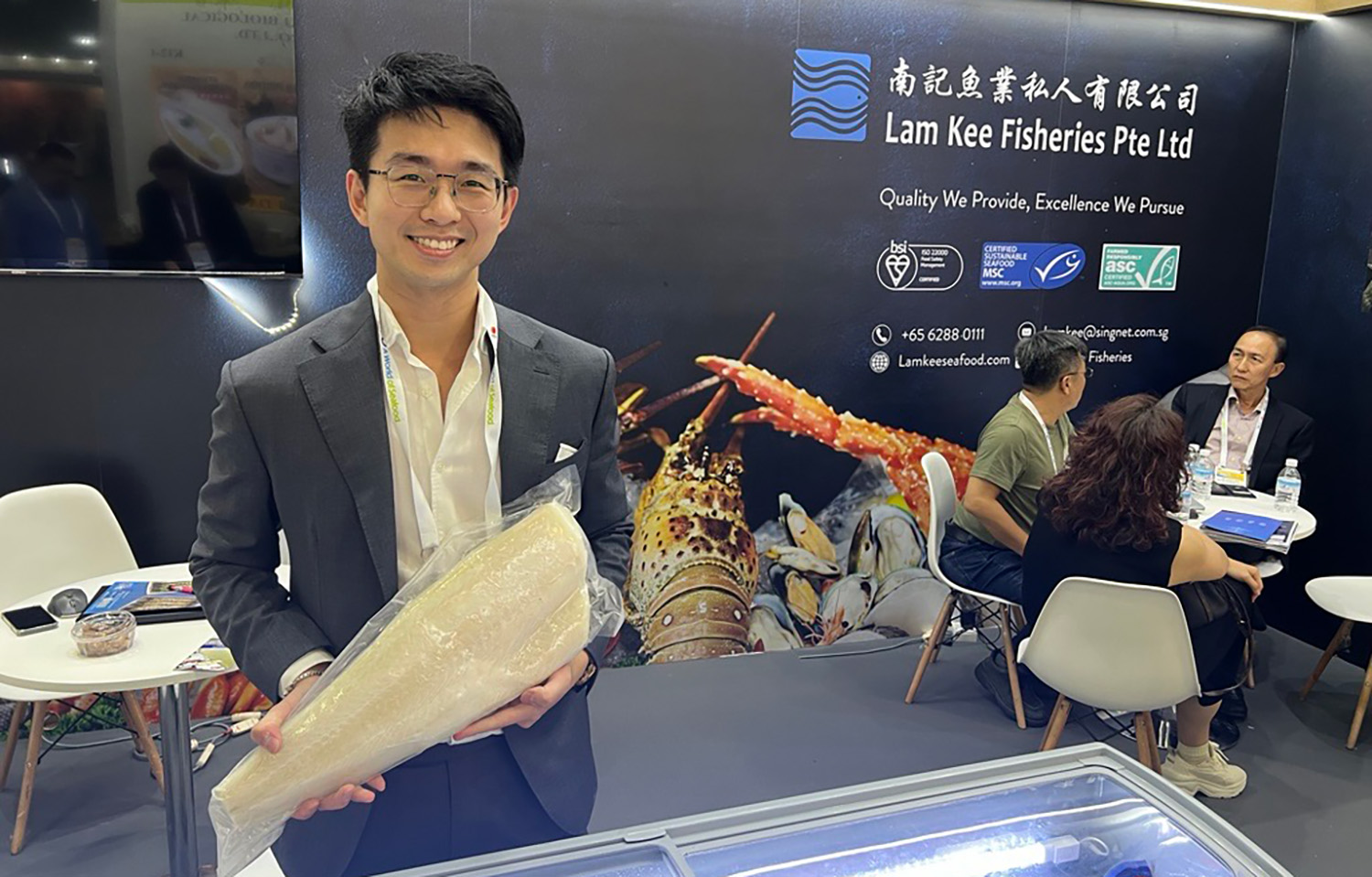
Singaporean seafood import/export firm and wholesaler Lam Kee Fisheries has adapted to shifting trends several times over its multiple decades in operation.
Starting as a live seafood trader supplying to hotels and restaurants in Singapore, the company has evolved to become a trading firm providing global export markets with a wide array of species, ranging from staple fish like Chilean sea bass and black cod to more niche offerings like sashimi-grade scallops and surf clams.
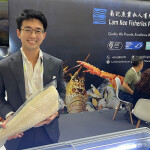
“The firm was started by my grandfather in the 1950s, and we were one of the first few companies to do live seafood trading in Singapore,” Lam Kee Business Development Manager Royston Chew told SeafoodSource at the 2026 Seafood Expo Asia (SEA) in Singapore. “Progressively, we moved from fresh to frozen seafood, and my dad, [Lam Kee Managing Director Chew Kim Koon], decided to focus more on exports.”
That innovation has continued as consumption trends shift, with Chew emphasizing the fact that the firm is increasingly trying to take core species and develop value-added products that align with changing consumer preferences for flavor and convenience.
“We are still focusing on the core product, but what we see is increasing demand for ready-to-cook or marinated products, with people preferring convenience, especially the younger generation,” Chew said. “We are trying to penetrate a market to provide convenience by launching items such as miso kombu salmon portions that’s very quick and easy.”
Other ready-to-cook items the firm has developed include its Snow Treasures Miso-Marinated Cod Cube, which won first place at last year’s Seafood Excellence Asia competition.
“We have always been trying to experiment with the sources or getting the correct, ideal formulations,” Lam Kee Head of Sales and Marketing Jansen Chew told SeafoodSource at last year’s SEA. “It was really a lot of formulation and making sure the taste was suitable for the Asian market.”
For this year’s show, Lam Kee had its Japanese Curry Cod product on display, which took home second-place honors.
“We cut the cod into cube size, and it comes boneless. Consumers can air fry at 200 degrees for 10 minutes, and it’s ready to serve. That got us second place, so I think that shows it’s a pretty good flavor,” Chew said.
The firm’s constant adaptation has helped it weather various headwinds.
Recently, Chew highlighted that climate change has affected the sourcing of such species as Japanese scallops, especially in sizes desirable to restaurants and other buyers.
“Suppliers have been telling us that certain sizes are just not there,” he said. “We fear restaurants may have to take it off their menus because it’s too expensive.”
Additionally, Lam Kee’s home market of Singapore has seen its HoReCa industry face pressure from cautious local spending, among other factors.
“Singaporeans head to Malaysia for holiday and to buy groceries. They go there for one day, everything is half-priced, and it takes one hour to get there. It is affecting our economy quite substantially,” Chew said.
Despite these issues, Chew said he is confident Lam Kee will be able to adapt, just as it always has.
“A key thing about Lam Kee is I believe we adapt quite well to the changing market. We have always looked to changing trends, even if the entire market has not caught up quite yet,” Chew said.
