



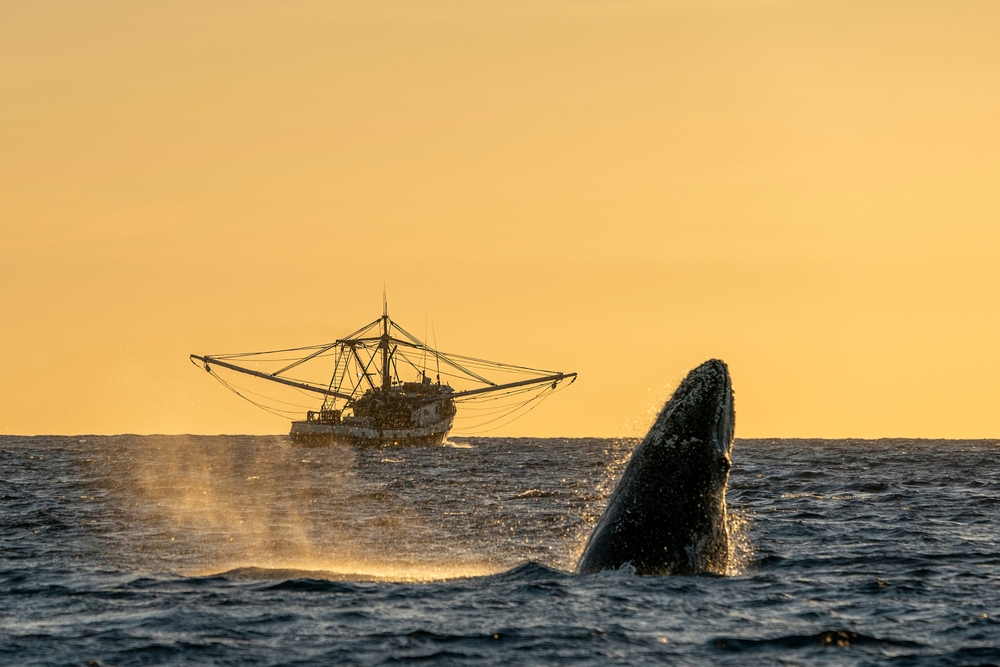
NOAA Fisheries recently said a law requiring it to ban imports from foreign fisheries that don’t align with U.S. marine mammal protections has been a useful tool in reducing bycatch but admitted it is very difficult to execute.
The Marine Mammal Protection Act (MMPA) has long required U.S. commercial fishers to take steps to reduce marine mammal bycatch, but a similar requirement to ban imports from foreign fisheries that do not take action to reduce marine mammal bycatch has not been consistently enforced. Amid growing pressure from conservation groups, in 2016, NOAA Fisheries finalized a rule laying out how it would assess those foreign fisheries. Under the rule, NOAA Fisheries would conduct a comparability finding for every single foreign fishery to ensure it met U.S. standards for protecting marine mammals and reducing bycatch. Those denied a comparability finding would be banned from exporting their products to U.S. markets.
Now, less than a year after issuing its first round of comparability findings, NOAA Fisheries is seeking public input on how to revise the program, arguing that the findings are much more difficult to complete than originally assumed.
“NMFS' implementation experience indicates that the MMPA import provisions framework is an important tool that can be used to encourage harvesting nations to implement more effective measures to reduce marine mammal bycatch but that administering the program at the scale required by the current regulations is resource-intensive and operationally complex,” the agency said in a 29 July post on the Federal Register. “As [NOAA Fisheries] moved from developing to implementing the regulatory framework, completing the first full round of comparability findings proved to be significantly more complex and time-intensive than [NOAA Fisheries] anticipated when the final rule was promulgated.”
Concern over the massive workload required to complete thousands of comparability reports isn’t new; NOAA Fisheries has argued as much for years. The agency repeatedly pushed back the deadline for issuing MMPA comparability findings for years, claiming that it needed more time to review more than 2,500 foreign fisheries. The rule for foreign fishery imports was finalized in 2016, with a five-year exemption period to allow other nations to come into compliance with the new requirements. However, five years proved to be too short of a time to launch the initiative; that exemption period was ultimately extended three times, with the final deadline set for 31 December 2025.
In 2024, a group of conservation organizations frustrated by the delays sued NOAA Fisheries in the hopes that a court would force the agency to finally complete and issue those comparability findings and prevent any more extensions.
“The MMPA sets a strong international standard for preventing bycatch, but the U.S. has been ignoring it and abandoning the iconic ocean animals it’s supposed to protect for more than half a century,” Center for Biological Diversity (CBD) Oceans Legal Director Kristen Monsell said at the time. “Whales and dolphins being caught in fishing nets around the world can’t afford any more delays. It’s long past time for the federal government to stop dragging its feet and start banning seafood imports from countries harming too many marine mammals.”
NOAA Fisheries finally released its first full slate of comparability findings in August 2025, denying 240 fisheries from 46 nations.
According to a 29 July 2026 post, completing all those findings was a massive endeavor.
“For each of these fisheries, [NOAA Fisheries] evaluated multiple, detailed conditions for each comparability finding as outlined in [the 2016 rule], a task complicated by vastly different legal systems, institutional capacities, monitoring programs, bycatch reduction strategies, and data availability among the harvesting nations. This required [NOAA Fisheries] to review massive volumes of documentation, conduct extensive follow-up engagement with harvesting nations to clarify its understanding of the harvesting nations' regulatory programs, resolve inconsistencies, and prepare fishery-specific determinations for publication. Including several extensions to the exemption period, the first comparability finding review took NMFS more than three years to complete,” the agency reported.
Reactions to the comparability findings have varied. Some countries that were denied comparability findings have since taken action to improve their fisheries regulations, reapplied, and secured a comparability finding. For instance, after being denied in 2025, Grenada undertook a massive overhaul of its fisheries regulations, increasing penalties for violations, introducing new observer requirements, and authorizing the government to enact conservation regulations. In March 2026, NOAA Fisheries declared that Grenada could once more export its fisheries products to the U.S.
Nevertheless, conservation groups have again sued NOAA Fisheries, this time alleging that the agency was wrong to issue comparability findings to Argentina, Ecuador, India, Norway, Taiwan, Tunisia, the United Kingdom, and Vanuatu.
“The United States can save the lives of countless whales and dolphins getting caught in fishing gear around the world but only if it enforces the law,” CBD International Program Director Sarah Uhlemann said in a release. “This litigation should result in a seafood import ban for the eight nations, and the governments will have to crack down on deadly bycatch to get back into the lucrative U.S. seafood market.”
Now, NOAA Fisheries is seeking public comments on how it can improve its efficiency in carrying out the effort while still meeting the requirements laid out by the law.
One of the biggest challenges in carrying out the rule, according to NOAA Fisheries, is simply defining what U.S. standards should apply to a foreign fishery that operates under a different legal regime and isn’t fully analogous to any one domestic fishery.
“Defining ‘U.S. standards’ and what may be considered to be ‘comparable in effectiveness’ for a multitude of fisheries under a range of systems of governance presents an immense analytical hurdle,” the agency said, explaining it “has had to grapple with applying a dynamic and tailored domestic set of requirements in determining comparability consistently for thousands of diverse foreign fisheries.”
The five areas for feedback laid out by NOAA Fisheries include:
- Clarifying the term “U.S. standards” for purposes of issuing comparability findings;
- Better accounting for the diversity among harvesting nations' legal and regulatory programs and their capacity to develop and oversee bycatch reduction programs that could meet the requirements of the MMPA;
- Changing the procedures to improve administrative operations and efficiency;
- Ensuring fair and consistent application across exporting nations; and
- Ensuring a level playing field such that fisheries abide by marine mammal bycatch standards that are comparable in effectiveness to the U.S. regulatory program when introducing fish or fish products into the U.S. market.
The government is accepting public comments through 28 September.
