






Chilean government authorities have signed an agreement with representatives of AquaChile and Cooke Aquaculture to remove the companies’ concessions in national parks and adjacent areas, relocating them to spots that are not under environmental protection.
Removing salmon farms from protected areas has been a priority of Chile President Gabriel Boric since he took office in March 2022. In November of that year, Chile’s Undersecretary of Fisheries and Aquaculture (Subpesca) Julio Salas announced that AquaChile – Chile’s largest salmon farmer – was preparing to relocate the concessions it has in national parks. However, no concessions have relocated as of yet, which AquaChile chalked up to bureaucratic delays.
The agreement, though, represents a step forward and is the result of “intense intersectoral work” between the Chilean Ministry of Economy, Development, and Tourism; the Environment Ministry; Subpesca; the Armed Forces; and the two salmon farmers.
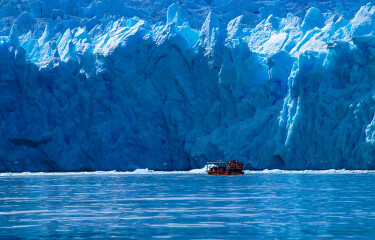
The parties have committed to prioritizing the relocation of nine aquaculture concessions that grant operation of aquaculture farms in or near Isla Magdalena, Laguna San Rafael, and Bernardo O’Higgins national parks, according to a release from the Environment Ministry. The concessions will move to places that are not listed under any defined protected area.
With this understanding, “three of the four national parks and adjacent areas in which industrial aquaculture activity still exists [in Chile] will be free of salmon farming, thanks to the commitment of two of the three companies that carry out their activities there,” the Environment Ministry said. No specific dates for such moves were reported.
The move also marks a step forward in the sector’s sustainable development and demonstrates that the relationship between government agencies and salmon companies need not be adversarial, according to Minister of the Environment Maisa Rojas.
“This protocol of agreement is a demonstration that we can sit at the same table to work together and that we can reach an agreement on common objectives. As a country, we need the industry to take decisive steps toward sustainability,” she said at the signing ceremony, in which the respective CEOs of AquaChile and Cooke Aquaculture Chile – Sady Delgado and Andrés Parodi – participated.
Other members of the Chilean seafood industry, including Arturo Clement – the president of the Chilean trade association SalmonChile – have also welcomed the move and stated that it did not come as a surprise.
“We’ve always held that we have to get out of the national parks. For the most part, that hasn’t happened because of state bureaucracy. Fortunately, we have been able to reach an agreement with the government for a couple of companies to leave the parks, but SalmonChile has always said that we as an industry shouldn’t be in the parks; if we’re there, it’s because the parks were formed after we obtained our concessions,” he told local broadcaster Emol TV.
Clement further clarified that the salmon industry is not asking for concession rules to be more permissive, just that they be modernized to provide clarity and certainty for the sector.
“Chile has a gigantic opportunity to continue developing the salmon aquaculture industry, but today, the number of hurdles and limitations we face don’t make this possible,” he said. “We have to have a conversation based on science and knowledge for everyone to have their space in the ocean and have a long-term outlook. Conservation is compatible with development.”
The Minister of Economy, Development and Tourism Nicolás Grau, said that the agreement satisfied that call for clarity and certainty.
“It reflects a path to follow, a path of dialogue, of public-private coordination, which allows us, on the one hand, to continue strengthening a very relevant economic sector – the salmon-farming sector and aquaculture in general – and, on the other hand, to protect the environment and, thus, find a balanced and sustainable development of this industry,” Grau said.
The first two aquaculture concessions that will relocate outside national parks are the Exploradores and Huillines 1 farming centers and belong to Cooke Aquaculture. These relocations have already been approved by the Undersecretariat of the Armed Forces.
Photo courtesy of Francisca Astudillo/Shutterstock
