






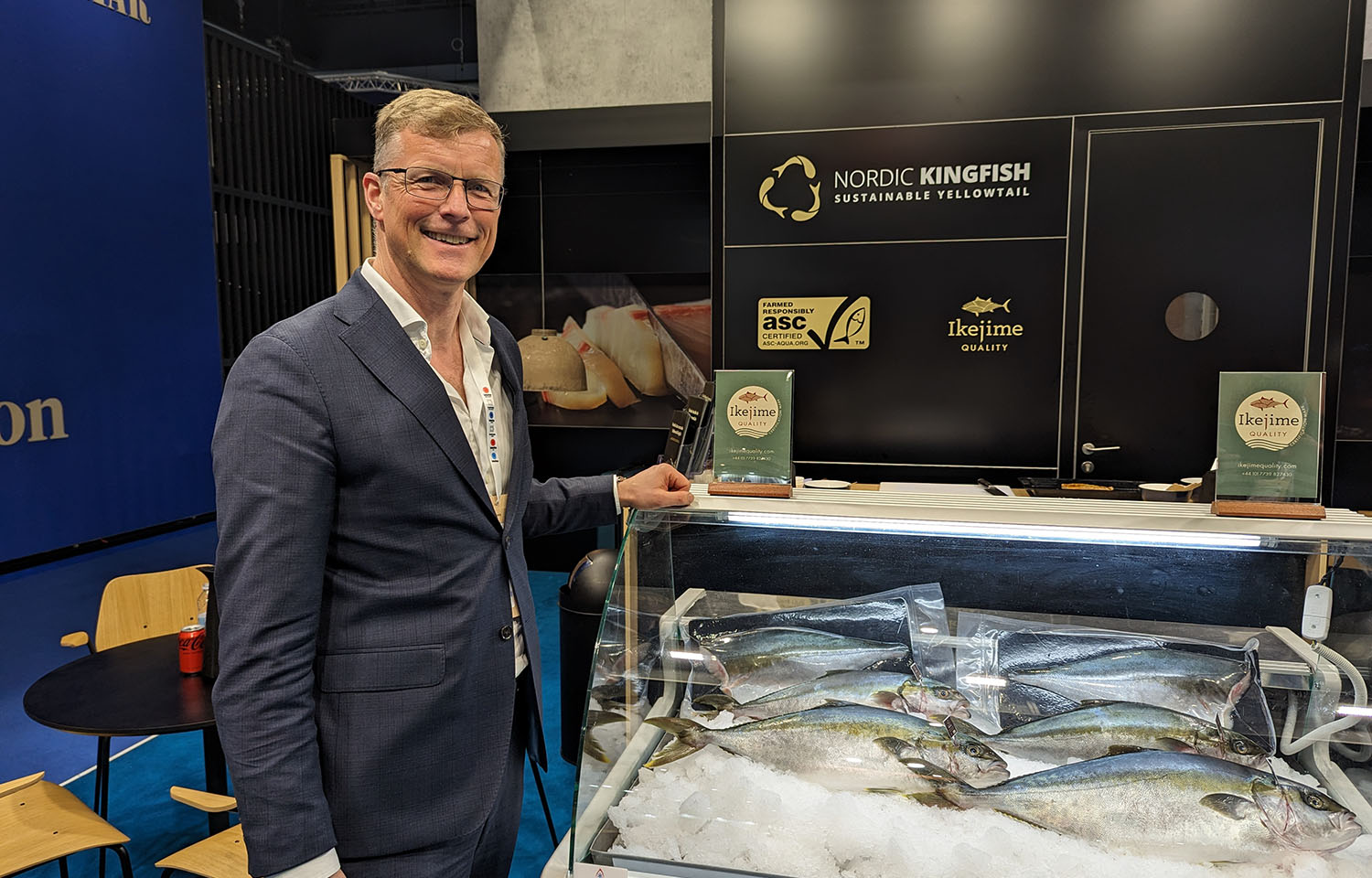
Nordic Aquafarms is seeing success with its pivot to yellowtail kingfish, as it nears steady-state production between its farms recirculating aquaculture system (RAS) facilities in Denmark and Norway.
The company, established in 2015, originally intended to farm salmon in a Norwegian RAS facility, Nordic Aquafarms CEO Bernt Olav Røttingsnes told SeafoodSource during Seafood Expo Global – which ran from 23 to 25 April in Barcelona, Spain.
“It took some time to be able to do that; the regulatory environment wasn’t ready,” Røttingsnes said.
As it was working to establish a salmon RAS, the company invested in both Sashimi Royal and Maximus –two Denmark-based yellowtail kingfish production companies.
Røttingsnes said Maximus had its own yellowtail broodstock, and Sashimi Royal was producing fully grown-out products.
Eventually, in 2019, Nordic Aquafarms began producing its own salmon, and at the time, the company was already producing yellowtail kingfish via the facilities in Denmark and an additional facility in Norway.
“We had some great results with the yellowtail. The production went well, and the demand was high; it was higher than we were able to supply,” Røttingsnes said.
The initial salmon production went well, too, but the issue with producing salmon in a RAS, Røttingsnes said, is that it needs to be at scale to be able to make a profit.
For Nordic Aquafarms, another issue with salmon production was its lack of control over its supply, as the company didn’t have its own broodstock or hatchery. Its yellowtail kingfish production, meanwhile, was controlled from egg to final production, and the company had full control over its own genetics.
“After three years of production on the salmon, we decided to combine the operations in Denmark and Norway,” Røttingsnes said. “It was a way of utilizing the resources we had in an even better way.”
The company fully acquired control of Sashimi Royal and Maximus in 2020 and announced the switchover to yellowtail in 2022.
“It was not because we didn’t make it with salmon; it was just because we control more of the process with yellowtail, and the yellowtail is sold at higher prices so you have a better margin per kilogram,” Røttingsnes said. “We were extremely happy with the salmon production. The quality was superb. This was mostly about the scale – 1,000, 1,200, or 1,500 metric tons of salmon is not enough.”
With salmon, the species’ current high prices is allowing for a RAS to be profitable, but relying on those high prices isn’t tenable, Røttingsnes said.
“I don’t think you can base your business on being able to have a premium on the land-based. It will end up costing more to establish that brand than you will get in return, and you have to believe that the salmon pricing will stay extremely high,” he said.
The company’s yellowtail operations, meanwhile, have been successful and the species' higher price point means it makes more sense for a RAS operation.
The Europe-based facilities are closing in on steady-state production, and Røttingsnes said they’re “weeks or months” from being profitable once the biomass of the more recently established yellowtail-farming facility in Fredrikstad – which was converted away from salmon in September – increases.
“We are approaching maximum biomass,” he said. “Six months from now, we are approaching what should be a steady-state production.”
As its European facilities approach profitability, the company is still working on its U.S.-based facilities. Røttingsnes said the company's project in California is progressing and will also farm kingfish.
He said he couldn’t comment on the plans for the company's other planned facility in Belfast, Maine, U.S.A. in the wake of a council decision that may jeopardize its viability.
“I cannot share anything on that. Let’s see how this develops. We still believe that this could be a really good project for Belfast,” Røttingsnes said.
He added that the company can continue developing its U.S.-based projects for years but will be focusing on its European operations for the time being.
"I think it’s time for us to really show that we can be successful at not just producing the fish but making money on it,” Røttingsnes said. “We are so close now; we are weeks ahead from being profitable. That’s our number one focus now.”
