






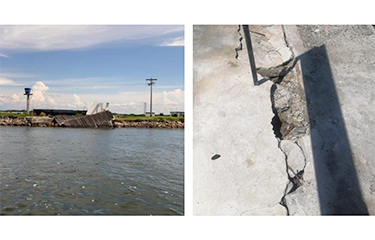
An earthquake that rocked Ecuador on 18 March has now been followed by several days of extreme rain and flooding that is expected to continue for several days, affecting the country’s multibillion-dollar shrimp sector.
The quake, which measured 6.5 on the Richter scale, caused the partial collapse of shrimp farms walls in the Bravito, Estero Huaylá, and Puerto Bolívar sectors, located in El Oro province. Ecuador’s National Chamber of Aquaculture (CNA) estimated damages in excess of USD 10 million (EUR 9.3 million). There were no casualties directly linked to the shrimp sector; However, national authorities reported 13 fatalities and more than 400 injuries across the country.
Torrential downpours began shortly after the quake, causing significant flooding and washing out bridges in El Oro and the neighboring province of Guayas, also home to large-scale shrimp-farming operations and Ecuador’s main port city of Guayaquil. The heavy rainfall shows no sign of letting up, according to the country’s national meteorological and hydrological institute, INAMHI.
“From the last days of March and during April 2023, an increase is expected in the frequency and intensity of rainfall in a large part of the nation, especially in the coastal region,” it said in a release. “There may be intense episodes of precipitation that may cause the monthly rainfall values for April 2023 to exceed their historical average.”
The heavy rainfall continued through the end of March, with some coastal areas getting 42 to 80 millimeters of rain per day. The rainfall had deadly consequences, with Al Jazeera reporting landslides that killed at least seven people.
“The expected scenario of rains responds to the persistent and abnormal warming of the sea surface off our coasts and to the unstable atmospheric conditions that favor the occurrence of rains,” INAMHI said.
According to CNA Executive President José Antonio Camposano, there are around 10,000 to 15,000 hectares of shrimp farms that have minor or considerable damage due to the extreme weather and recent earthquake. The Universidad Técnica de Machala estimates there are 210,000 hectares dedicated to shrimp farming across Ecuador, with 60 percent in Guayas province, 15 percent in El Oro province, 9 percent in Esmeraldas, 9 percent in Manabí, and 7 percent in Santa Elena.
“In the case of the pool walls, these are minor reconstruction processes, depending on the type of infrastructure they have at the shrimp farm,” Camposano said, outlining the damage in a video sent to SeafoodSource. “When the pumping stations are damaged, this is civil concrete work and when they are affected, that shrimp farm has to stop pumping and production for several weeks or months, depending on the impact. Once you stop a pool, you have to empty it to start the reconstruction and then you start counting the days of loss because the shrimp farmer works every day.”
The financial damage to the shrimp-farming sector may increase as production is halted to repair infrastructure, Camposano said. The industry is also suffering from welfare issues caused by the collapse of houses in shrimp-farming areas and other infrastructure used by farm workers.
As such, the damages have brought “an economic impact but it also has an important social overtone,” Camposano said.
The heavy rainfall may trigger further problems for the shrimp industry, particularly in slowing down transportation, an issue every winter in Ecuador, but one that is likely to be exacerbated by the extra precipitation, Camposano said.
“Attention is required from the local authorities in combination with the Ministry of Transportation to give immediate attention to main arteries and secondary roads that allow shrimp to be taken from the farm to the packing plants,” Camposano said. “This is serious because prior to the rains, we quantified the annual impact of USD 45 million [EUR 42 million] on the shrimp sector exclusively due to the fact of not having a first-rate highway that connects the city of Machala with Guayaquil, which are two shrimp-production and -processing poles. If you add to that delays due to the poor condition of the road and lack of maintenance, without a doubt the impact multiplies and you continue adding an additional cost to an activity that has to compete internationally with other countries.”
Camposano has complained about a lack of government support for the industry and has asked for additional investments in infrastructure and security. Ecuador's shrimp exports reached USD 6.6 billion (EUR 6.1 billion) in 2022, up from USD 5.08 billion (EUR 4.73 billion) in value in 2021 and USD 3.6 billion (EUR 3.3 billion), set in 2020. Ecuadorian shrimp producers also set a new volume record, harvesting 1.3 million metric tons in 2022, up 26 percent from the 843,681 MT of shrimp in 2021 and 675,852 MT in 2020.
Camposano said he expects just a small impact in the flow of shrimp exports from the latest natural disasters, but said the shrimp sector remains vulnerable to worse losses in the future without further government assistance.
"The shrimp zone is located in very low-lying, floodable areas, but they are areas where we have to operate because they are areas that we have historically used for production and we cannot move them,” he said. “Our sector is vulnerable to nature and that is why we are monitoring to activate [emergency response] with the Secretary of Risk Management, as we have done on previous occasions, firstly to provide assistance to the people who may be affected, and secondly, to try to coordinate aid in the case of infrastructure damage.”
An earthquake that hit Ecuador on 16 April, 2016, resulted in more than USD 150 million (EUR 140 million) in losses related to non-oil export products. Shrimp farmers in Manabí and Esmeraldas provinces, representing 8 to 10 percent of the country’s shrimp export volume at the time, were particularly affected According to CNA figures, the reactivation in these areas took several years and cost more than USD 40 million (EUR 37 million).
Photo courtesy of Ecuador’s National Chamber of Aquaculture
