






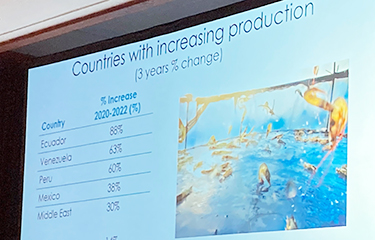
The future of farmed shrimp production is likely to center around South and Central America, according to Charoen Pokphand Foods Executive Vice President Robins McIntosh.
“And Ecuador is the star,” McIntosh said at the National Fisheries Institute's Global Seafood Markets Conference’s shrimp panel on Tuesday, 17 January in Palm Springs, California, U.S.A.
Ecuador’s vannamei production increased 88 percent by volume since 2020. It has risen to become the world’s top shrimp-farming country, with 1.3 million metric tons (MT) produced in 2022 – far above India and China, which are tied for second place with 800,000 metric tons in 2022. Ecuador produced 843,681 MT of shrimp in 2021 and 675,852 MT in 2020.
McIntosh, who has worked in shrimp farming and technology development since 1978, including stints in Brazil, Guatemala, Mexico, Belize, Myanmar, India, The Philippines, Thailand, and the United States, noted several South and Central American countries had hit significant increases in their shrimp production since 2020, including Venezuela, Peru, and Mexico. But he had singular praise for Ecuador and its unique approach to shrimp farming.
“No one can really copy what Ecuador is doing – only Ecuador can do Ecuador,” he said. “It's got resources that really you can't duplicate anywhere else, plus it has an industry that has developed since the 1970s, so much of the capital is already in it. And they’ve been able to change their dynamic around in ways that have been really beneficial.”
McIntosh referenced Ecuador’s efforts at technification, as the country’s shrimp firms have improved their genetics, added aerators and autofeeders, and added processing capabilities to meet the varied market demands of both China, which prefers head-on shrimp, and the United States, which prefers headless and value-added products.
“They've adapted very, very fast, and now they’ve got more and more products to sell. So I think the trend stays in place that Ecuador sends more shrimp to the U.S.,” he said. “It's a high-quality product, it's got a good story, and they're putting in the infrastructure and the service into the U.S.”
Ecuador reached USD 5.08 billion (EUR 4.56 billion) in shrimp export value in 2021, based off success diversifying to serve the world’s three biggest shrimp markets. Ecuador increased the share of its shrimp exports to the U.S. from 17 percent in 2020 to 22 percent in 2021, achieving a goal of diversifying away from China, which had accounted for 53 percent of its exports in 2020 but 46 percent in 2021. The European Union took 23 percent of Ecuador’s shrimp exports in 2021, up from 22 percent in 2020, according to Ecuador’s National Chamber of Aquaculture (CNA).
Global trends favor Ecuador’s continued dominance of the global shrimp market, according to McIntosh. China recently eliminated inspections of imported seafood for traces of Covid-19, which had resulted in numerous bans on individual Ecuadorian shrimp exporters and significant frustrations as hundreds of containers of shrimp were returned to Ecuador. And Ecuador is close to finalizing a free-trade agreement with China and, in August 2022, signed an agreement to facilitate growth of shrimp exports to the U.S. Not to mention its increasingly favorable position when it comes to shipping costs to the U.S. compared to its competition in Asia.
Even with the surprising move in December 2022 by Ecuadorian President Guillermo Lasso to eliminate a diesel fuel subsidy for the country’s largest shrimp farms, McIntosh predicted Ecuador will remain the dominant producer in 2023.
Amidst a backdrop of global oversupply and lower prices being paid to farmers, McIntosh prognosticated a leveling off of Ecuador’s shrimp production in 2023. But that will be contingent upon how Ecuador’s shrimp sector chooses to play the market, McIntosh said.
“Ecuador is in the driver's seat right now,” McIntosh said. “Unless they unless they drive their car off the road, they're a good position.”
Photo courtesy of Cliff White/SeafoodSource
