


Planning continues on a project that could provide a way forward for Canada’s land-based aquaculture industry.
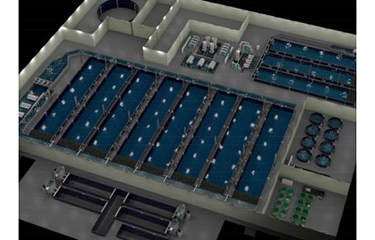
Gold River Aquafarms is seeking to build a recirculating aquaculture system (RAS) facility on the site of a former sawmill in the village of Gold River, British Columbia, to produce steelhead trout.
Planning for the project began three years ago, when the company submitted permit applications to federal and provincial authorities. To date, the company has received the go-ahead from Canada’s Department of Fisheries and Oceans, and is currently waiting approvals for provincial water and effluent permits.
“The regulatory piece is still up in the air, but not critically,” he said.
The other piece to the puzzle is financial – a commonality among companies seeking to construct viable RAS operations in North America.
“Atlantic Sapphire has had some pains and the investment world has gone from bullish to slightly bullish,” Walker said.
Because RAS farming is still a nascent industry, there’s little for investors to compare a project to, Walker said.
“Investors who are unsophisticated in the RAS world, they have an unease because they don’t have the experience. It is something new to them,” Walker said. “They believe in this, but they have a huge responsibility. There are risks they need to consider.”
Even with a challenging investment climate, Walker said the farm's proposed location on the site of a former sawmill provides several benefits that could convince would-be investors to jump onboard.
“What’s left is a couple of substantial warehouses and deep concrete floors,” he said. “This is an ideal situation for us, which will save us a pile [of money] on infrastructure costs.”
An additional selling point Walker cited for his project is an offtake agreement the company has in place with a Vancouver distributor to take all of the farm's production.
Walker said if all goes according to plan, Gold River Aquafarms will be in a position to break ground in Q3 2023.
The project is taking off as B.C.’s wild salmon fisheries are feared to be facing commerical collapse due to poor runs, and while the future of open net-pen fish farming in the province is being debated.
It’s a shift that could play into Gold River’s plans.
University of British Columbia Professor Colin J. Brauner has been researching how to create the best conditions to rear fish in RAS environments. Despite recent advances, he said land-based farming still has a number of challenges to overcome before its gains widespread acceptance from investors and the broader seafoo industry. With higher start-up costs in RAS operations compared to open net-pen farming, his research aims to improve profit margins that could make projects like Gold River more viable.
“What we've been working on is trying to define optimal conditions for rearing fish with the idea that, if you can rear fish as economically as possible, than you're more likely to be able to find ... that economically-viable solution,” he said.
One area identified by Brauner where RAS has an advantage over open net-pen aquaculture is a farm's monitoring environmental footprint, as RAS facility operators can fully observe and control waste produced at the farm.
“Anything that leaves could be treated sort of as sewage and reduce impacts on the environment,” he said. “That way you have more control potentially of disease and things like that.”
That ability to tightly control the environment of an RAS facility is a point spurred the launch of Gold River Aquafarms, Walker said.
“Our reason for being land-based is risk management,” he said. “Ocean management is risky, it’s dangerous, and there are a lot of unknowns. The more we can control our environment, the better.”
Another factor playing into Gold River Aquafarms favor is its choice to farm steelhead trout. Walker said the decision aligned with feedback from some of B.C’s big-name chefs.
“Atlantic salmon is ubiquitous in the salmon world, its grown everywhere,” he said. “That means all the economies of scale have been realized so it’s not easy to compete with that.”
Steelhead trout has less competition globally, but still competes on price, Walker said.
“Our operations costs are roughly equivalent. It would still be a money-maker,” Walker said. “Why not do something different? We’ve never gotten to a point where there is too much steelhead.”
Image courtesy of Gold River Aquafarms
