


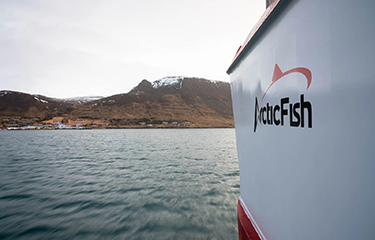
Ísafjörður, Iceland-based salmon-farming company Arctic Fish harvested just 100 metric tons (MT) of head-on gutted (HOG) fish in the second quarter of this year – a major drop from the 1,029 MT of HOG salmon harvested in the same period last year.
Because of the small volume harvested in the quarter, Q2 constituted a low-income period, with its operational revenue and other income totaling NOK 22.8 million (USD 2.1 million, EUR 2 million). In the same quarter last year, the company earned NOK 87 million (USD 8.2 million, EUR 7.6 million).
Its operational earnings before interest and taxes (EBIT) fell from NOK 35.8 million (USD 3.4 million, EUR 3.1 million) to a loss of NOK 2.3 million (USD 215,776, EUR 199,909), while its operational EBIT per kilogram dropped from NOK 34.82 (USD 3.27, EUR 3.03) to losses of NOK 23.11 (USD 2.17, EUR 2.01).
The company harvested 4,966 GWT of fish in the first six months of 2023, compared to the 5,250 MT the company harvested in H1 2022.
In its quarterly results, Arctic Fish, which previously sold its products through a “free carrier” sales agreement with Seaborn, a distributor of Icelandic and Norwegian salmon, said it plans a switch to selling through Mowi, which acquired a majority stake in the firm in November 2022.
“Routes have developed positively, and there is potential to enter new markets in the future efficiently,” the report stated.
Arctic Fish also announced it has shifted its harvesting operations to a new facility in Bolungarvík, a town in the northwest of the country. The Bolungarvík plant underwent testing at the end of Q2, with full operations starting in July. The company confirmed in its Q2 2023 report that the testing and kickoff operations had gone according to plan and that all salmon processing will take place at Bolungarvík from the third quarter onward. Arctic Fish said the facility has growth possibilities that may include future external service contracts with other farmers.
Arctic Fish’s Q2 2023 net financial losses totaled NOK 62.7 million (USD 5.9 million, EUR 5.4 million), compared to a loss of NOK 25 million (USD 2.3 million, EUR 2.2 million) a year previously. Its capital expenditure in the quarter amounted to NOK 104.4 million (USD 9.8 million, EUR 9.1 million), mainly relating to the new harvest facility.
At the end of the reporting period, total assets amounted to NOK 2.33 billion (USD 218.6 million, EUR 202.5 million), an increase of NOK 82.4 million (USD 7.7 million, EUR 7.2 million) from Q1 2023. Property, plant, and equipment valuation increased by NOK 80 million (USD 7.5 million, EUR 7 million), receivables decreased by NOK 93.7 million (USD 8.8 million, EUR 8.1 million), and on hand cash decreased by NOK 104 million (USD 9.8 million, EUR 9 million). The value of the firm’s biological assets and other inventories increased by NOK 173.6 million (USD 16.3 million, EUR 15.1 million).
Arctic Fish’s net interest-bearing debt increased by NOK 163 million (USD 15.3 million, EUR 14.2 million) from NOK 893 million (USD 83.8 million, EUR 77.7 million) at the end of the first quarter of 2023 to NOK 1.06 billion (USD 99.5 million, EUR 92.2 million) at the end of the second quarter.
Also in the latter quarter, the company added an additional farming license with a maximum allowable biomass (MAB) of 8,000 MT, with 5,200 MT of salmon and the remainder slated for trout.
Arctic Fish currently holds licenses for a production capacity of 27,100 MT MAB with additional applications for 4,800 MT MAB that it said it expects to receive in the near future. Existing licenses are split into 21,800 MT MAB of salmon and 5,300 MT MAB of trout licenses in Ísafjarðardjúp, the latter of which is in the process of being converted to salmon licenses later this year.
The company plans to harvest 14,500 MT in 2023, which would represent a 68 percent increase year over year from 2022. The report stated that the company is “very optimistic” on continuing strong market performance moving forward and believes that it can generate a healthy margin on sold quantities in the latter half of the year.
Its biomass at the end of the quarter totaled 9,194 MT in the sea, and the closing average weight was close to 1.7 kilograms, resulting in more fish and more biomass in the sea compared to Q1 2023.
Due to a planned ramp-up in its smolt production, Arctic Fish reported having 6.4 million fry and smolt at an average weight of 26.6 grams, compared to 6 million fry and smolt at an average weight of 28.8 grams in the same quarter last year.
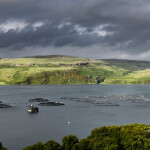
Arctic Fish’s seawater sites are strategically located in fjords on the west coast of Iceland, and the company also has a modern freshwater hatchery in Norðurbotn, which uses recirculating aquaculture system (RAS) technology. It also owns more than 36 square kilometers of land around its smolt facility, which it will use for the facility’s expansion.
Photo courtesy of Arctic Fish
