






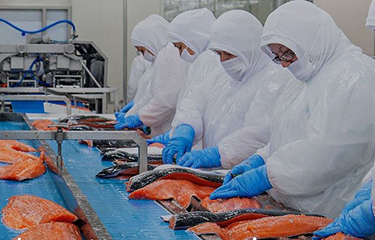
Chilean salmon-farming firm Australis Seafoods announced it will shutter its Torres del Paine processing plant, an action the company claims is directly due to the legal battle in which its owner – Chinese foodservice giant Joyvio – remains embroiled.
Joyvio accused the firm’s former owner Isidoro Quiroga and his inner circle of maliciously hiding information regarding salmon overproduction when the Chinese firm purchased Australis in 2018 for USD 921 million (EUR 872 million). In June of this year, Joyvio officially filed a USD 1.22 billion (EUR 1.16 billion) lawsuit against Quiroga.
Joyvio sustained CNY 1.1 billion (USD 150.5 million, EUR 142.5 million) in losses in 2022 and announced its plan to file suit against Quiroga in March 2023. The firm lost USD 33 million (EUR 31.2 million) in Chile alone in the first half of 2023 and has sought to cut costs through several actions, including staff reduction and renegotiation of debt, to respond to its trying situation.
The company said in a public statement released on 6 October that the closure of the plant is the latest consequence of the legal battle.
“This is a very sad situation and a difficult decision for everyone, but at the same time, it is one taken responsibly,” the company stated. “Since the end of 2022, the company has had to make very important adjustments to its operation and production levels.”
Australis purchased Pesquera Torres del Paine for USD 26.5 million (EUR 25.1 million) in 2019, when it announced it would use half of the salmon processing plant’s capacity of 40,000 metric tons (MT) per year for itself; the company subcontracted the remaining 20,000 MT to fellow salmon farmer Cermaq. At its peak, a reported 800 people worked at its facilities, but at the time of the latest announcement, only 200 workers remained.
“This firing of more than 200 people [due to the closure] is to be added to the numbers we’ve discussed before,” Francisca Rojas, general manager of the Magallanes Salmon Farmers Association, said on ITV Patagonia television, particularly emphasizing the concerning trends of falling production in the region. “There have been about 1,100 workers [in the Magallanes region] that have lost their jobs since December. This is a social, economic, and regional crisis that affects us as an industry, as a region, and as the Salmon Farmers Association.”
Recognizing these concerning trends and attempting to offer some relief, Australis said it would offer its affected workers outplacement services.
“We are aware that we are not facing an easy scenario, and so with the objective of supporting our workers, we have opened the possibility for them to receive labor reintegration [training], of which human resource specialists will be in charge,” the company stated.
However, Rojas and others are not buying the fact that this action will be to workers’ benefit.
“They [the workers] will be trained so that they can look for other sources of work, but unfortunately, due to this complicated situation where the industry is lowering its production, it won’t be possible to reincorporate them in the salmon industry,” Rojas countered. “That is a concern we have today.”
At the same time, Australis said it plans to concentrate its functioning processing operations in the Magallanes region into its new, modern Dumestre processing plant, located in the city of Puerto Natales, where Australis will be looking to fill about 300 jobs. Due to the level of the plant’s automation, most of those jobs will center around service and technical support areas, with minimal human intervention in the processing line.
The Dumestre plant – with a price tag of some USD 70 million (EUR 66.3 million) and processing capacity of over 71,000 MT a year – is wrapping up construction and will begin operations in December, Australis CEO Andrés Lyon told the Puerto Natales city council during an informational session.
Dumestre, Australis claims, will be the most technologically modern plant of its kind – wholly unique in both the collection and transferral of fish – and “in a couple of more months, we are going to have the Norwegians visiting this plant because they are going to want to copy it,” Lyon said.
The plant will be able to receive live salmon from wellboats through a 1,200-meter pipeline; alternatively, the plant will be able to receive fish from trucks at its four on-land, 1,000-cubic-meter recirculating seawater tanks. Following the slaughter and processing of the salmon, fresh whole fish will leave Dumestre for Brazil and the United States; frozen whole fish for Russia, the U.S., China, Korea, and Japan; and gutted fish for secondary processing plants in Magallanes or other regions.
“The advantage of having an integrated primary process is that it reduces traffic and container-transporting activity through the city,” Lyon said. “The fish will be unloaded directly from well boats to the tanks, and the trucks that circulate through the city will only have ice.”
Further, Dumestre is reportedly the only Chilean plant of its type that will incorporate biological treatment for wastewater.
Meanwhile, the company’s lawsuit is ongoing, and Australis has been working closely with Chile’s environmental authorities to right its historical infractions. Chile’s Superintendency of the Environment (SMA) accused Australis Seafoods of producing more than 85,000 metric tons (MT) of farmed Atlantic salmon beyond what its permits allowed between 2014 and 2022.
In response, Australis proposed more than 20 programs containing nearly 300 actions to compensate for its self-reported overproduction at a total cost of CLP 64 billion (USD 67.5 million, EUR 64 million).
Still, Australis remains hopeful that projects like Dumestre will help to lead the company through the troubling climate in which it finds itself.
“We are convinced that, thanks to the collaboration of many … we will be able to position Australis in its rightful place, dedicated to seeking efficiency, and, thus, continue to be a decisive contribution to development of the people and the regions in which we operate in our beloved south,” the company stated.
Photo courtesy of Australis Seafoods
