



The Kingfish Company reported it nearly doubled its sales and achieved higher prices in the third quarter of 2022.
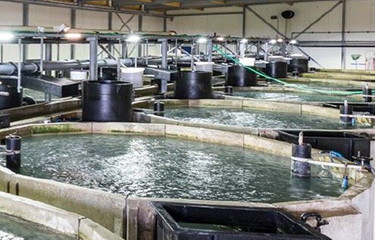
Its Q3 2022 sales reached EUR 5.4 million (USD 5.3 million), up from EUR 2.8 million (USD 2.7 million) in Q3 2021. All of its production – 374 tons, up from 334 tons in Q3 2021 – came from its recirculating aquaculture system farm in Kats, The Netherlands.
“This has resulted in a robust productivity index performance of 0.73 (net biomass growth per cubic meter capacity per day), representing an improvement of 11 percent compared to Q3 [20]21,” Kingfish Company CEO Ohad Maiman said in a press release.
The company achieved price increases for its fish, with its large fish selling for an average per kilogram whole-fish equivalent price of EUR 17.10 (USD 16.75), 25 percent higher year-over-year, and its small fish going for EUR 12.10 (USD 11.85) per kilo WFE, 14 percent more on average.
“The third quarter of 2022 was another solid quarter for The Kingfish Company, where we have stabilized at full capacity run-rate for phase one. We are now ready to launch capacity for phase two, which is nearing completion,” Maiman said. “We are pleased to report another quarter with strong sales growth, significant sales price increases, particularly for large fish, while achieving robust steady production and consistently high productivity.”
The Kingfish Company is currently in the process of expanding its Kats facility, which Maiman said has now been fully funded through a EUR 35 million (USD 34.2 million) equity raise – now fully subscribed and guaranteed for all three tranches – as well as its funding from its EUR 75 million (USD 74 million) debt facility from P Capital Partners, a new revolving credit facility of EUR 5 million (USD 4.9 million), and a new lease facility with an EUR 3.5 million (USD 3.4 million) framework. The combination of funding streams “is estimated to fully finance the phase two capex with a buffer,” Maiman said, with any leftover funds to be used for biomass build-up and corporate expenses.
“The Kingfish Company has reached full capacity run-rate in phase one [and] it has started the production of fingerlings for the pre-stocking of phase two,” Maiman said. “Phase two production is set to commence in early Q1 [20]23. The significant volume increase is expected to result in material improvements to unit economics, building on an already strong basis.”
Maiman confirmed The Kingfish Company’s effort to build a 8,500-metric-ton capacity farm planned for Jonesport, Maine, U.S.A., is advancing, with all state and federal permits secured and only permission from the Jonesport Planning Board remaining to be secured.
“From a legal and environmental standpoint, we are quite comfortable with the permits already secured. We're working closely with the town planning board, but with tailwind of the strong support of the local community. So we expect we might continue to see some challenges but we should be able to overcome them,” Maiman said on the company’s Q3 corporate earnings call.
Reflecting the company’s confidence it will soon be breaking ground on the farm, the company has shipped third-generation fingerlings to its U.S. hatchery to serve as future broodstock for the U.S. operation, Maiman said. However, Maiman previously told SeafoodSource the funding environment for new RAS projects has tightened in the past year.
Kingfish Company Chief Financial Officer Jean-Charles Valette said the company faced “significant cost increases” in Q3, especially for aquafeed and electricity, and that the company didn’t have a hedge in place for those costs, but that prices are normalizing in Q4. Electricity costs rose to EUR 400 (USD 390) per megawatt hour in Q3 but are now at around EUR 200 (USD 195) per MWh.
“We have a hedge in place for 2023 and also some hedging plays for 2024 to 2026 at very favorable conditions. So we hope that the bad months for electricity are now behind us and until the end of the year, it doesn’t go to go back to the very high levels … that we had, especially in August and September,” Valette said. “So far, our price increase has been very well offsetting the cost increase that we have encountered in Q3.”
Maiman said the company is now pursuing a healthy mix of foodservice and retail sales “optimized to specific markets,” after dealing with turbulence and a swing to retail sales in the midst of the COVID-19 pandemic.
“We’re trying to find where is the optimal return, while making sure that we limit exposure to a single channel,” Maiman said. “Some of the larger retail plans we have in the pipeline would require additional volume, so [will need to wait until] at least phase two, if not phase three.”
Photo courtesy of The Kingfish Company
