






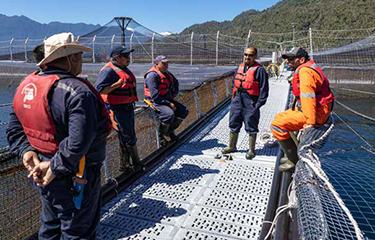
Puerto Montt, Chile-based salmon farmer Salmones Camanchaca increased its Atlantic salmon harvest to 17,760 metric tons (MT) in Q3 2023, a 24 percent year-over-year increase, but the jump in production was not enough to keep the company from falling into the red for the second straight quarter.
“This was a very challenging quarter due to the weakness of global demand and its effects on prices, added to costs that included higher prices of food inputs, inflation on [prices of] services, and outbreaks of SRS [salmonid rickettsial septicemia] and Caligus that hurt the costs of fish harvested from two centers,” Salmones Camanchaca Vice President Ricardo García Holtz said.
The higher harvest volume did not fully translate into higher sales during the period, and the company’s Atlantic salmon sales volumes totaled 11,311 MT whole-fish equivalent (WFE) in the period, slipping 3.4 percent year over year. The lower sales, coupled with the company selling off frozen products which reduced inventory rotation, resulted in the company accumulating an inventory of more than 9,000 MT WFEat the end of the quarter.
The inventory surplus and lower sales, coupled with a 12.9 percent decrease in Atlantic salmon sales prices, led to its third-quarter revenue falling 14.5 percent year over year to USD 83 million (EUR 76.1 million). Year to date, the company’s operating revenue has reached USD 259.3 million (EUR 236.9 million), a 5 percent decrease compared to the same period of 2022.
Cost of sales in Q3 2023, meanwhile, increased 10.5 percent year over year to USD 77.7 million (EUR 71.2 million), resulting in earnings before interest, taxes, depreciation, and amortization (EBITDA) before fair-value adjustments of just USD 2.9 million (EUR 2.6 million), an 88.6 percent drop from Q3 2022.
Net losses for Q3 2023 reached USD 5.49 million (EUR 5.03 million), compared to USD 18.5 million (EUR 16.9 million) in net profits for the same quarter in 2022.
The company added in its earning report that its EBIT per kilogram of Atlantic salmon fell to USD 0.05 (EUR 0.04), compared to USD 1.78 (EUR 1.62) per kilogram in Q3 2022.
Salmones Camanchaca did not harvest coho salmon during the period as it is not in season, but its coho sales volume jumped 307 percent when compared to last year, reaching 438 MT WFE.
However, the average price of its coho fell 24.3 percent during the quarter, dropping to USD 4.80 (EUR 4.40) per kilogram. The company attributed this to higher Chilean supply – Salmones Camanchaca itself said it still had inventories of over 1,000 MT – and a devaluation of the Japanese currency, which hurt profits as Japan is the main market for its coho.
The low price resulted in the company posting a negative EBIT per kilogram of coho salmon, with the company losing USD 0.54 (EUR 0.49) per kilogram of coho salmon in Q3 2023, down from Q3 2023, when it posted an EBIT per kilogram of USD 1.15 (EUR 1.05) for coho.
Looking forward, the company said its coho salmon smolt stocking in early 2023 will likely double its harvest volumes in the 2023-2024 season, which will begin in Q4 2023.
Despite the losses, García remained upbeat about Salmones Camanchaca’s performance, emphasizing the company’s “productive and commercial flexibility to focus on the most attractive formats and markets,” allowing for higher-than-market-average prices.
“Notwithstanding the challenges we have for the end of 2023, we are observing a good sanitary performance, somewhat less cost pressure for the harvests at the beginning of 2024, and better prices for the following months,” he said.
The company also saw an improvement in biological indicators in the quarter, with a 52 percent reduction in the use of antibiotics and 38 percent dip in the use of antiparasitics. However, the company did see slightly higher mortalities compared to Q3 2022, causing roughly USD 1 million (EUR 914,000) in costs in Q3 2023 compared to USD 600,000 (EUR 548,000) in Q3 2022.
“The main commercial objective is probably the sale of coho inventory, which we estimate will be larger at the conclusion of this season in January 2024, and on the production side, it’s verifying the benefits of mitigating measures for oceanographic incidents,” García said, referring to the algal blooms that typically affect Chile during the southern hemisphere summer due to increased temperatures and sunlight.
The company’s estimated Atlantic and coho salmon harvest volumes for 2023 are between 54,000 and 58,000 MT WFE, comprising between 44,000 and 46,000 MT WFE of Atlantic salmon and between 10,000 and 12,000 MT WFE of coho salmon.
Photo courtesy of Salmones Camanchaca
