






Biological challenges at farming sites hurt the operations of Shetland, Scotland-based Scottish Sea Farms in the second quarter of this year, negatively affecting harvest volume, average harvest size, and price achievement, according to reports from Lerøy Seafood Group, which operates the company as a joint venture with SalMar.
Lerøy CEO Henning Beltestad confirmed when presenting his firm’s Q2 2023 results that Scottish Sea Farms had experienced a “weak second quarter,” saying the company accrued high costs tending to sites with challenges stemming from the second half of 2022 that continued into this year. But Beltestad said the back half of this year should bring “gradual improvement” to Scottish Sea Farms.
“We still see some biological challenges going into Q3, but there are improvements in fish size and cost base. We expect we will have much better results going forward, and we also believe we know the cause of the performance at Scottish Sea Farms in these sites,” Beltestad said. “There have been challenges with some groups of fish which didn’t perform well in Shetland and the mainland, but we strongly believe this will be much better going forward.”
Scottish Sea Farms recorded a loss of NOK 65 million (USD 6.1 million, EUR 5.6 million) in Q2 2023, a stark reversal of the NOK 70 million (USD 6.6 million, EUR 6.1 million) in earnings it took in during Q2 2022. The company harvested just 6,325 metric tons (MT) of salmon in Q2, compared to 9,489 MT in Q2 2022. For the first six months of 2023, its harvest totaled 11,495 MT, compared with 17,329 MT in the first half of last year. The salmon producer has revised its harvest guidance for the year down to 27,000 MT, which, if realized, would be 30 percent lower than its 2022 totals.
Scottish Sea Farms’s quarterly revenue totaled NOK 692 million (USD 64.9 million, EUR 60.1 million), down from the NOK 884 million (USD 82.9 million, EUR 76.8 million) the company earned in Q2 2022. At the same time, its operational earnings before interest and taxes (EBIT) plummeted from NOK 190 million (USD 17.8 million, EUR 16.5 million) to a loss of NOK 144 million (USD 13.5 million, EUR 12.5 million).
To improve its performance and improve efficiency, Scottish Sea Farms has plans to modernize and consolidate its farming estate into a smaller number of sites with fewer but larger-sized pens.
Loch Nevis, one of the company’s longest-farmed locations, is next in line for a GBP 1.5 million (USD 1.9 million, EUR 1.8 million) upgrade. Two of the three farms at Loch Nevis – Nevis A and Nevis B – are undergoing modernization. The site originally had 12 80-meter circumference pens at each farm, but there will now be just five 120-meter pens, reducing the overall number of units from 36 to 10 while maintaining the same overall biomass.
Under recent permitted development rights (PDRs) rulings, the Scottish government confirmed that salmon farmers are now able to apply to increase pens to a maximum circumference of 200 meters.
The plan’s objective is to create more space between pens, increase water exchange and oxygen flow in and around farms, and, in turn, enhance growing conditions further. Additionally, with fewer pens for the farm teams to tend to and support vessels to get around, the new configuration should enhance operational efficiencies and response times. The project also aims to minimize the impact of environmental challenges that can occur at farms, such as the acute micro-jellyfish bloom event that affected Loch Nevis last autumn.
Scottish Sea Farms will stock both farms later this year.
Loch Nevis is the fourth of six such Scottish Sea Farm upgrades and consolidations to take place this farming year, following Fiunary in the Sound of Mull, Bring Head in Orkney, and Setterness South in Shetland, with Wyre and Swarta Skerry – both also in the Northern Isles – due for stocking soon. This will bring the total number of company modernization projects undertaken since 2021 to 14. Next up, in early 2024, the company will aim to modernize the farming sites of Kishorn North, South, and West, as well as Summer Isles and Toyness.
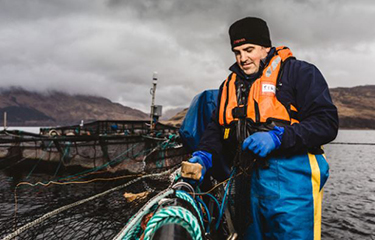
Photo courtesy of Scottish Sea Farms
