


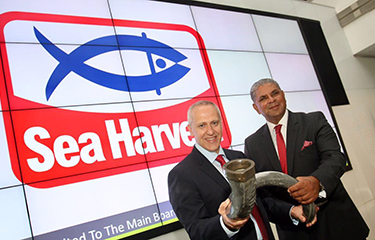
Sea Harvest Group achieved higher revenue in the first half of 2023.
The Cape Town, South Africa-based seafood company reported an 18 percent year over year increase in revenue for the first half of 2023. Revenues for the six months ending 30 June, 2023, totaled ZAR 3.2 billion (USD 170.1 million, EUR 159.7 million), compared to ZAR 2.7 billion (USD 143.7 million, EUR 134.9 million) earned in the same period a year prior, according to an unaudited financial report approved for release to shareholders by Sea Harvest CEO Felix Ratheb and the firm’s chairperson, Frederick Robertson.
Sea Harvest reported a 23 percent year-over-year surge in its earnings before interest and taxes (EBIT), totaling ZAR 352 million (USD 18.5 million, EUR 17.3 million) in the category.
Sea Harvest’s South African fishing operations posted a 10 percent increase in revenue to ZAR 1.57 billion (USD 82.6 million, EUR 77.3 million), up from the ZAR 1.42 billion (USD 74.7 million, EUR 69.9 million) earned in H1 2022, which the company mainly attributed to “strong demand in all markets and channels, higher selling prices, and a weaker rand against the major trading currencies.”
Higher selling prices Asia, one of the company’s main export destinations, where demand has recovered to pre-Covid totals, continued to benefit Sea Harvest’s South African aquaculture segment, as it did in H1 2022.
“The increasing global populations and a growing global trend toward healthier proteins continue to drive an upward trend in global demand for sustainable and natural seafood and value-added dairy,” it said.
Regarding future growth in this sector, the company has warned that its quotas for capture fisheries remain static, and that its whitefish supply was flat year over year at approximately 7 million metric tons.
Sea Harvest’s operations in Australia also performed well, overcoming challenges such as lower hake catch volumes and additional investments required to maintain fishing vessels formerly owned by MG Kailis – a Western Australia-based fishing assets seafood company with significant operations in Exmouth, Western Australia, and a live export tropical rock lobster business in Cairns, Queensland – that Sea Harvest acquired in 2022.
The acquisition included vessels, licenses, and fishing rights for prawns in the Exmouth region and trawled fish in the Pilbara region in Western Australia. The company said the acquisition continues to complement Sea Harvest’s existing business operations in Australia it acquired through its takeover of Mareterram in 2019.
“The acquisition is a significant step in the execution of the Sea Harvest Group’s investment strategy of acquisitive growth in the international seafood space focusing on businesses of scale in high-value seafood species,” Sea Harvest said at the time.
Sea Harvest Group’s Australian operations recorded 94 percent growth in revenue for H1 2023, reaching ZAR 524 million (USD 27.5 million, EUR 25.8 million), upfrom the ZAR 270 million (USD 14.2 million EUR 13.3 million) the segment earned during the same period in 2022. The report noted that this was the first financial period that fully reflected the MG Kailis acquisition and that its results were aided by a weaker rand to the Australian dollar.
“The segment did well, with the prawn-fishing seasons in both Shark Bay and Exmouth only commencing in April and sales weighted toward the second half of the year,” the report stated.
One financial measurement lagging behind in Sea Harvest’s H1 2023 Australian operations was operating profit, which dropped 50 percent to ZAR 2 million (USD 105,000, EUR 99,000), down from the ZAR 4 million (USD 210,000, EUR 197,000) achieved in H1 2022.
The group’s aquaculture business earnings overall increased 11 percent to ZAR 62 million (USD 3.2 million, EUR 3.1 million), compared to ZAR 56 million (USD 2.9 million, EUR 2.7 million) for the first half of 2023. The company could have achieved even higher earnings but ran into lower available abalone volumes. In 2022, Sea Harvest reported reduced margins in abalone “due to the farms still being in the growth phase of their life cycle, resulting in mainly sales of smaller-sized, lower-value, live abalone.”
Photo courtesy of Sea Harvest
