

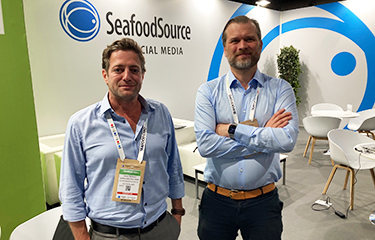
Former Kingfish Company CEO Ohad Maiman and former Atlantic Sapphire CTO Thue Holm recently announced the formation of AquaFounders Capital, an investment company that will concentrate on three sub-sectors pertaining to land-based aquaculture: farming, software, and hardware. In a joint interview with SeafoodSource, Maiman and Holm discussed their reasons for forming AquaFounders Capital and their goals for the firm.
SeafoodSource: Both of you just made it through to the other side of your previous ventures, having gotten RAS systems built and producing fish. Why start over with a new project?
Maiman: It feels like a natural progression. I think the macro trends for land-based are possibly even more favorable than they were five or 10 years ago with taxation in Norway and potential bans on net-pens in Canada. So the forces requiring a new solution or a new source for seafood have only gotten stronger. And the sector has gone through that next stage of development. What five years ago was a need to show proof of concept and proving you could grow a high-quality fish to market in a land-based system has now evolved into the next phase of reaching scale and profitability. In some ways I feel like this is a simpler challenge. To actually prove we could do it was difficult, and now comes the next stage of maturing the technology to scalability and better economic viability – that's what every new technology sector goes through. Think of windmills or solar panels or [electric vehicles] – at some point, when the proof is there, the key focus shifts to efficiency and cost. If you compare it to net-pen farming, RAS is probably where it was 20 years ago, or even 10 years ago. But when you look forward, there will be a leader on the farming side, a leader on the hardware side, and a leader in operating systems. These are the three sub-segments we're looking at to effectively support the industry and help facilitate and build those future consolidated leaders.
SeafoodSource: What are the origins of AquaFounders Capital and general thesis of it?
Holm: We are basically hedging that the industry is heading towards significant scale, and there will be some companies that can understand what it takes to mature this industry and take the lead, and we intend to identify and enable them. There are lots of opportunities for the companies that do this right, between farming and technology and hardware services, where we think there's a significant upside. Overall, land-based farming continues to grow and projects are coming online. With net-pen farming limited, it’s either offshore, or land-based that need to fill the gap. That said, land-based technology is not only limited to full grow out- last year, 36,000 tons of post-smolt production came online, and if you're a technology provider, if you're a solution provider, this becomes additional upside. By focusing on hardware, software, and high value farming, AquaFounders Capital enables a wide exposure to the land-based farming sector across the value chain.
SeafoodSource: How do you describe AquaFounders Capital?
Maiman: Advancing the future of land-based aquaculture, focused on opportunities in its three critical sub-segments. There are obviously opportunities in other places, but we will stick to what we know best. Europe and North America are the main focus for farming operations, but it is a global sector. So if we find an interesting opportunity in Asia or the Gulf or technology from anywhere else that fits our model, we wouldn't exclude it. We are convinced that the sector has evolved past proof of concept and in line with the macroeconomic environment, scale and profitability are now the key focus, and we’re convinced the sector can get there.
Holm: Our focus is where we come from, and what we know best, where we can also contribute to companies we invest in. Our philosophy as founders is we can contribute to the growth journey of these companies. We've been through start up to scale up challenges, and we will be applying that experience and vision for the industry to these companies to make sure that we succeed together.
SeafoodSource: How big will the fund be?
Maiman: We’re still in discussions with likely anchor investors, so as far as size and timeline we'll announce it as soon as we can.
SeafoodSource: Do you want to be the go-to land-based investment firm out there? Do you think anyone's doing it right now or are you doing this because no one is fully focused on it right now?
Maiman: I don't mind if others come into the sector, but that's what we're focused on. There's some intersection with some current funds in the seafood sector in general, but the other ones I'm aware of are more generalist – they could do net-pens, they could do seaweed, they could do feed ingredients. The cohesiveness of our focus on land-based is quite unique and plays to our strengths and experience.
SeafoodSource: You don't see AquaFounders as competition to your previous ventures?
Maiman: I think personally that Sapphire is clearly the leader in salmon and Kingfish in kingfish. So it makes no sense to go up against them head-on. But there's plenty of other opportunities with other high-value species and the general hardware and software ecosystem required to enable the sector to reach its full potential.
Holm: We are still close with our former companies and we’re both still advising them, and so I hope there can be some good synergies there. I don't see any conflicts or direct competition.
SeafoodSource: Has the case for land-based aquaculture been proven? There are still a lot of ventures struggling and failing. Where is the industry in the process of presenting proof of concept to investors and the wider world?
Maiman: As far as I'm concerned, proof of concept is being able to deliver high quality fish to market at full size and that in particular, Atlantic Sapphire and The Kingfish Company have shown that it can be done. Then I keep thinking of any other technology sector – wind and solar panels or EVs were too expensive 10 years ago, and now they are commercially viable. Even when we talk to investors, five and 10 years ago, the big worry was, can you make the technology work? Now it's a more familiar journey of the typical development of any sector. Now the focus is on making it profitable and scalable, and that's a lower-hanging fruit because that is a process that's more familiar from other industries.
SeafoodSource: What type of investors are you courting, and what is the pitch that you're making to them? How savvy are they about aquaculture? How much background do you need to give them?
Maiman: Today, there are more and more multinational investors that are not familiar with the sector, but know that, generally, seafood is a growth sector that's very interesting to be in. Five or 10 years ago, they wouldn't look at land-based, but now – maybe thanks to significant investment from the Norwegian side – there are players I've never heard of before looking at the sector. They’re now saying, “Okay, we want exposure to it.” With AquaFounders, instead of them taking a less-educated risk on a specific company, they are able to somewhat hedge and buy into the wider platform we're building. Beyond that, what Thue and I specifically bring to the table is an experience-based ability to scrutinize and assess some of the business models and concepts we’re being presented.
SeafoodSource: Given what both of you have achieved with your previous companies, are you currently technology-agnostic or do you have a horse in the race?
Maiman: As far as flow-through versus RAS, whenever water source conditions are conducive, flow-through is a great option, when they're not, you need RAS, and both of them make sense under the right circumstances. But overall, we are looking to answer the need for scalability and profitability in the sector. When it comes to the software technology side, the end vision is a dummy-proof operating system that maximizes efficiencies and minimizes risks. When it’s about critical RAS components and the actual hardware, we’re aiming to bring it towards how greenhouses are built – basically ready-to-assemble kits with fast deployment ability versus the current year or more of engineering followed by years of construction watching layers of concrete dry. And when we look at the farming side, even though we came from salmon and kingfish, the future may not be necessarily a one-species play but rather a carefully selected consolidation of high-value species deployed in small- to medium-sized farms in the right locations, to effectively maximize the advantage of being able to deploy land-based farms where they’re needed.
SeafoodSource: You've seen every possible curveball get thrown at a business model, and you’ve still come out the other side. So how do you do it? How do you look at a business model and determine if it's going to work?
Holm: It depends. We have three very different sectors that we invest in. There are a lot of aspects we know instantly when we look at those budgets, like “What is your operating cost? How many people do you need to run that farm?” And if you think it takes three people to run a farm, then those have to be very special people. If you’re looking at a small start-up on a new species, you can question the market price they're putting into the budget. What's your processing cost? If it’s EUR 0.50 (USD 0.54), that’s completely crazy. It's probably closer to EUR 2.00 (USD 2.15) at small scale. When it comes to technologies, there are a lot of people developing products where the technology is just not actually viable, and we have enough experience to spot that, and differentiate the must haves from the nice to haves. We've seen a lot of crazy ideas and crazy technologies, and when it’s just a black box and all secrets, it’s usually because it’s bullshit.
Maiman: It’s also quite intuitive. The way I think of it is, especially on the technology and the hardware, everything that kept me up at night at Kingfish, or technology I wish I had there, is what we would like to support and develop.
SeafoodSource: Is there any specific technology you’d like to champion?
Maiman: We want to help develop a scalable, easier, faster, cheaper-to-construct method of deploying and operating land-based farms. And on the farming side, we want to maximize the strategic advantage of land-based that is to optimal with business cases that focus on high-value species at a market where they're not available that perform well in land-based systems.
SeafoodSource: Will you encourage collaboration and co-development between your different projects?
Maiman: The idea is to aspire towards eventual consolidation into a sector leader in our three targeted sub-sectors. And of course there's natural synergy between them and we want to encourage cross-pollination. That's one of the things we'll be able to bring to the table as an investment company solely focused on the land-based sector.
SeafoodSource: Dealing with such a young industry, how much mentoring needs to happen with these projects? Will that be part of what AquaFounders does for the companies in which it invests?
Holm: It can be mentoring on many levels. It depends on the size of the company and how mature it is. But if we go into a company, our general philosophy is that it should have the concept of a functioning product and maybe already be selling some or being on the path to commercialization. But that involves overcoming a lot of different challenges, and we have already done that with our previous companies, so we’re looking forward to mentoring the companies we work with and we think that will be very beneficial for them. It can range from how to get bank financing, how to optimize your product to market needs, how to manage cashflow issues – it sounds like small details, but it's not always obvious for people who maybe are doing this for the first or second time.
SeafoodSource: Predictions are dangerous, but where do you predict the land-based sector can be in five, 10, 20 years?
Maiman: Macro forces are making it almost inevitable that the sub-sectors we’re investing in will grow. I’ve seen some predictions showing seafood demand will double by 2050, but even if you take it linearly for the last 30 years and into the next 30 years, there'll be a need for another 80 to 90 million tons of seafood globally. It’s been obvious for a while that wild-catch will not increase, and it's becoming more and more obvious that traditional aquaculture will have some barriers to increasing volumes. It may not be necessarily with the same species, because every technology needs to figure out where it's stronger and where it's weaker, but it's almost the only way I can see that additional supply becomes available.
Photo by Cliff White/SeafoodSource
