






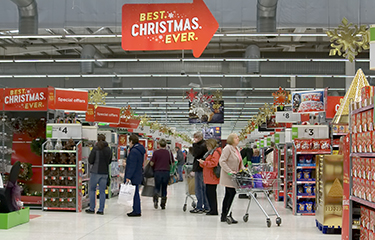
Following a month in which U.K. grocery sales soared 6.3 percent to GBP 11.7 billion (USD 14.7 billion, EUR 13.7 billion), London, U.K.-based data and analytics firm Kantar is projecting that U.K. grocery sales will surpass GBP 13 billion (USD 16.4 billion, EUR 15 billion) for the first time ever in a monthly period this December, suggesting that the nation’s consumers are less wary to shop as inflation continues to ease.
“The scene is set for record-breaking spending through the supermarket tills this Christmas,” Kantar Head of Retail and Consumer Insight Fraser McKevitt said in a press release. “The festive period is always a bumper one for grocers, with consumers buying, on average, 10 percent more items than in a typical month.”
Despite price increases on food products continuing to slow, some of that predicted record-breaking total will still be directly due to inflation, McKevitt said. Food and beverage inflation dropped to 9.1 percent in November but still stands at 9.6 percent for the most recent quarter.
A new report from the think tank Energy and Climate Intelligence Unit (ECIU) highlights the difficulties facing U.K. consumers, finding that energy costs and climate change/unseasonal weather over the past few years have increased household food bills by an average of GBP 605 (USD 761, EUR 706) annually compared to 2021. Climate costs alone accounted for 60 percent of the spike, the ECIU stated, as “historically high” oil, gas, and fertilizer prices have particularly hit companies and, therefore, consumers.
For the rest of 2023 and into the new year, the ECIU anticipates that falling energy prices will continue to act as a brake on food price increases.
“While the rate at which grocery prices are rising is still well above the norm, the good news for shoppers is that inflation is continuing to come down,” McKevitt added.
To help shoppers save money, grocers are spending more on promotions, particularly for their own-label lines, according to Kantar. Spending on promotions hit its highest level in over two years in November, and even better for consumers, supermarkets are “battling it out” to offer value this month and keep competitors at bay, McKevitt noted.
“The amount of money spent on deals usually leaps in the run-up to Christmas, but this year is already looking a bit different,” McKevitt said. “We’re well above 2022 levels, with customers [raking in] an additional GBP 180 million [USD 226.5 million, EUR 210 million] in savings this November compared to 12 months ago.”
This has led to wins for both consumers and retailers alike. Specifically, in November, Sainsbury’s achieved its largest market share gain – rising 0.4 percentage points to reach 15.6 percent – in over a decade, thanks in part to success with its own-label products. Sales of its popular “Taste the Difference” range of products shot up 23 percent last month, according to McKevitt.
“These premium products feature prominently in Sainsbury’s Christmas TV spot this year, and our testing showed its lead TV ad is one of the top performers for potential short-term sales impact,” McKevitt said.
Tesco also realized a sales increase of 8.6 percent in November and increased its market share to 27.5 percent. Aldi realized a sales increase of 11 percent in the period and now holds a 9.6 percent share of the market.
Lidl was the fastest-growing grocer in the nation yet again in November, experiencing sales increases of 14.2 percent to claim a record high market share of 7.8 percent.
Photo courtesy of Loch Earn/Shutterstock
