






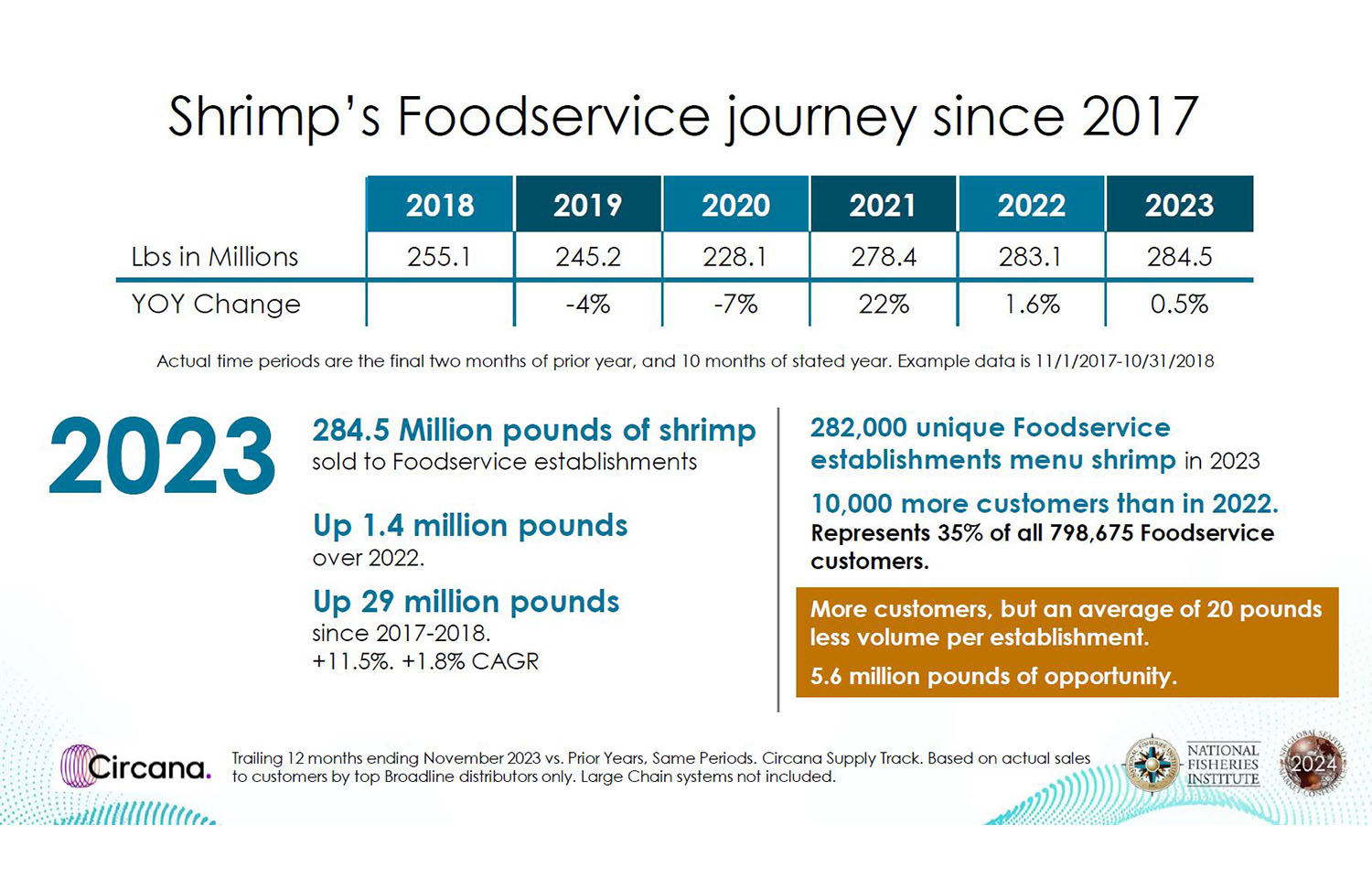
U.S. foodservice outlets sold more shrimp year over year in 2023, due in part to lower prices, and more outlets included shrimp on their menus, improving the products' countrywide menu penetration.
However, customers bought less average volume per visit, and foodservice businesses used an average of 20 pounds less volume per establishment, according to Performance Food Group Vice President of Procurement Michael Seidel.
Foodservice outlets have grown their shrimp purchases by 11.5 percent by volume since 2017, but that total grew just 0.5 percent in 2023 to 284.5 million pounds, Seidel said, citing Circana data from the top 25 U.S. broadline distributors while speaking at the 2024 Global Seafood Marketing Conference in Orlando, Florida, U.S.A. on 23 January.
The panel on which he spoke at the conference said 2023 was a difficult year and predicted continued contraction across the seafood industry in 2024, particularly with shrimp imports.
Still, a total of 282,000 unique foodservice establishments had shrimp on their menus in 2023, up 10,000 from 2022, representing 35 percent of the 798,675 foodservice operators present in the data.
Shrimp is an incredible value for foodservice operators, Seidel said. In 2023, it was selling for an average of USD 5.68 (EUR 5.28) per pound – its lowest average since 2020.
“You can buy shrimp and have several different meals,” Seidel said.
A half-pound portion costs under USD 3 (EUR 2.79) for operators to pruchase. They can add sides and sauce for an average food cost of USD 5 (EUR 4.65) per plate. Then, operators can price the plate at USD 19.99 (EUR 18.60), achieving a USD 15 (EUR 13.95) profit, according to Seidel.
White shrimp accounted for 93 percent of shrimp sold to foodservice venues by volume in 2023, while tiger shrimp accounted for 5 percent; brown shrimp made up 3 percent. However, white shrimp had less than 1 percent growth in 2023, while brown shrimp volume plunged 10 percent and tiger shrimp volume increased 3 percent.
A majority of shrimp volume sold to foodservice customers – 39 percent – was 16-20 count and 21-25 count. That combined segment increased 4.4 percent by volume in 2023, while 26-30 count, 41-50 count, and 60-90 count shrimp declined by sales volume in 2023, Seidel said.
Peeled and deveined, tail-on shrimp sales rose 3.3 percent last year to reach 32 percent of foodservice sales, while peeled and deveined, tail-off sales grew 2.8 percent to reach 36 percent. While EZ-peel shrimp sales grew during Covid-19, sales dropped 1.6 percent in 2023, slumping to account for 8 percent of sales.
A majority – 85 percent – of foodservice customers use raw shrimp, representing a gain of 8,800 customers in a year, while 55 percent use cooked shrimp, marking a gain of 3,200 customers in 2023. But, 78 percent of shrimp sold to foodservice is uncooked, unchanged since last year. Sixteen percent of sales in 2023 comprised breaded/battered or coated products, which was flat compared to 2023, but the total is up 30 percent since 2019.
Bar and grills purchased the most shrimp by restaurant type at 49 million pounds last year. Mexican, Latin, Cuban, and Hispanic restaurants bought 47 million pounds of shrimp in 2023 – a 2 percent increase compared to 2022 – which Seidel attributed to the pandemic-era popularity of takeout food, as Mexican food “takes home really well and delivers fairly well.”
Conversely, seafood restaurants purchased 35 million pounds of shrimp in 2023, a 6 percent decline. Sales to Asian restaurants also dropped 1 percent, and QSR chicken restaurants used 9 percent less shrimp.
Image courtesy of National Fisheries Institute
