






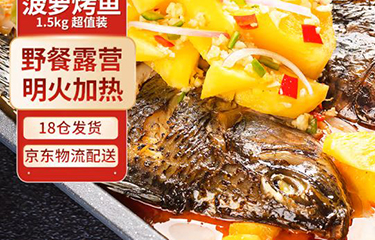
The COVID-19 pandemic has prompted major shifts in Chinese seafood consumption patterns, favoring value-added products and pre-prepared meals for home consumption. And seafood companies are starting to respond by offering increasingly complex pre-prepared meal options – in effect, replicating restaurant meals.
Packaged convenience food – often referred to in Mandarin as prefabricated, became mainstream during COVID, according to Hoang Nguyen, an analyst in Beijing-based Daxue Consulting’s Shanghai office. E-commerce leader JD.com has also sought to extract higher yields from the trend by selling gift boxes of prefabricated meals, Nguyen said, including seafood products from Guolian Aquatic and Hainan-based tilapia processor Xiangtai.
Guolian is selling range of pre-cooked products via JD.com, including a roasted tilapia fillet meal for CNY 55 (USD 7.62, EUR 7.36), while Xiangtai has begun offering a range of pre-cooked, hotpot-style meals in 500-gram packets for CNY 89 (USD 12.35, EUR 11.91).
JD.com said its results from Singles Day, which took place 11 November, showed steady interest in seafood products across China.
“Consumption in mid- and lower-tier markets has grown healthily,” it said. “Average basket size from new lower-tier market consumers increased 12 percent year-on-year.”
When it comes to online seafood sales, the top-selling product is hotpot, a staple of the Chinese fast-service food industry, which uses large amounts of lower-cost fish inputs like tilapia, carp, and perch, according to Daxue Consulting.
Chinese consumers are staying home as a way to avoid being designated a close contact on one of the government’s contact tracing phone apps, said Nguyen, who said consumers also eat at home as a “way to guarantee hygiene and avoid contagion.” That has also led to a growing trend of home cooking.
“Our research in 2022 showed that 66 percent of Chinese families cook at home,” Nguyen said. “Early in 2022, there were millions of people in lockdown. Young people didn’t go home [to their hometowns] but in Shanghai, for instance, they were locked down for three months, cooking by themselves. This is a new habit and will continue.”
Guolian Aquatic also supplies processed seafood to China’s quick-service restaurant sector – another industry that has thrived in COVID-era China, according to Nguyen.
“Fast food chains often have an advantage because of the lower costs,” Nguyen said. “Their outlets are usually in lower-cost locations compared to more expensive restaurants, while fast food is also popular among younger and lower-waged consumers.”
COVID lockdowns in China have benefitted retailers including Hema Xiansheng (also known as Fresh Hippo), which operates online and offline, and which grew its sales 25 percent year-over-year and grew its subscriber base 247 percent in the first 10 months of 2022.
“Hema has benefited from a perception of quality,” Nguyen said. “If you don’t go out to eat, you still want to ensure you’re buying quality and safe food. Some of the other delivery companies are cheaper but have been perceived as selling lower-quality goods for lower prices.”
That shift was also reflected in Singles Day sales, Nguyen said, as overall sales grew in 2022 and 2021 but the rate of growth is starting to taper off.
“This is also matched by consumer trends towards quality over quantity of products,” Nguyen said.
Photo courtesy of JD.com
