




Sales of fresh, frozen, and ambient seafood in U.S. retail stores all decreased in June in spite of prices for the first two categories dropping in the period.
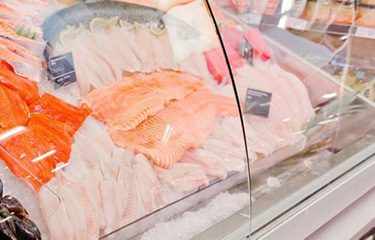
Fresh seafood sales fell 2.8 percent to USD 624 million (EUR 555 million) in June. Frozen seafood sales fell harder, dropping 5.3 percent to USD 627 million (EUR 558 million), according to Circana data provided by Lakeland, Florida, U.S.A.-based 210 Analytics
The decrease in sales comes despite frozen seafood prices dropping 7.5 percent and fresh seafood prices falling 3.2 percent in the month, driven by a significant decline in shellfish prices – most notably crab, which saw its average price plummet 19.2 percent.
“Deflation pulled dollar sales below June 2022 levels, as consumer demand has not yet caught up with deflationary patterns,” 210 Analytics President Anne-Marie Roerink told SeafoodSource.
Shelf-stable seafood sales declined 2.3 percent by value to USD 254 million (EUR 226 million) and 3.8 percent by volume, coinciding with a price increase of 2.2 percent to USD 5.30 (EUR 4.72) per pound on average.
Through the first half of 2023, however, ambient seafood sales increased 1.4 percent.
“We’re starting to see a gap between units and volume, with pounds starting to fall behind units, which would indicate that people are shifting to smaller pack sizes,” Roerink said.
Roerink said the decline in sales of ambient seafood is “following more closely with the patterns we are seeing in center-store [items] that is leading the pressure on units.”
“There are very few exceptions in center-store items that are seeing unit growth, but interestingly, peanut butter, jelly, and white bread are exceptions – giving some big clues as to what is on shoppers’ lists as ways to stretch the food dollar,” she said.
New consumer price index data from the U.S. Bureau of Labor Statistics reported a decline in overall fish and seafood prices of 0.9 percent, compared to an increase in overall food inflation of 5.7 percent in June.
Chicago, Illinois, U.S.A.-based Conagra, which owns frozen seafood brands Mrs. Paul’s and Van de Kamp’s, is one of many companies that have noticed a slowdown in its sales recently; its earnings fell 23 percent to USD 684 million (EUR 609 million) for the 2023 fiscal year.
“Food companies are starting to wrap pricing in the year-ago period, and dollar sales are coming down as expected. The rate of improvement, [though], in volume recovery is lagging,” Conagra Brands President and CEO Sean M. Connolly said during a conference call, per Food Business News. “That suggests new consumer behavior shifts beyond the initial elasticity effects that occurred when pricing actions were initially taken.”
Connolly noted “an overall category slowdown” since just after Easter. He said a busy summer travel season may be contributing to a sales lull, calling the situation a “temporary behavior shift” as consumers stretch their budgets.
One of the few seafood categories experiencing an uptick is frozen crab, with sales up 16 percent by value and 34 percent by volume in the first six months of 2023. This is likely due to a steep decline in crab and lobster prices, which has “continued to be substantially more favorable to the consumer in the longer and shorter time periods,” Roerink said.
Fresh crab prices dropped 16.3 percent to USD 9.53 (EUR 9.48) per pound on average for the 52-week period ending 2 July, while lobster prices dropped 13.1 percent to USD 6.88 (EUR 6.12) on average.
Conversely, fresh shrimp prices rose 6.1 percent to an average of USD 9.12 (EUR 8.12) per pound in the first half of 2023, including a 3.3 percent increase in June to reach an average of USD 9.10 (EUR 8.10) per pound. Frozen shrimp sales declined 6 percent by value for the first six months of 2023, and frozen scallop sales also dropped around 13 percent by value.
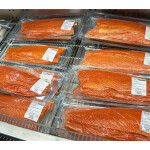
Fresh salmon prices jumped up 4.9 percent by volume in June, but dropped 1.4 percent by value to USD 11.46 (EUR 10.20) per pound on average, according to Circana and 210 Analytics. Salmon remains the most popular fish in fresh seafood departments, generating USD 1.4 billion (EUR 1.2 billion) in sales during the first six months of the year, Roerink told SeafoodSource.
“Salmon has become a true powerhouse in fresh [sales] and is making inroads in frozen [sales] as well,” she said.
Photo courtesy of Sobey's
