



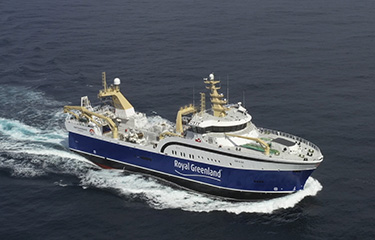
Work on the fifth vessel in the rebuild of Royal Greenland’s fishing fleet has begun, with processing firm Carsoe chosen to supply its onboard shrimp-processing technology.
The vessel, the Akamalik, is to be delivered in Q1 2025 and will conduct shrimp fishing in the waters around Greenland.
Nuuk, Greenland-based Royal Greenland is in the midst of a fleet-renewal program, previously having rebuilt its factory shrimp trawler Nataarnaq, its shrimp and halibut combination trawler Avataq, and the halibut and whitefish trawler Sisimiut. It is scheduled to launch its halibut, cod, and shrimp trawler Tuugalik in 2023.
Each of the vessels has been equipped with an onboard processing factory from Aalborg, Denmark-based seafood-processing equipment manufacturer Carsoe. Carsoe said the processing set-up for the Akamalik is nearly identical to that of the Nataarnaq, including automatic bycatch separation and shrimp grading capabilities, a continuous cooking line, and four IQF-tunnel freezers, each with a capacity of 25 tons per day.
“The factory is also designed with a separate line for Japan shrimp with a highly automated flow, including an automatic horizontal plate freezer and a masterpack line,” Carsoe said in a press release. “The factory deck includes a complete shrimp processing factory with a high level of automation including robot handling and automatic freezing of the processed catch.”
As a new solution created by Carsoe, the Akamalik will be equipped with a palletizing section with three integrated palletizing robots. Carsoe said the “unique and adaptive” solution permits palletizing and transportation of the catch to the cargo to be performed in a continuous flow and at a minimum of floor space, with a cargo elevator as an integrated part of the palletizing machine.
“On the compact factory deck of a factory trawler, it is essential to make the most of the space, all while ensuring an operationally reliable factory. With a total of three palletizing and sorting robots, the handling can be adjusted according to product type and production flow to keep the final part of the processing plant running smoothly,” it said. “For instance, with three robots, each overlapping the next robot’s range of motion, the production can continue without stop, even if one robot is inoperative. Furthermore, it is possible to bypass one or two robots and send the products straight to the cargo hold, if the catch does not require any further sorting.”
In November 2022, Susanne Arfelt Rajamand has been named the new CEO of Royal Greenland, replacing Mikael Thinghuus, who announced his departure from the company in January 2022.
Photo courtesy of Skipsteknisk
