





Manila, Philippines-based Asian Development Bank (ADB) has approved separate funds worth total USD 166 million (EUR 155.8 million) to help drive sustainable development of the seafood sector in Indonesia and Cambodia.
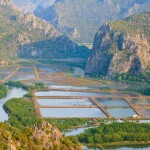
ADB announced on 15 December it will provide a USD 93 million (EUR 87.3 million) loan to support smallholder shrimp farming in seven provinces in Indonesia. The funding is for the Infrastructure Improvement for Shrimp Aquaculture Project to be implemented in Bali, Banten, Central Java, East Java, Lampung, Nangro Aceh Darusalam, and South Sulawesi. Indonesia’s Ministry of Marine Affairs and Fisheries said the ADB funding will help sustainably increase the productivity, quality, profitability, and environmental sustainability of smallholder farmers’ shrimp farming in the country.
“Indonesia is a key player in the global shrimp market, ranking among the top five shrimp producers in the world, with a global market share of 8.7 percent and export markets in the European Union, Japan, and the United States,” ADB Principal Water Resources Specialist for Southeast Asia Eric Quincieu said. “Through ADB’s assistance, we expect that sustainable aquaculture practices will help reduce pressure on the ecosystem while boosting productivity.”
Through investments in climate adaptive infrastructure, capacity-building, and strengthening of value chains, the project will enable smallholder farmers to access to quality inputs, production, and post-harvest practices and traceability. The project also aims to stimulate the transfer of knowledge in producing high-quality genetic shrimp fry to the Indonesian ministry, which will help it reduce the national industry's reliance on imported broodstock.
Approximately 5,200 smallholder farmers, including more than 1,000 women farmers, are expected to benefit from the loan as it goes toward improving infrastructure and capacity. Around 35,000 other smallholder farmers, including an estimated 7,000 women, are likely to benefit from improved access to quality inputs and capacity-building programs the program will provide.
An estimated 80 percent of total farmed shrimp production in Indonesia is vannamei shrimp, which is produced by large companies and about half of the country's smallholder farmers. The other half of the smallholder farmers produce black tiger shrimp. In 2021, Indonesia produced 707,951 metric tons (MT) of shrimp with an export value of IDR 43 trillion (USD 2.75 billion, EUR 2.57 billion), accounting for 7.1 percent of global market share.
In December 2022, ADB also approved a USD 73 million (EUR 68.5 million) financing package for the Sustainable Coastal and Marine Fisheries Project to help enhance the climate resilience and sustainability of coastal and marine fisheries in Cambodia.
To support the project, ADB will provide a loan worth USD 41 million (EUR 38.5 million), while its Asian Development Fund will contribute a USD 22 million (EUR 20.6 million) grant, and the ASEAN Infrastructure Fund under the ADB-managed ASEAN Catalytic Green Finance Facility (ACGF) will provide a USD 10 million (EUR 9.4 million) loan. The Agence Française de Développement will also participate by providing cofinancing equivalent to USD 20 million (EUR 18.8 million), which will be administered by ADB.
“This project is ADB’s first significant investment in marine fisheries and represents an important milestone for its action plan for healthy oceans and sustainable blue economies,” ADB Senior Natural Resources and Agriculture Specialist for Southeast Asia Alvin Lopez said. “It responds to several key government strategies, including the Strategic Planning Framework for Fisheries 2015–2024, and the Statement of the Royal Government of Cambodia on Marine Fisheries Management Key Principles (2019) for the management, conservation, and development of sustainable marine fisheries resources.”
Marine fisheries accounts for 13 percent of Cambodia’s fisheries subsector, which contributes between 8 and 10 percent to the kingdom’s gross domestic product. However, due to overfishing and climate change impacts, fish stocks in the country have declined, with local fishermen reporting their caught output has fallen by between 40 percent and 60 percent between 2017 and 2022. Fisheries resources in Cambodia and in the Gulf of Thailand are forecasted to drop by a further 30 percent by 2030. The decline in marine resources has affected coastal communities and businesses, resulting in higher fish prices, according to an ADB assessment.
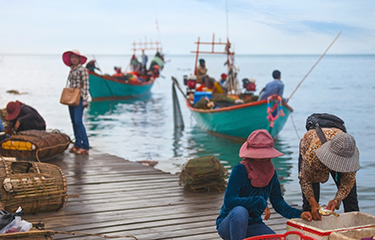
The ADB-funded project will help improve Cambodia’s marine fisheries and support its efforts to enhance the shared fish stocks and ecosystems in the Gulf of Thailand. Four coastal provinces of Cambodia will receive help under the project, including Kampot, Kep, Koh Kong, and Preah Sihanouk. The project will also help the provinces developr sustainable mariculture and improve fish-landing sites to improve seafood safety. Additionally, 40 percent of the nearshore fisheries covered by the project will be regenerated into more-productive and -sustainable enterprises, ADB said.
Photo courtesy of Lena Serditova/Shutterstock
