





Total U.K. seafood sales reached almost GBP 10.67 billion (USD 13.3 billion, EUR 12.2 billion) last year, representing an increase of 3.8 percent on the previous 12 months, with the country’s consumers purchasing GBP 8.67 billion (USD 10.8 billion, EUR 9.9 billion) worth of products, up 2.2 percent, according to new analysis published by Seafish.
The public body’s provisional data for 2019 found that some GBP 3.85 billion (USD 4.8 billion, EUR 4.4 billion) worth of seafood was sold in retail channels for in-home consumption, which was 0.6 percent more than in 2018. At the same time, there was GBP 4.82 billion (USD 6 billion, EUR 5.5 billion) of seafood consumed out of home, up 3.4 percent.
Products valued at GBP 2 billion (USD 2.5 billion, EUR 2.3 billion) were exported, an increase of 11.8 percent, with France, the United States, Spain, Ireland, and China providing the main overseas markets for U.K. seafood. Species with the greatest export volume included salmon, mackerel, herring, crabs, and nephrops. In total, U.K. exports amounted to 452,354 MT in 2019, up 1 percent.
The analysis’ Nielsen ScanTrack figures confirm that the value, volume, and unit sales of seafood increased across the country’s major multiple supermarkets and discounters, and that all sectors reported an increase in sales value – but only the chilled sector also reported growth in sales units and volume.
Fewer shoppers bought less seafood more often for a higher price, the report stated.
The top species sold in retail by sales value were salmon, cod, tuna, warmwater shrimp, and haddock. By volume, the main species were salmon, tuna, cod, pollock, and haddock.
Meanwhile, there were overall increases in both the number of seafood servings and frequency of sales in commercial out-of-home foodservice outlets. The average spend per seafood eater was GBP 3.98 (USD 4.97, EUR 4.56), up 13.4 percent on 2018, and the total number of seafood servings increased by 2.4 percent to more than 1.2 billion.
With regard to supply, the market sourced GBP 5 billion (USD 6.2 billion, EUR 5.7 billion) worth of seafood products, an increase of 0.4 percent. In volume terms, this amounted to more than 1.3 million metric tons (MT), a drop of 1.1 percent.
The U.K. supply comprised GBP 727.2 million (USD 908.4 million, EUR 832.3 million) of landings made by U.K. vessels, up 1 percent; GBP 962.2 million (USD 1.2 billion, EUR 1.1 billion) of domestically produced aquaculture products, down 15.6 percent; and imports of GBP 3.3 billion (USD 4.1 billion, EUR 3.8 billion), up 6.2 percent.
The countries that imported the largest value of seafood into the U.K. market were Iceland, with GBP 300.1 million (USD 374.8 million, EUR 343.4 million); China, with GBP 248.3 million (USD 310.2 million, EUR 284.2 million); Germany, with GBP 239.6 million (USD 299.3 million, EUR 274.2 million); the Faroe Islands, with GBP 239.5 million (USD 299.2 million, EUR 274.1 million); and Sweden, with GBP 232.9 million (USD 290.9 million, EUR 266.6 million).
The total volume of these imports increased by 4.8 percent to 687,274 MT, while the species with the greatest import volume were tuna (107,390 MT), salmon (99,165 MT), cod (95,482 MT), haddock (49,973 MT), and warmwater shrimp and prawns (39,537 MT).
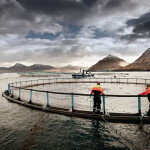
Photo courtesy of Sun_Shine/Shutterstock
