





The world’s biggest aquafeed producers are tightening their control over the global shrimp-feed industry.
Acquisitions over the past decade have consolidated the shrimp-feed sector, with Skretting, Cargill, BioMar, ADM, and De Heus emerging as the biggest global players. They have extended their advantage by establishing a strong emphasis on innovation and technology, with most operating their own research and development facilities and demonstration farms, and developing proprietary farm-management software and smart-feeding systems, according to analyst Willem van der Pijl in a recent Shrimp Insights blog post.
Stavanger, Norway-based Skretting, which was absorbed by Nutreco in 1994, is currently the world’s largest salmon-feed producer and the third largest shrimp-feed producer. It runs seven shrimp feed manufacturing facilities in four countries, and R&D facilities in Ecuador and China. It recently invested in new facilities in Vietnam and Ecuador.
Wayzata, Minnesota, U.S.A.-based Cargill is rapidly growing its aquafeed business. It has expanded to operate 20 feedmills, 14 of which are dedicated to producing feed for warmwater species including shrimp. However, like Skretting, its market share in Asia remains small.
Aarhus, Denmark-based BioMar has also gained stature in the global shrimpfeed scene, fueled by several recent acquisitions. It became a top five player in Ecuador's shrimp feed sector after acquiring a 70 percent stake in Alimentsa in 2017, moved further into Vietnam through the purchase of a majority stake in Viet Uc’s feed business unit in 2021, and stepped further into the technology space with its acquisition of AQ1, a leading smart-feeding system supplier, in 2022.
Chicago, Illinois, U.S.A.-based ADM has scaled up its engagement in the aquafeed sector since its acquisition of Neovia in 2018, and now has significant operations in Brazil, Mexico, Ecuador, and Vietnam. It announced a deeper foray into China in 2017, and has said it will continue its push into China via expanded production in Vietnam.
While on a smaller scale, Ede, The Netherlands-based De Heus has also begun venturing into the shrimp-feed business. The company is the largest producer of freshwater fish feed in Vietnam and has the capacity to produce four million metric tons (MT) per year of animal feed in the country, including shrimp feed for domestic use. In 2020, De Heus acquired Neovia’s Indonesian assets, and is aiming to grow its share of the shrimpfeed market there in coming years.
Ecuador, which had an estimated shrimp feed demand of about 2 million MT in 2022, is a primary target market for all major shrimpfeed players. In 2012, Skretting acquired a 75 percent of stake in Expalsa, a major shrimp producer in Ecuador. Expalsa's aquafeed operation, GISIS, operates feed mills in Ecuador and Honduras and is now the market leader in Ecuador, with a production capacity of around 800,000 MT per year and a 40 percent market share. Skretting was the first to sell extruded shrimp feeds in Ecuador and has reinforced its market-leading position with the 2021 opening of a research center in Guayaquil focused on innovation.
Vitapro, a part of Alicorp in Peru, has a 20 percent share of the Ecuadorian shrimp-feed market. In 2013, it opened a feed mill in Ecuador with Santa Priscila, one of the country’s biggest shrimp-farming companies. Vitapro has a production capacity of 400,000 MT per year in Ecuador and has a goal of increasing its share of the local shrimpfeed market to 45 percent, more than doubling its current 20 percent market share.
In 2015, Cargill established a joint venture with Naturisa, which has a 50 percent stake in Songa, Ecuador’s third-largest shrimp exporter. The JV opened a shrimp feed mill in 2018 that it claims is the most technologically advanced plant of its kind in the country. In November 2022, Cargill and Naturisa announced a joint venture with Skyvest to expand its presence in Ecuador, resulting in a doubling of Cargill’s shrimp-feed capacity in Ecuador to an estimated 250,000 - 300,000 MT per year.
Through continued investment in Alimentsa, BioMar said it plans to nearly double its annual shrimp-feed production capacity from 220,000 MT to 400,000 MT per year. BioMar is currently the fourth-largest shrimp feed producer in Ecuador.
In East Asia and Southeast Asia, other players have taken larger shares of the shrimp-feed market, including CP Foods and Thai Union, both based in Bangkok, Thailand. Other companies include Taoyuan, Taiwan-based Grobest; Guangzhou, China-based Guangdong Haid; and Beijing, China-based New Hope Liuhe.
CP Foods is believed to be the world’s largest shrimp feed producer in terms of capacity, though its manufacturing operations are primarily located in South and Southeast Asia. CP Foods is the leading shrimp-feed producer in China, Thailand, India, Malaysia, the Philippines, and Vietnam.
Thai Union is also involved in shrimp-feed production through its subsidiary Thai Union Feedmill (TFM). TFM runs two major feed mills in Thailand with a total capacity of 250,000 MT per year, with roughly 165,000 MT per year set aside for shrimp, making it the second-largest producer in the market after CP Foods. TFM also has invested in Avanti Feeds, India’s largest shrimp feed producer, a shrimp -feed plant in Indonesia with 35,000 MT in annual production, and a joint-venture aquafeed operation in Pakistan.
Grobest operates 13 shrimp-feed manufacturing units across China, India, Indonesia, Malaysia, the Philippines, Taiwan, Thailand, and Vietnam – with Vietnam and China serving as its primary markets.
Guangdong Haid, a top aquafeed producer in China, owns more than 600 subsidiaries across China and abroad, with its shrimp feed sales believed to have outstripped those of rival CP Foods. Besides its dominant position in its huge domestic market, it also serves Vietnam, India, Indonesia, and Malaysia.
New Hope Liuhe, runs aquafeed-manufacturing operations with 1.3 million MT in annual production volumes. It is active in China, India, Indonesia, and Vietnam.
In Vietnam, the shrimp-feed market is largely controlled by foreign producers such as CP Foods’ CP Vietnam, Grobest’s Grobest Vietnam, Guangdong Haid’s Sheng Long Biotech, Uni-President from Taiwan, and Evergreen from China, along with local subsidiaries of Skretting, Cargill, De Heus, and BioMar.
Indonesia is unusual in that the largest players in the market are domestically owned. But Chinese shrimp-feed producers are making a hard play for the market, according to van der Pijl. Van der Pijl said he expects the biggest global shrimp-feed firms to continue to scoop up smaller players in India, Indonesia, Brazil, the Philippines, Saudi Arabia, and Venezuela to fuel their aspirations for continued growth.
However, he warned both Thailand and India are facing overcapacity in their shrimp-feed production. In Thailand, where the shrimp-farming sector has been hurt badly by early mortality syndrome (EMS), demand for shrimp feed has shrunk to 500,000 MT per year, about a third of the 1.5 million MT total shrimp feed produced in the country annually. Similarly, annual production of 2.4 million MT of shrimp-feed in India is far outstripping expected annual demand in the range of 1.4 million MT.
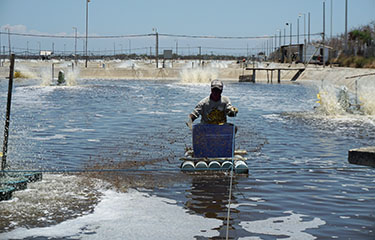
Photo courtesy of Meri Hariantisasi/Shutterstock
