





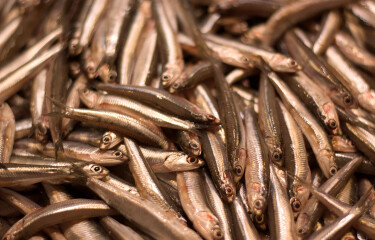
Peru’s industrial anchovy fishing fleet has caught 71 percent of the 1.68 million metric tons (MT) available in its total allowable catch, which was established 26 October 2023 when the Peruvian Ministry of Production (PRODUCE) launched the second anchovy fishery season in the country’s north-central zone.
The launch of the second season came on the heels of the cancelation of the first season of 2023 – partly due to the effects of El Niño, which led to a high incidence of juveniles and deficient biological conditions needed to fish sustainably. Nevertheless, the decision to cancel the season resulted in an estimated USD 1.4 billion (EUR 1.3 billion) in lost revenue from fishmeal and fish oil exports. Peru is the world’s largest supplier of fishmeal and fish oil, for which anchovy is the main ingredient.
Despite high hopes that were put on the second season and almost three-quarters of the TAC already caught, it is likely nearing its conclusion, according to Pablo Trapunsky, the CEO of Peruvian anchoveta fishing and processing firm Pesquera Diamante.
“I believe we have reached the last few days of activity,” he told SeafoodSource. “Basically, since mid-December, we’ve seen a dramatic change in ocean conditions as a result of some Kelvin waves that arrived on the coast with high-salinity waters, which caused the anchovy to move away.”
Further, Peruvian industrial fishing fleets have just about reached their limit in terms of the percentage of juveniles they are allowed to haul in with their catch, and signs are pointing toward another spawning period beginning season, which is another primary reason why Trapunsky believes the end of the season is approaching.
So far, the anchovy catch has been “better than nothing, [but] it could have been much better if [PRODUCE] decided to open the season a bit earlier,” Trapunsky said. “Nevertheless, looking at the glass half full, the fish are there, and we expect 2024 to return to so-called normal conditions.”
Those expectations were echoed by Peru National Fisheries Society (SNP) President Eduardo Ferreyros.
“The Peruvian Sea is as rich as it is variable, and stating that 2023 was the most challenging year of this century for the industrial fishing sector is no exaggeration,” he said in a post on the SNP’s website. “Although this year [2023] has been anomalous, we trust that environmental conditions will be regularized in 2024 and, thus, return to normality in anchovy fishing, which is very relevant for the sustainable development of the country, the fishers, and the communities in the fishing ports all along our coast.”
Despite the historically challenging year for the anchoveta fishery, PRODUCE Minister Ana María Choquehuanca said there were other highlights in Peru's seafood industry in 2023. Peru’s squid fishery broke an all-time record in 2023, with catch coming in at 600,000 metric tons [MT] – more than double the historical average.
“We have had a surprise with the squid … [which] in previous years never exceeded 300,000 MT in fishing. Now, it has reached a historical level of 600,000 MT; it is our second star now,” she said in an interview with local publication RPP. “The squid not only energizes the local market but also the regional market; it can provide work and reach thousands of families."
Choquehuanca said PRODUCE is aiming for gains from several other seafood species seen as having high growth potential, including trout; paiche, which is of the genus Arapaima and native to South America’s Amazon and Essequibo basins; and the doncella, or the tiger shovelnose catfish, which is indigenous to the Amazonian tropical forest ecosystem. Unlike anchovy and squid, however, which are wild-caught, Choquehuanca believes these species could help bolster the country's aquaculture sector.
Choquehuanca defended PRODUCE’s decision to launch the second anchoveta fishing season on 26 October, stating that the ministry was left with a “complicated scenario” after the cancelation of the first season.
“We acted based on the technical and scientific reports from [the Peruvian Sea Institute] Imarpe,” Choquehuanca said. “It was possible to open the season, and we did.”
Photo courtesy of Shutterstock/Corrado Baratta
