






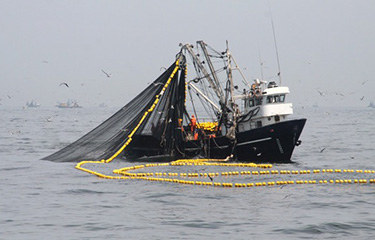
Peru’s Ministry of Production (PRODUCE) authorized a 26 October launch of the second anchovy fishery season in the country’s north-central zone, establishing a total allowable catch (TAC) of 1.68 million metric tons (MT) and giving hopes to Peruvian fishermen and the seafood industry as a whole that had to adjust to the first season’s cancelation earlier this year.
The newly established TAC aligns with recommendations from the Peruvian Sea Institute (Imarpe) to guarantee the sustainability of the biomass. The institute has kept the effects of the El Niño weather pattern and recent anomalous environmental conditions in mind and has carried out multiple operations at sea to monitor and evaluate the anchoveta stock.
Imarpe determined an anchovy biomass of 7.18 million MT – 7.8 percent more than the average winter-spring numbers found between 1996 and 2022, the country’s official gazette El Peruano reported. At the end of the season, an estimated 5 million MT or more of spawning anchovy will remain, which will keep the population in line with fishing sustainability.
“PRODUCE’s decision is of great relevance for the economic reactivation of the fishing sector and the entire productive chain that is developed as a result of the anchovy fishery,” El Peruano reported. “It generates employment and contributes significantly to national income … [offering] a positive signal for the country’s economy and [ensuring] the continuity of a vital activity.”
The TAC is significantly below the TAC established for the second season in 2022 of 2.28 million MT, but the decision still came as a relief to the country’s anchovy-fishing firms. The first season was canceled in part due to the effects of El Niño, which led to a high incidence of juveniles and deficient biological conditions needed to fish sustainably.
Eduardo Ferreyros, the president of Peru’s National Fisheries Society (SNP), stated that the opening of the second anchovy fishing season will reactivate PEN 1.35 billion (USD 349 million, EUR 330 million) in supplier purchases from the main fishing cities such as Chimbote, Chicama, and Callao. The launch of the new season will also put some 18,000 crew members back to work, generating about PEN 63 million (USD 16.3 million, EUR 15.4 million) a month in salaries.
PRODUCE’s latest anchovy TAC will bring in some USD 1 billion (EUR 947 million) in exports of fishmeal and fish oil.
“It will help reactivate the sector – which has been hit hard as there was no first fishing season – as well as the local economy at the ports; in general, it will cushion the fall in GDP for 2023,” Ferreyros said.
Peru’s fishing sector generates around USD 3.5 billion (EUR 3.3 billion) per year, representing 7 percent of the country’s total exports. A recent study prepared by Peruvian economic consulting company Macroconsult found that the cancelation of the first anchovy fishing season resulted in USD 1.4 billion (EUR 1.3 billion) in lost revenue from fishmeal and fish oil exports so far. It expects the national GDP to fall between 0.3 percent and 0.4 percent this year due to the lackluster industrial fishing performance.
The consultancy also found that 250,000 people work directly and indirectly in anchovy fishing, and that the cancelation of the first fishing season translated into losses of 1,500 jobs per month between April and September of this year.
The halt also threatened the livelihood of more than 3,500 sector-related small- and medium-sized businesses dedicated to equipment maintenance, mechanics, logistics, transportation, and storage, as well as small enterprises at fishing ports dedicated to food, lodging, commerce, and transportation.
In its latest report, the Marine Ingredients Organization (IFFO) said that the global cumulative production of fishmeal and fish oil for the first eight months of 2023 was down 28 percent compared to the same period of 2022.
“The predominant factor contributing to this decline must be attributed to the 70 percent year-over-year decrease in Peru,” the IFFO said.
With its large anchovy fishery, Peru is responsible for the production of about 20 percent of the world’s fishmeal and fish oil, and according to IFFO, three-quarters of all fishmeal and fish oil produced is used in aquaculture as aquafeed.
For the full year 2022, Peru's total catch was an estimated 4.25 million MT – only 84 percent of the TAC established and well below the 5.1 million MT of anchovy Peru caught in 2021 – due to a late launch of the second season, coupled with challenging weather and oceanographic issues and a high presence of juveniles – issues that it is still facing.
Peru divides its anchovy fishing areas into two regions – south and north-central – with different capture limits and seasons set for each. The north-central is Peru’s main fishing region, with capture measuring several times that of the southern region.
Photo courtesy of PRODUCE
