





India is “showing a lot of weakness right now,” leading Charoen Pokphand Foods Executive Vice President Robins McIntosh to predict a slight decline in global farmed shrimp production in 2023.
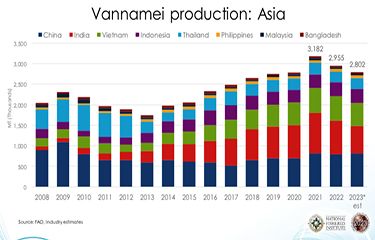
McIntosh predicted a 1 percent decline in global production, with a 4 percent decline in Asia, and a 2 percent decline in Latin America, made up for with an increase in production in other areas of the globe. He expects global farmed shrimp production to shrink to 4.87 million metric tons (MT), down from 4.97 million MT in 2022 and drawing nearly even with 2021’s total of 4.84 million MT.
“This is probably the most-difficult year to project in the last five or six years,” he said at the National Fisheries Institute's Global Seafood Market Conference’s shrimp panel on Tuesday, 17 January. “The first three months I think are pretty sure to be down, just because stocking levels declined in the last three months of 2022.”
McIntosh tentatively predicted a turnaround in the second half of 2023, but overall the year would be a correction to previous years of fast expansion of shrimp aquaculture.
“We're basically seeing a slowing of what had been very vigorous growth,” he said. “And now that growth is slowing, as the economic conditions and margins to the farmers have disappeared, or certainly narrowed to the point that it's harder to put new capital to work.”
McIntosh issued a note of caution regarding India’s farmed shrimp sector.
“India has some work to do to reverse [its] continuing downward trend. It needs real leadership to basically get their engine going. Because it doesn't have the strong momentum and it had it three years ago,” he said. “It's losing momentum. And I think that some active energy needs to be put in to [turn it around].”
Both in India and elsewhere, shrimp farmers have seen inflation in their inputs – most prominently, the cost of feed – and a deflation in terms of the value received in their output, as the global average payment to the farmer for product has remained flat at around USD 2.00 (EUR 1.85) per pound, despite end consumers paying higher prices.
“Margins are being squeezed to the point that the farmer looks at the risk versus his reward and the risk is higher than reward. And so he backs off,” McIntosh said.
There is capacity globally to produce more shrimp, McIntosh said, but demand has not been steady enough to warrant that expansion.
“If we shared a little bit more down to the farmer, there would be expansion, but the question is, I mean, is the system really broken? Do we need expansion? Do we need more production? Again, how do you get more consumption?” he said. “I would say that we still probably have more supply than [current] consumption, but that consumption can go up if you reduce the prices, and then we'll need more supply.”
McIntosh said countries that consume a significant portion of the shrimp they produce “hold up better” through oscillating global pricing and supply cycles.
“Countries with domestic consumption seem to be affected less than those dependent on exports,” McIntosh said. “They're the countries that I would project to be increasing [production] next year, because their markets hold up much better.”
While globally, shrimp production could be up or down 1 or 2 percent in 2023, McIntosh warned individual countries are still susceptible to crashes in shrimp production. McIntosh pointed to two cautionary tales – China, which in 2008 and 2009 produced around 1.3 million metric tons of shrimp, and Thailand, which in the early 2010s was producing 650,000 MT.
“Then they fell off the planet,” he said. “If things fall into place, or people don't take the correct actions, strong production can crumble very quickly.”
Photo courtesy of Cliff White/SeafoodSource
