
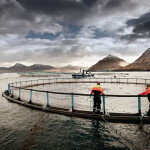


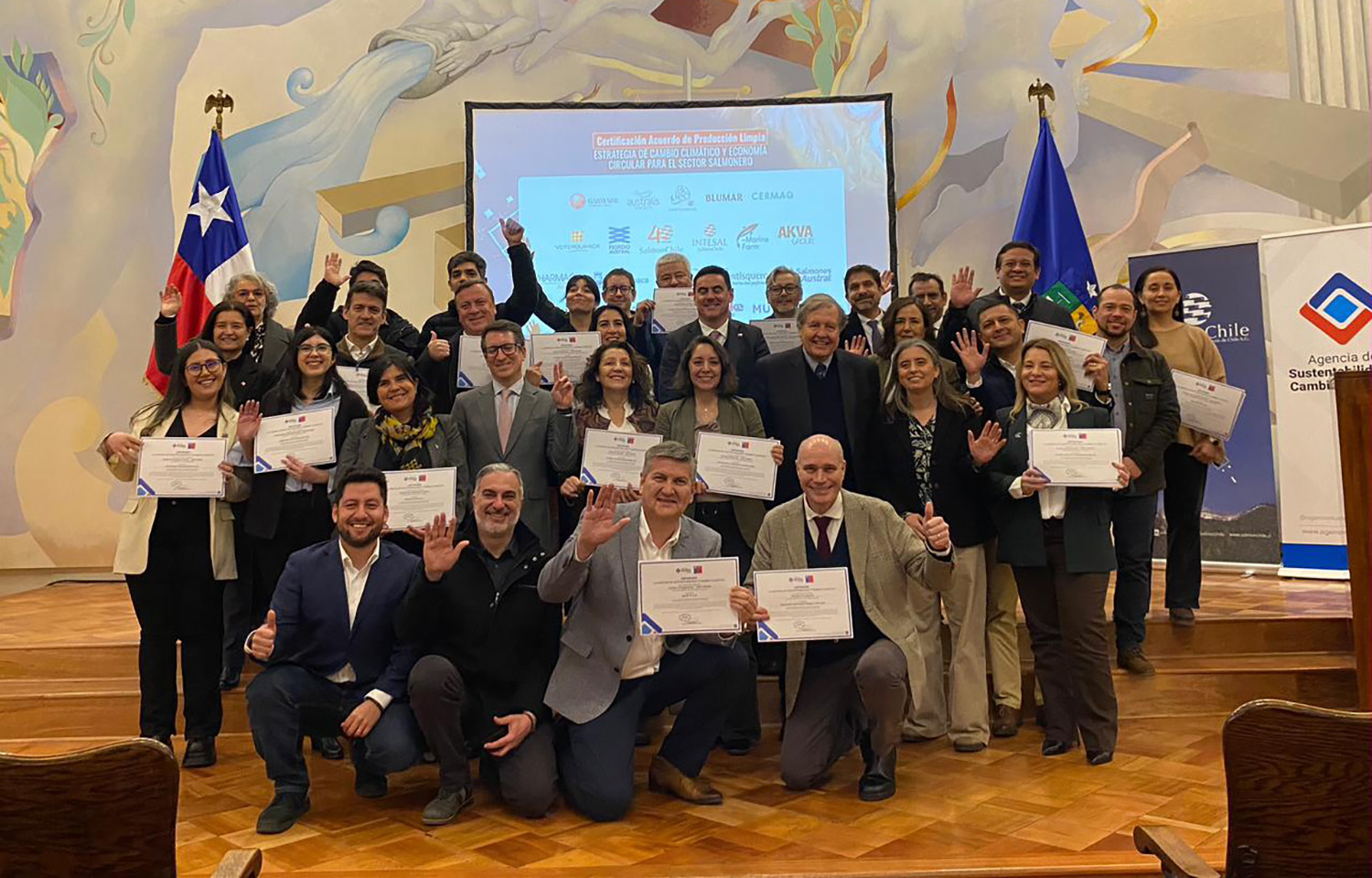
Chile’s salmon-farming sector wrapped up a four-year, CLP 4.22 billion (USD 4.6 million, EUR 4 million) sustainability initiative that delivered measurable gains in emissions reduction, waste recovery, water footprint measurement, and circular economy practices and led to the recent certification of 19 firms.
The Clean Production Agreement, or APL as per the acronym in Spanish, was implemented between 2021 and 2025 and coordinated by salmon-farming association SalmonChile, with support from Chile’s Undersecretary of Fisheries (Subpesca) and the nation’s Energy Sustainability Agency.
Chile’s government-run Agency for Sustainability and Climate Change certified 19 companies and 80 facilities under the program. The certified facilities – belonging to both producers and suppliers – represent approximately 60 percent of Chile’s national salmon production.
The 19 certified companies include salmon-farming firms Cooke Aquaculture Chile, Salmones Camanchaca, Salmones Austral, Multi X, Australis Mar, Cultivos Yadrán, Cermaq Chile, Salmones Blumar, Marine Farm, Fiordo Austral, and Ventisqueros, alongside supply companies Vitapro Chile, Skretting Chile, AKVA Group Chile, Pharmaq Chile, Bioled, Zero Corp, Veterquímica, and Garware Technical Fibres Chile.
“This APL has a special meaning because it reflects a relationship of more than two decades with the salmon sector and demonstrates that public-private collaboration can drive progress with concrete, measurable, and verifiable results,” Chile Agency for Sustainability and Climate Change Executive Director Ximena Ruz said in a release.
The program resulted in all 19 certified companies establishing sustainability policies, 52 percent of the electricity used by participating companies came from certified renewable sources, 27 professionals were accredited as energy managers, 11 companies advanced their energy management practices, and average greenhouse gas emissions associated with feed declined by 17 percent.
Meanwhile, recovered waste surged 288 percent between 2023 and 2024, reaching 270,954 metric tons (MT) in 2024. The valuation rate – the proportion of waste recovered or otherwise put to use – increased from 56 percent to 69 percent.
Under the program, the sector also developed its first Circular Economy Roadmap, focusing on innovation, culture, and regulation. More than 900 people received training in climate change, while 1,141 were trained in circular economy practices.
The APL supported 10 circular business initiatives, representing CLP 588 million (USD 643,000, EUR 555,000) in investment. The projects incorporated solutions involving composting, packaging recycling, sensors, refrigeration efficiency, and liquid fertilizer production.
Another milestone was the first measurement of the sector’s water footprint, with participants investing a total CLP 131 million (USD 143,000, EUR 124,000) in establishing a standardized approach to measuring water use.
The program also included community-focused activities, with awareness initiatives reaching 1,952 people and mobilizing CLP 190 million (USD 208,000, EUR 179,000) in resources.
SalmonChile said the results of the four-year APL strengthen the international competitiveness of the industry through measurable improvements in environmental management, resource efficiency, and traceability.
SalmonChile President Patricio Melero said the agreement demonstrated the value of bringing together government, companies, science, and innovation around shared objectives.
“None of them would have single-handedly come to a result like this,” he said. “The most complex challenges are not solved from a single perspective but when we are able to build agreements around shared objectives.”
Participating companies such as Ventisqueros have made sustainability a core focus, going beyond the requirements APL outlined over the past few years.
For instance, the firm reported recovering 99.4 percent of the waste generated by its operations in 2025.
The company generated 30,592 MT of waste during the year, of which 30,396 MT were recovered, reused, or otherwise diverted from disposal. Only 0.6 percent was sent to an authorized landfill – a significant improvement from 2019, when 26 percent of Ventisqueros’ waste went to landfill. The company is targeting zero waste to landfill in 2026.
“Reducing the proportion of waste sent to landfills from 26 percent in 2019 to just 0.6 percent in 2025 reflects a profound transformation in our management practices and tangible progress toward more circular operations,” Ventisqueros Technical Manager Igor Stack said.
Puerto Montt-based Ventisqueros plans to continue strengthening its approach to sustainable operations with best-in-class performance, including reducing antibiotics, Chief Commercial Officer Javier Calvo previously told SeafoodSource.
Milestones the company has achieved in its sustainability push include its E-Site fish-farming center that operates 100 percent on certified renewable energy and using biofuel along a few shipment routes, where it has been able to reduce 25 percent of the CO2 related to sea freight transportation.
