

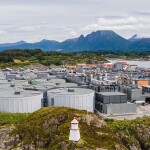


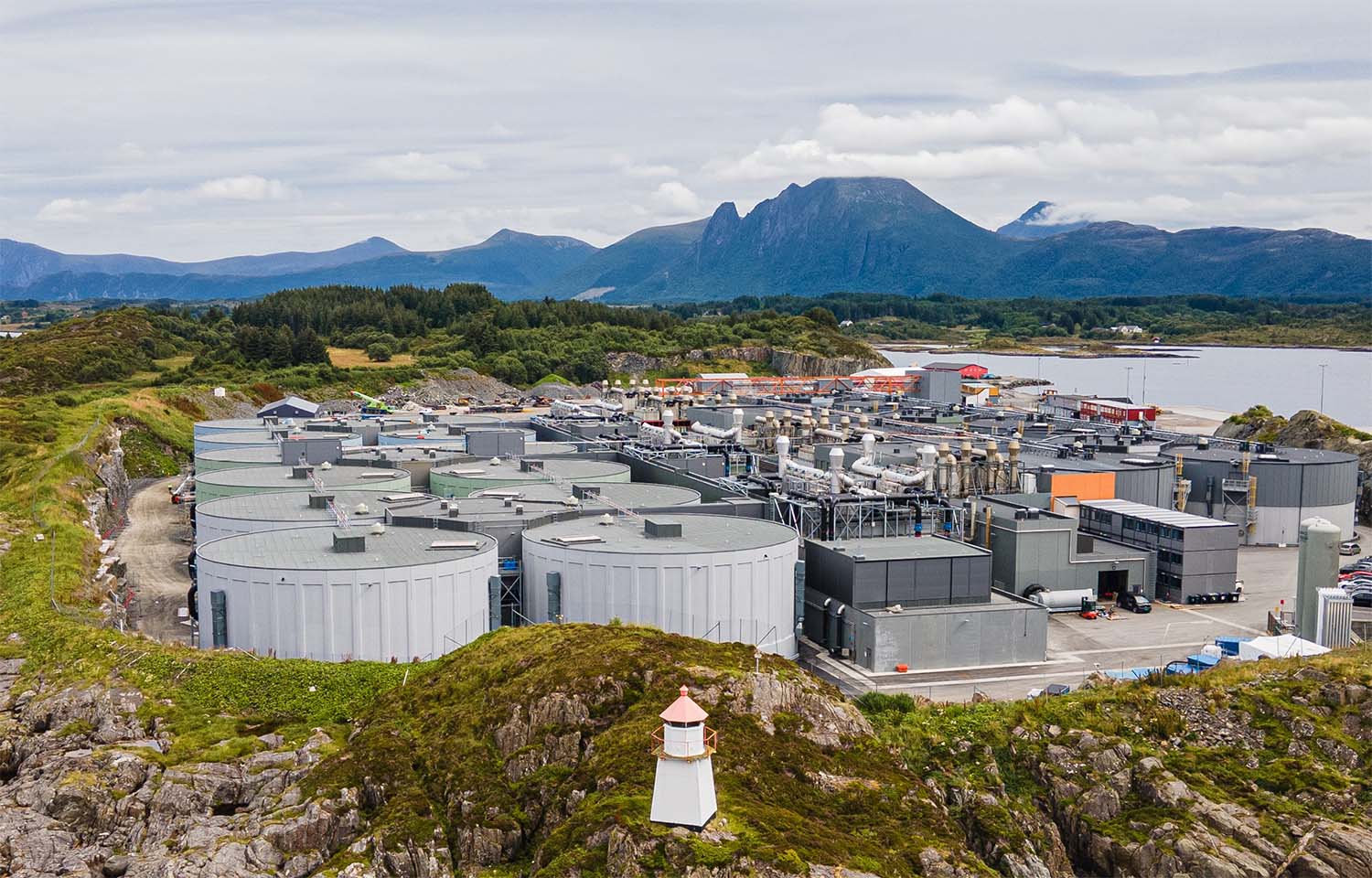
Land-based salmon farming company Salmon Evolution has secured an additional credit facility, and is “fully focused on execution” as it works to complete Phase 2 of its Indre Harøy facility.
Salmon Evolution achieved revenue in Q3 2026 of NOK 105 million (USD 11 million, EUR 10 million), up from NOK 87 million (USD 9 million, EUR 8 million) in Q3 2025. Its operational EBITDA also increased to a loss of NOK 13.3 million (USD 1.4 million, EUR 1.3 million), improved from a loss of NOK 30.6 million (USD 3.3 million, EUR 3 million) in the same period of 2025.
The company also said its operational EBIT per kilogram improved to a loss of NOK 21 (USD 2.27, EUR 2.03) per kilogram, up from a loss of NOK 36.8 (USD 4, EUR 3.60) per kilogram in Q3 2025.
As it continues to work toward Phase 2, the company said it has secured a credit facility of NOK 200 million (USD 22 million, EUR 19 million) to provide additional funding following “lower than expected” salmon prices, which contributed to a lower EBIT per kilogram.
The company said its operations remained stable throughout Q3 2026, with net biomass growth of 1,984 metric tons (MT) live weight. That growth was impacted by “one underperforming fish group” from Phase 1, which the company said was fully harvested in the quarter, with Phase 2 growth continuing on schedule. That underperforming group made up 25 percent of tank capacity in Q3 2026, and resulted in lower average harvest weights.
“We remain fully focused on unlocking the Phase 1 biomass growth potential through targeted and ongoing initiatives centered on continued water quality improvements,” Salmon Evolution CEO Trond Håkon Schaug-Pettersen said in a release.
Harvest volumes during Q3 2026 reached 1,597 MT head-on gutted (HOG), up from 1,387 MT HOG in Q3 2025. That harvest achieved a superior rate of 94 percent, according to the company. The farming cost per kilogram of that harvest dropped to NOK 71.3 (USD 7.70, EUR 6.90) per kilogram, down from NOK 81.8 (USD 8.83, EUR 7.92) per kilogram.
“Strong underlying demand and limited supply growth provide a favorable backdrop for salmon prices as we move into 2027,” Schaug-Pettersen said. “With our production volumes set to more than double next year, this provides a strong foundation for Salmon Evolution as we enter the most exciting phase in the company’s history.”
The company said at the beginning of 2026 that it was entering its “scale-up phase,” as it approaches the completion of Phase 2 and transitions from construction and investment toward working on generating cash flow. When Phase 2 is online, the company anticipates a production capacity of 18,000 MT, and the company is currently expecting a harvest of 11,000 to 12,000 MT HOG in 2027.
For now, the company’s 2026 harvest guidance has been updated to 5,500 MT HOG salmon, which is another drop from the 6,000 MT HOG it revised to in a Q2 2026 production update. That, as well, was a drop from the 7,000 MT HOG it predicted earlier in the year.
The company said that decrease is related to its decision to move the first Phase 2 harvest using “available flexibility in the production plan.”
