



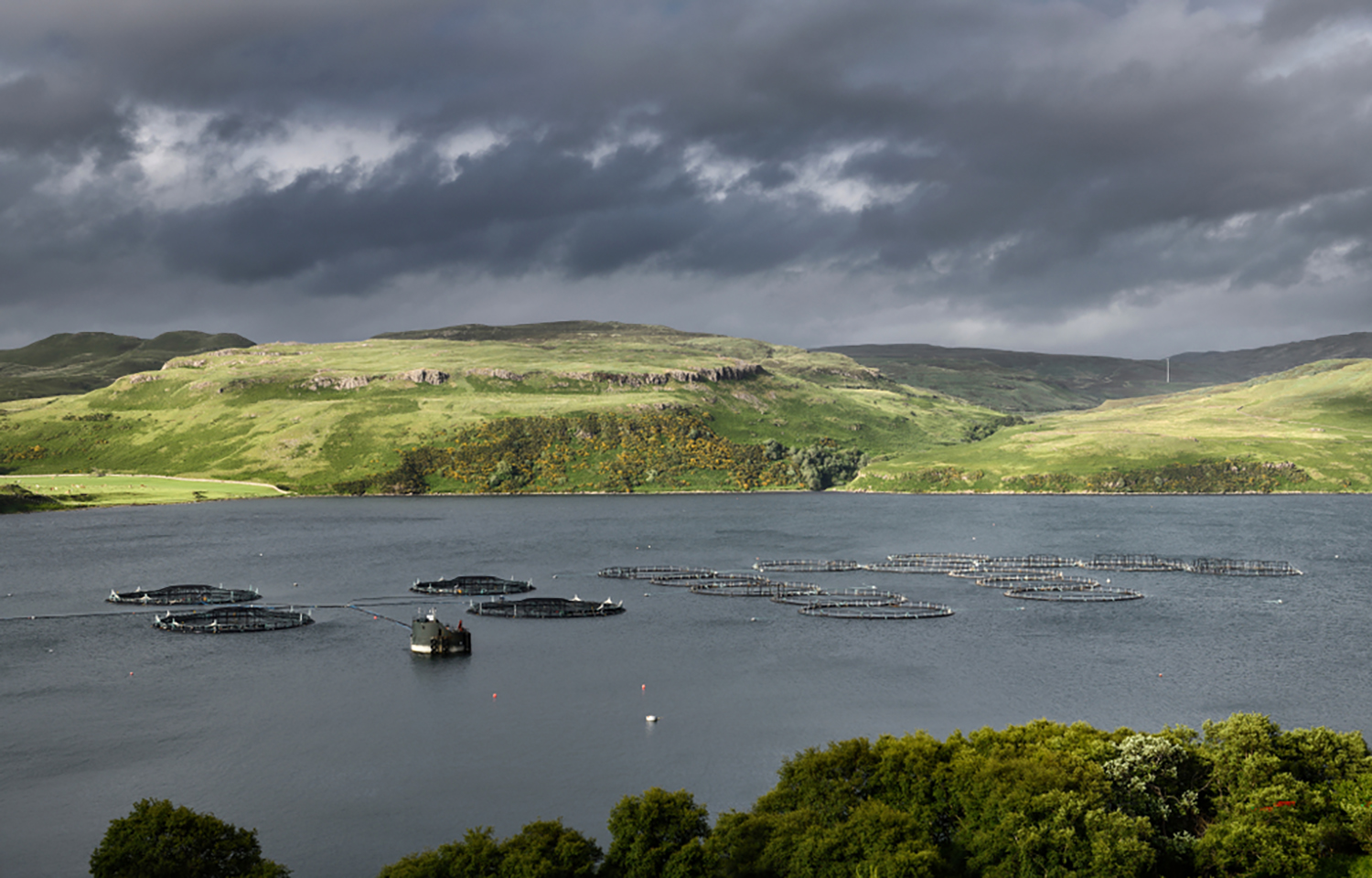
According to new statistics from the Scottish government, the nation’s salmon-farming firms achieved improvements in both fish production and survival rates last year.
The recently published “Scottish Fish Farm Production Survey 2025” found that Atlantic salmon production increased 3 percent, or 5,836 metric tons (MT), in 2025 to 197,836 MT. At the same time, survival-to-harvest rates for the 2023 Atlantic salmon year class increased to 68.8 percent, compared to 61.8 percent for the 2022 year class. Monthly survival rates averaged 98.3 percent in 2025.
The analysis also found the total number of smolts produced in 2025 increased by 20 percent, or 8.9 million, to 53.5 million.
Salmon Scotland CEO Tavish Scott said the new figures served as “another vote of confidence” for Scottish salmon, with the bump in production reflecting farmers’ response to strong demand in domestic and export markets.
Employment increases in the sector, meanwhile, underline the importance of salmon farming to Scotland’s rural and coastal communities, Scott said.
“These are high-quality, well-paid jobs, which help sustain local economies and enable communities to thrive. Our producers are continuing to invest for the future, helping ensure Scotland can meet growing demand at home and overseas while supporting the communities where salmon farming matters most,” he said.
To ensure the sector continues on its growth path, the trade body has continued calls for a more streamlined regulatory system, saying it’s necessary to allow the industry to respond to growing market opportunities.
“Better regulation will really help the industry,” Scott said previously. “Like all industries that produce food, we need really good regulation. It helps us enormously if regulations are credible, authoritative, and also efficient. And, it doesn’t quite do all those things yet.”
Other key findings in the production survey include a 56 percent decrease in the production of rainbow trout, while production of other species remained limited last year, with brown/sea trout production falling from 23 MT to 14 MT.
Halibut and wrasse continued to be reared at a small number of sites, but the report advised that production and trade figures cannot be published, as this would disclose information relating to individual producers.
