






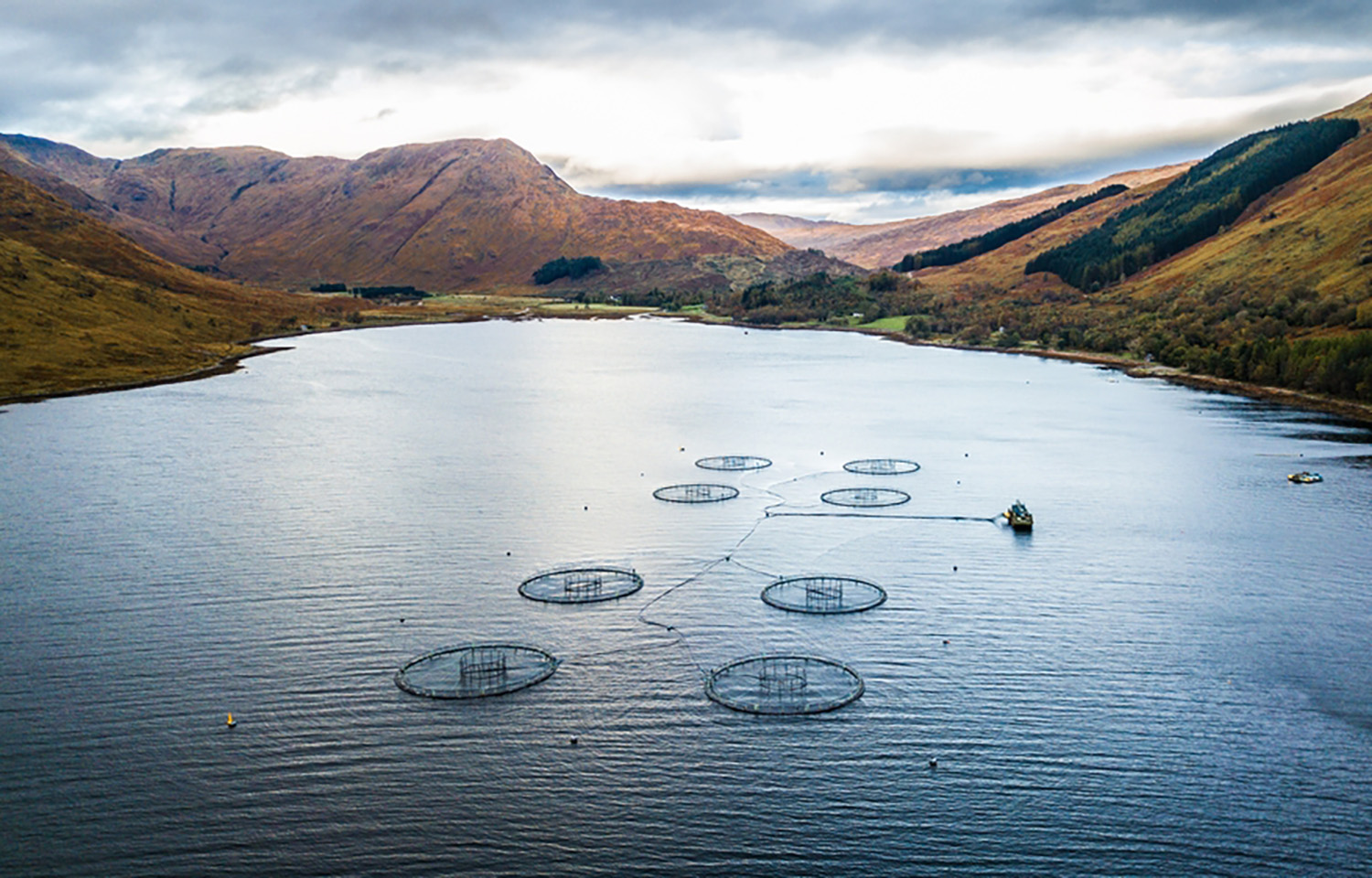
Scottish salmon remains the leading food export out of the U.K. – outperforming cheese, chocolate, and lamb – after overseas sales totaled GBP 828 million (USD 1.1 billion, EUR 947.4 million) in 2025, representing a decrease of 2 percent compared to the previous year, according to new figures from HM Revenue & Customs.
The volume of salmon sold rose to a record 110,942 metric tons (MT), which was up 9 percent year over year.
“Underlining its global appeal,” Scottish salmon was exported to 45 countries in 2025, Salmon Scotland Chief Executive Tavish Scott told SeafoodSource.
Regarding the GBP 16.2 million (USD 21.8 million, EUR 18.5 million) dip in total export sales, Scott said that "Scottish salmon proudly benefits from a premium in the international marketplace, but the overall price of salmon on the international market will influence where value can be gained.”
France remained the largest market for Scottish salmon last year, accounting for 42 percent of total export value, but sales fell 27 percent year over year to GBP 337.6 million (USD 445.2 million, EUR 386.3 million). The U.S. followed at GBP 300.6 million (USD 405.3 million, EUR 343.9 million) – up 34 percent year over year and representing 40 percent of the overall export value.
Growth was particularly strong in Asia, where trade increased by more than 18 percent last year, driven by rising demand in China, where exports were up 28 percent to GBP 97 million (USD 130.8 million, EUR 111 million), as well as Vietnam.
Growth in Asia is likely to continue in 2026, as producers are now preparing to access the Indian market following the introduction of the new U.K.-India free trade agreement (FTA).
"The agreement between the U.K. and India is yet to be ratified, but at that point, a 33 percent tariff will be lifted on Scottish salmon entering India, paving the way for exports potentially worth tens of millions annually,” Scott said.
Alongside export growth, salmon also remained the U.K.’s most popular fish at retail, with retail sales rising 7.2 percent in the year ending August 2025 to reach GBP 1.5 billion (USD 2 billion, EUR 1.7 billion).
Scotland’s salmon sector employs around 2,500 people directly in coastal and rural communities, with a further 8,500 jobs supported across the supply chain, generating around GBP 1 billion (USD 1.3 billion, EUR 1.1 billion) annually for the U.K. economy.
Scott said that while the sector is already heavily regulated, smarter and more effective regulation would help unlock further growth.
"Scotland rightly has very high standards and robust regulation governing raising salmon, but we need better regulation, not less,” he said. "The system is fragmented, unclear, and has delays and unnecessary bureaucracy built in.”
What would also help unlock growth, according to Scott, would be the realization of industry calls for a streamlined, one-stop shop for assessment, licensing, and enforcement that is coherent, proportionate, and evidence-based.
“That was right in 2022 and is right in 2026,” he said.
Still, the latest export figures have been welcomed by the U.K. and Scottish governments.
Scotland Deputy First Minister Kate Forbes said the results were “testament to the hard work of salmon farmers and those in the supply chain,” while U.K. Scotland Office Minister Kirsty McNeill highlighted the role of trade deals in supporting export growth, particularly in Asia.
“It is fantastic to see the growth in Asian markets – and with the U.K.-India trade deal signed last year, the future is even brighter,” McNeill said. “This agreement is helping to give our world-class salmon farmers the competitive edge they deserve.”
