





Rancho Cucamonga, California, U.S.A.-based Aquamar is branching out further from its surimi base.
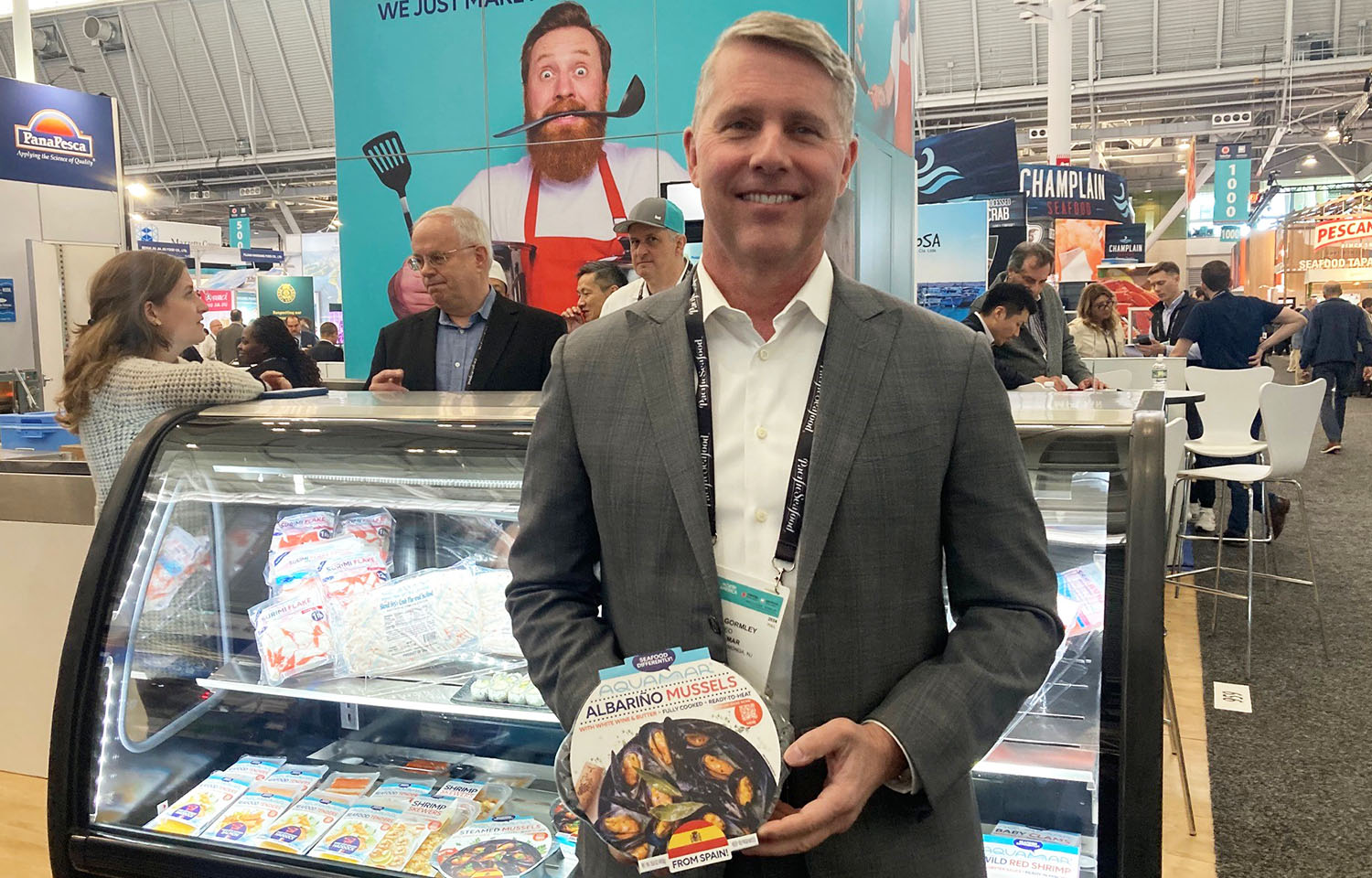
At the 2024 Seafood Expo North America, Aquamar introduced “Shellfish Innovations” – a range of refrigerated products modeled after traditional dishes from Italy and Spain. The line includes Wild Red Shrimp in Lobster Sauce; Baby Clams with Garlic; Seafood Medley in Seafood Sauce; Mixed Seafood in Tomato Broth; Shrimp Skewers in a Tangy Garlic Dressing; Albariño Mussels with White Wine and Butter; and Steamed Mussels with Tomato and Garlic.
“We spent the last couple of years working with consumers to understand what barriers there are to driving seafood consumption, and what we heard is that people are uncomfortable making seafood at home for a variety of reasons,” Aquamar CEO Daryl Gormley told SeafoodSource at the show. “Solutions based around convenience have the promise to unlock consumption and to give retail an opportunity to have their fair share of the seafood business.”
In 2021, Aquamar, which is owned by Detroit, Michigan, U.S.A.-based lower-middle-market private equity firm Huron Capital, became the second-largest surimi producer in North America through the acquisition of Shining Ocean. The deal also enabled Aquamar to advance a plan to diversify its seafood offerings. It launched the Seafood Tenders line of fully cooked, refrigerated, ready-to-eat seafood products in August 2023, and its Day’s Catch Fish Fillet Smoked Haddock was a finalist in the 2023 Seafood Excellence Awards.
“The products are designed to be merchandized in the refrigerated case in retail. The Seafood Tenders are in a really easy-to-use format, with different species of fish that can be incorporated into pasta, rice, salad, or tacos,” Gormley said. “Everything is four minutes of preparation time from refrigerated, so it's super easy.”
Gormley said the products have tested off the charts in trials.
“Typically, 50 percent of consumers say they definitely would buy a product that’s coming out of a new concept. These are like between 70 and 76 percent. In my career, I've never seen scores that high,” he said.
Gormley said besides being convenient, the products are high-quality and affordable.
“[Customers] can get these products home with a full retailer markup for between USD 3.00 and 4.00 [EUR 2.76 and EUR 3.68] per serving, which I think is very competitive,” he said.
A major emphasis of the new line is its provenance, Gormley said, with the ingredients local to the origin of the dish – such as Albariño wine used in the Galician mussel meal – incorporated whenever possible.
“We like the origin call-out because we're giving people not just an opportunity to eat a really convenient format for seafood consistent with a foodservice experience, but we're also giving them an authentic experience for Spanish and Italian food,” Gormley said.
Aquamar spent a significant amount of time perfecting the packaging of its products, according to Gormley.
“We want packaging that works really hard for consumers, particularly at retail, where the average time looking at shelf is like seven seconds; you have such a short time to make an impression. We think about hierarchy of communication, and we want to make sure that people understand it's a brand. They need to know what the product is. They need to know this is ready to eat and refrigerated, which is surprising in the marketplace because so much of the product isn't ready-to-eat, it's frozen. Communicating that has to be a really bold part of the packaging,” Gormley said. “And then, we want appetite appeal. We want people to understand how good the product can be because they eat it first with their eyes.”
Gormley said he’s hoping to see the line picked up by retailers and that Aquamar is “completely committed to continue bringing innovation to market.”
“As we're bringing these products to market, we're working on the next 10 items,” he said.
That product development work is based off of thousands of interviews with U.S. consumers and hundreds of hours of research into the retail marketplace. Gormley said Aquamar still identifies as a surimi company but committed to broadening its portfolio three years ago.
“We grew up as a surimi company, and we're incredibly proud of that heritage and [still] committed to that industry. We think there's an enormous growth opportunity for the market and for us as a business in both foodservice and retail in surimi, so we play across the whole spectrum. But, while we look at the market from a surimi perspective, we’re laddering into this convenience solution,” he said. “We thought that we're in all these foodservice and retail locations today, and if we can bring other seafood convenience solutions to the market, we can leverage that same supply chain and those same relationships to expand our offerings.”
Gormley admitted the extreme volatility of the retail landscape for seafood products over that timespan has not been easy to cope with but that Aquamar was driven by the conviction that “there's always an opportunity for innovation, and if you can address unmet consumer needs, you endure.”
“It has been extraordinarily volatile. Consumers have eaten more, then less, seafood over that time frame. Pricing has been lower, then higher, in that time frame. Supply has changed. But, the one thing that endures is people wanting more seafood, and their reluctance to prepare seafood at home because they're uncomfortable cooking it also endures in and out of the pandemic. Those fundamentals aren’t changing, and with that north star, it gives us the confidence to continue to do the work, even though we're in such a volatile environment.”
Fortunately for Aquamar, Gormley said the surimi market has weathered the ups and downs of the market in recent years better than most seafood products.
“Surimi has a little more resilience than other parts of the broader seafood category just because of where it competes in terms of lower price point. But, we're seeing it still being impacted by inflation and by the downturn in demand,” he said. “Surimi, like much of seafood, is softer right now in terms of consumption, and we think it's a function of the inflationary environment.”
Gormley said the Biden administration’s move to expand the U.S. ban on Russian seafood imports to products processed in third countries has fed instability into the surimi marketplace. Aquamar does not use Russian-sourced products, so it is reliant on U.S. pollock catches for its supply.
“The change in posture from the U.S. toward Russian product may impact the market short-term, but longer-term, not so much, because I think our fundamentals are still there,” he said. “It’s hard to say how the situation with Russia is going to shake out. We're in the throes of negotiation season right now, and I just don't know where it's going to land. Supply has materially expanded globally, and seafood is a global market. So, even with trade restrictions and embargoes, it still puts pressure on the overall market, and we're seeing that play out.”
Aquamar’s unique position in the marketplace means it is better-positioned to absorb that impact, Gormley said.
“Aquamar doesn't fish; we source as a processor. There are always pros and cons to a strategic choice like that. But, I like that position for us because we have a really diversified supply, which gives us a couple of advantages,” he said. “We're able to buy a more consistent quality product. I've worked in vertical businesses before, and if you're catching fish, you pack what you catch, and you’re going to pack everything. We don't do that. We buy what we want. I think as a result, we get more consistent quality product over time, and our diversified supply gives us a more reliable supply, which was extraordinarily important during Covid and is even more important now.”
